
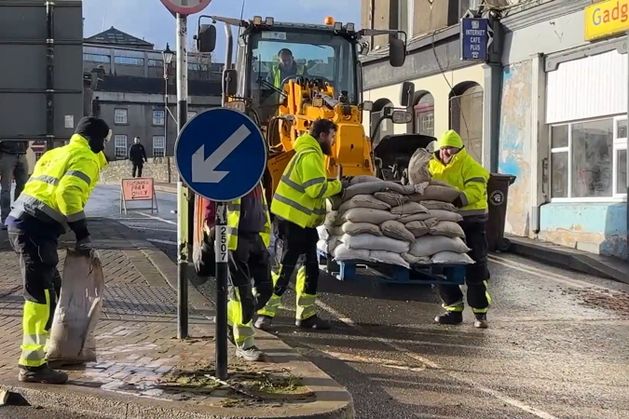
Minister for Transport Darragh O’Brien said the burst on a major water main in Fairview Park in Dublin, which caused flooding and a major travel disruption in the city, might not be related to Storm Chandra.
This resulted in a “significant number” of homes left without water, he said, but works continue on site to resolve the issue.
Speaking on Newstalk’s The Pat Kenny Show, Mr O’Brien said it’s been treated as an “absolute priority”.
“I don’t know the exact reason for it. It may not be storm-related, but Uisce Éireann are on site, they’re providing updates. It’s been treated as an absolute priority because it’s a main artery into the city. It is one of the main water mains as well for that area.
“If we look at Storm Chandra, which is a significant weather event, we have them much more regularly now, we’ve had 24 days of rain in 28 days of January.
“So the rain that’s actually in the water that’s been held within our system, but also in the ground, Storm Chandra coming in on top of that obviously has an impact on our water system. And this is not unique to Ireland, either.
“That’s why, in the last five years, we invested €8.5 billion in water to improve infrastructure, which is badly needed. And over this period of time, to 2030, that’s been increased to €12.2 billion.
“Some of the water mains are old. They’ve been there for decades. They need to be replaced, but that programme is underway.
“There’s a lot of debris because of the storm. There will be culverts and drains that are blocked. Local authority crews are out all across the country,” he said.
Mr O’Brien said a full review is done after every storm event, and that warning systems and responses “continue to improve”.
It comes as yesterday, Minister for Housing James Browne accused Met Éireann of holding back information on the severity of Storm Chandra. Meanwhile, Mr O’Brien said Met Éireann has a “very difficult job” and “they do it very well”, adding that he would like to see river flood forecasting “accelerated”.
“People do need to heed the warnings, but we have had situations where warnings have been given, and the weather event hasn’t happened, and then they’re criticised for that. We have to be fair as well.
“We have actually invested heavily in [Met Éireann’s] weather radar equipment that badly needed to be replaced. We were actually operating with some radar systems that were basically [from] the 1970s and 1980s.”
Meanwhile, Head of Climate Services division at Met Éireann, Keith Lamkin, told Morning Ireland yesterday that building the flood warning system is a long-term project of up to 20 years, which Ireland was about halfway through.
However, Minister O’Brien said he doesn’t accept that it could take a decade.
“I don’t accept that a further 10 years are required for the river flood forecasting. What we need is even indicatives, and you can actually put warnings on the warnings, if you understand what I mean.
“It is not going to be perfect, but there are river levels that are monitored in Ireland, not every river, that’s something that needs to be done, and that we can at least give indications to communities, where river levels are monitored, of the potential of a river bursting at banks or overflowing.
“In some instances, you’re not going to be able to mitigate against some weather events. Every country is dealing with these challenges. Some do it better than others. And I think in the main, we do it well.
“Local authority planning is critical. I think where data is available, particularly around river flood forecasting, that should be provided. And I agree with Minister Browne on that element.”
In relation to Enniscorthy, there have been plans for a flood relief scheme for a “quite number of years”, but “those plans were scuppered because of a pearl mussel”, he said.
“We’ve got to balance things as well, between life and limb and people as well, and to get a balanced approach towards providing the infrastructure that we need to mitigate and to adapt against weather events.
“That’s just a reality. I could probably give you 10 other examples of communities across the country that have been affected by flooding because of people objecting to schemes, holding schemes up and schemes that need to be deployed.
“And we all share responsibility to stand back and have a look at this and deliver the schemes that are needed,” he added.
Adrianna Wrona