
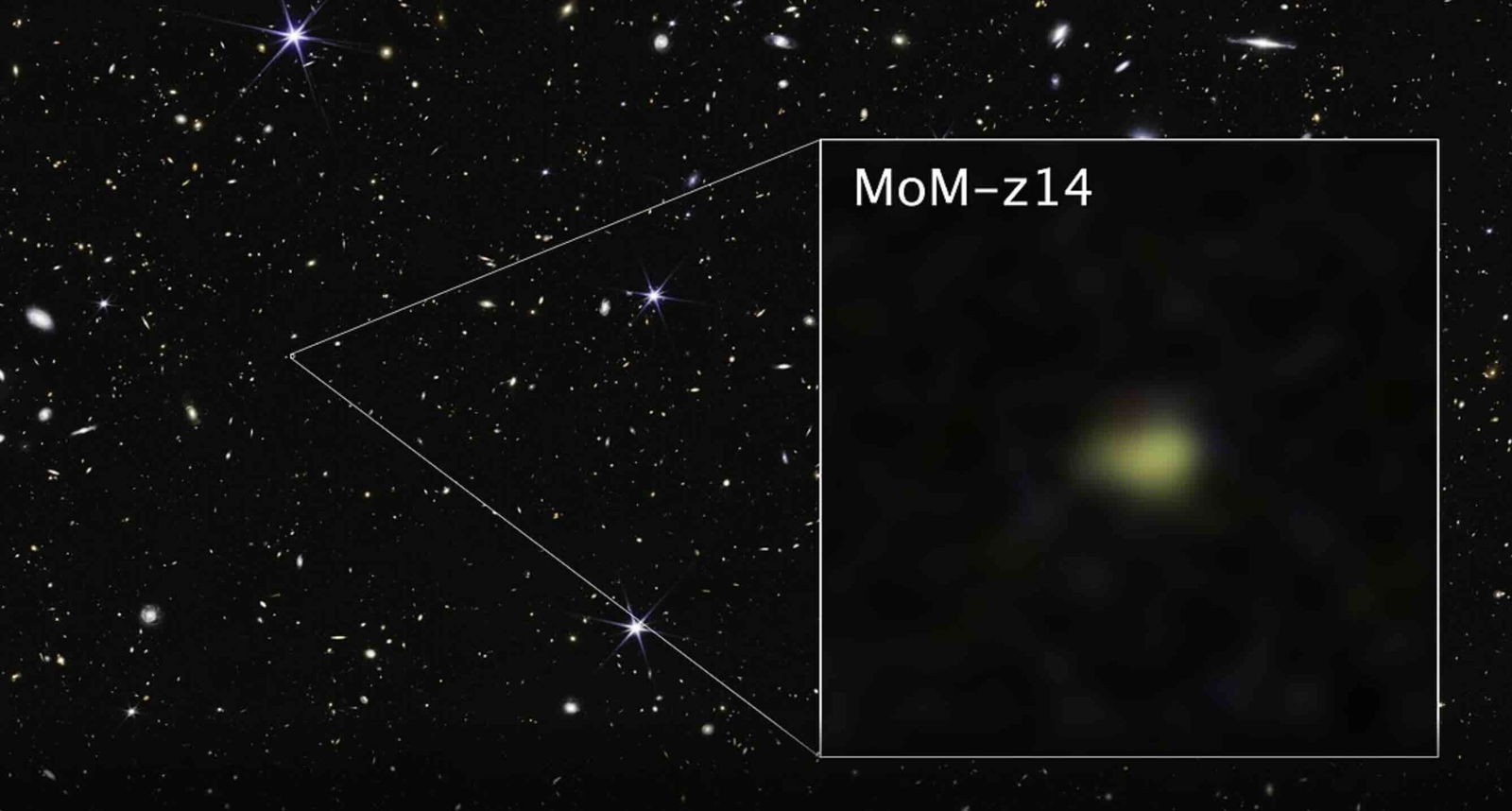
The James Webb Space Telescope has spotted the earliest galaxy ever recorded, originating from only 280 million years after the Big Bang, moving astronomers ever closer to observing the Cosmic Dawn.
A NASA/ESA/CSA collaboration, the James Webb Space Telescope (JWST) has enabled astronomers to view ever farther back in the galactic past, as light from the edges of the universe takes immense spans of time to reach the telescope’s instruments.
Now, a paper soon to be published in the Open Journal of Astrophysics reveals the JWST’s most ancient discovery yet—the galaxy MoM-z14—offering views of an early universe that defies expectations.
James Webb Space Telescope Views Remote Galaxies
“With Webb, we are able to see galaxies farther than ever have before. We find that the early Universe looks nothing like what we predicted, which is both challenging and exciting,” said lead author Rohan Naidu of the Massachusetts Institute of Technology’s (MIT) Kavli Institute for Astrophysics and Space Research.
Dating such a remote object is challenging for researchers, as the dark-energy-driven expansion of the universe introduces uncertainty into measuring time by distance at these large scales. The JWST’s Near-Infrared Spectrograph (NIRSpec) instrument confirmed that the light emitted from Mom-z14 stretched out for 13.5 billion years of the 13.8 billion years that the universe has existed.
“We can estimate the distance of galaxies from images, but it’s really important to follow up and confirm with more detailed spectroscopy so that we know exactly what we are seeing, and when,” said co-author Pascal Oesch of the University of Geneva in Switzerland.
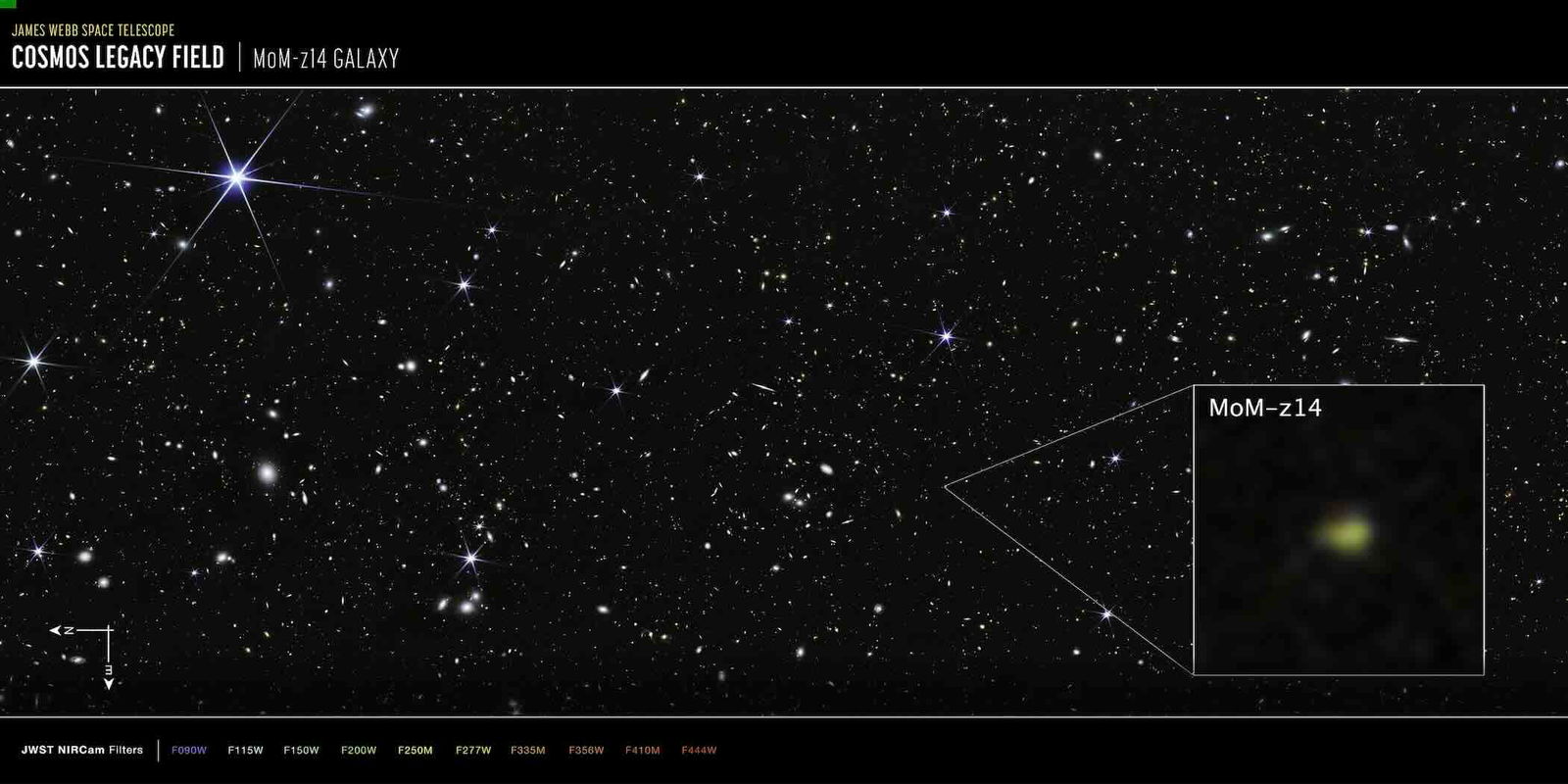 Galaxy MoM-z14 is the farthest and most ancient galaxy known, recently detected by the James Webb Space Telescope. Credit: NASA, ESA, CSA, STScI, Rohan Naidu (MIT); Image Processing: Joseph DePasquale (STScI)
An Unexpected Early Universe
The discovery of MoM-z14 and other bright galaxies in the early universe has surprised astronomers. According to the researchers, JWST is on track to discover 100 times as many of these bright galaxies as expected prior to the telescope’s launch.
“There is a growing chasm between theory and observation related to the early Universe, which presents compelling questions to be explored going forward,” said co-author Jacob Shen, a postdoctoral researcher at MIT.
Another intriguing element is that MoM-z14 appears to be clearing the early universe’s heavy-hydrogen fog in its local area. One of astronomers’ initial goals for the JWST was to study the Epoch of Reionization, the period in which this fog was cleared from the early universe, as stars finally produced enough light to break through the hydrogen gas. Observations of MoM-z14 provide an important new data point for clarifying that timeline.
James Webb spies Ancient Nitrogen
The team says that nitrogen may offer a clue toward explaining the discrepancy. A handful of the oldest stars in our own Milky Way Galaxy reveal high nitrogen concentrations, a pattern echoed in some JWST observations of early galaxies.
“We can take a page from archeology and look at these ancient stars in our own galaxy like fossils from the early Universe, except in astronomy, we are lucky enough to have Webb seeing so far that we also have direct information about galaxies during that time,” Rohan said. “It turns out we are seeing some of the same features, like this unusual nitrogen enrichment.”
At such a remote period, a mere 280 million years after the Big Bang, galaxies like MoM-z14 should not have been capable of producing such quantities of nitrogen, according to the methods astronomers currently understand. However, the team notes that the dense environment of the early universe may have been more conducive to nitrogen production, potentially explaining how these ancient galaxies contain stars that are more nitrogen-rich than the supermassive stars in our local universe.
“It’s an incredibly exciting time,” concluded co-author Yijia Li, a graduate student at the Pennsylvania State University, “With Webb revealing the early Universe like never before and showing us how much there still is to discover.”
The paper, “A Cosmic Miracle: A Remarkably Luminous Galaxy at Zspec=14.44 Confirmed with JWST,” appeared on arXiv on January 26, 2026.
Ryan Whalen covers science and technology for The Debrief. He holds an MA in History and a Master of Library and Information Science with a certificate in Data Science. He can be contacted at ryan@thedebrief.org, and follow him on Twitter @mdntwvlf.