
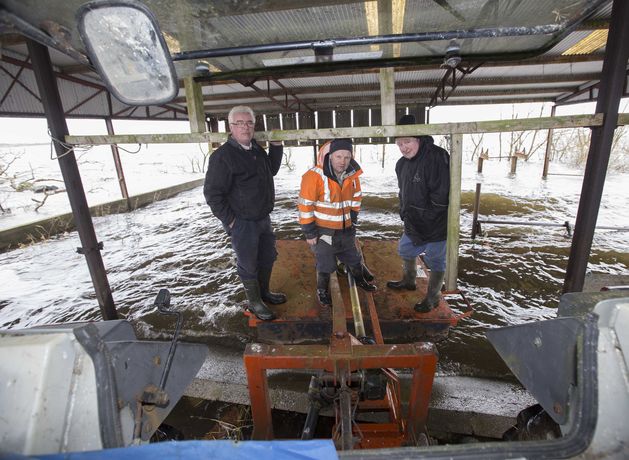

With an eastern county boundary marked by the River Shannon, flooding is becoming ever-more frequent in landlocked Co Roscommon.
Should sea levels continue to rise, Roscommon is at lower risk of being swamped by the Atlantic than, say, Mayo, Galway or Donegal, but bordering Ireland’s longest river and being home to a number of lakes has taken its toll in a climate that is becoming wetter and wetter.
There are few better examples than Lough Funshinagh.
Sitting west of Lough Ree, the lake is one of 500 recorded turloughs – seasonal water bodies – in Ireland. For years, it was known locally as “the disappearing lake” for its unique drainage qualities.
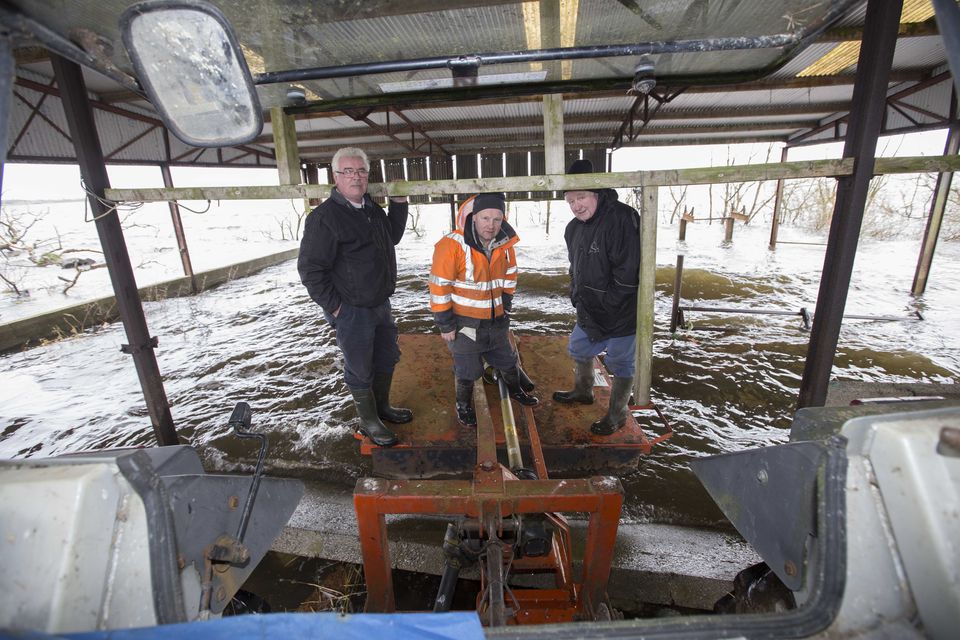
Farmer Tom Carney with neighbours Leo Kenny and Laurence Fallon as they clear out his sheep shed, which was flooded by the swelling of Lough Funshinagh in 2020. Photo: Brian Farrell
How your county is weighing in on fighting climate change
Try saying that to the residents who’ve had their homes, sheds and farm buildings inundated during wet spells in recent years.
Local campaigners have welcomed the announcement of an interim flood relief scheme that will see water pumped out of Lough Funshinagh into the Cross River, but Roscommon is not about to get any drier – at least not in winter, anyway.
In the past 10 years, Roscommon has experienced three of its wettest years on record. In Loughlinn, average annual rainfall has increased by 16pc for the most recent period (1981-2010) when compared to the 1961-1990 baseline.
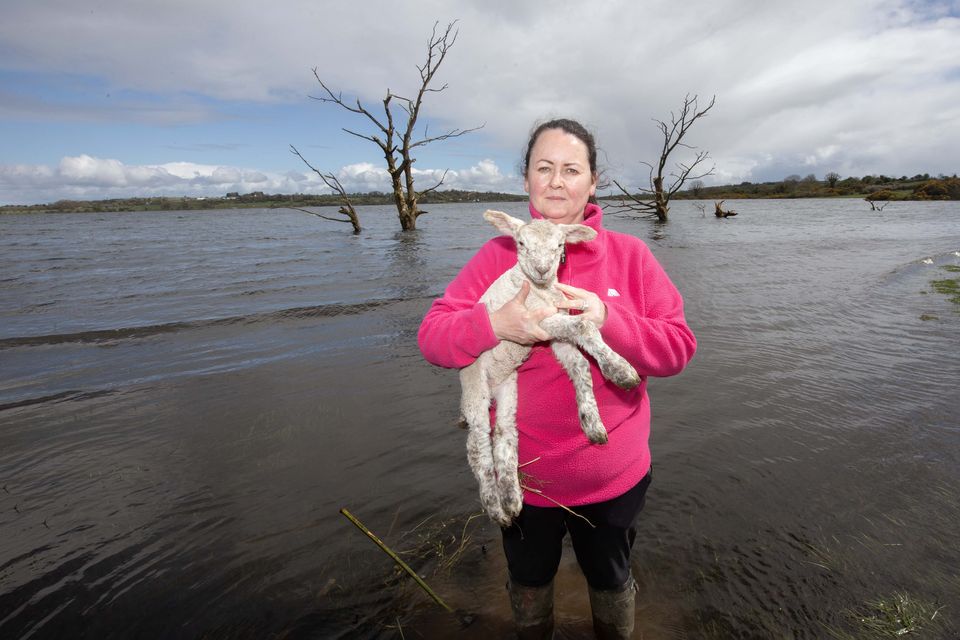
Fionnuala Mee with a newborn lamb that should be running in a field that is flooded in Funshinagh, Co Roscommon in 2024. Photo: Brian Farrell
In the coming years, some areas in Roscommon are expected to see 56pc more heavy rainfall days, leading to an increased risk of pluvial flooding.
“As the climate changes, it is likely that extensive flood events such as these will become more common with wetter winter conditions,” according to a 2023 Environmental Protection Agency-authored report.
Roscommon County Council’s Climate Action Plan identified river flooding and severe windstorms among the county’s greatest climate-related risks. This would have a “wide range of impacts for County Roscommon, including road closures, disruption to public transport, power outages and a reduction in agricultural production”.
While frost and crippling snowstorms like 2018’s Beast from the East will become increasingly rare, drought and heatwaves are expected to become more frequent.
In May 2025, forest fires raged mainly in the west of the county, scorching over 1,300 acres of bog and forest and destroying about 90pc of the Carrowbehy/Caher bog special area of conservation.
Although Roscommon experienced heatwave and drought in 2018, and heatwaves in 2021 and 2022, the 2025 wildfires caused unprecedented damage to land and wildlife.
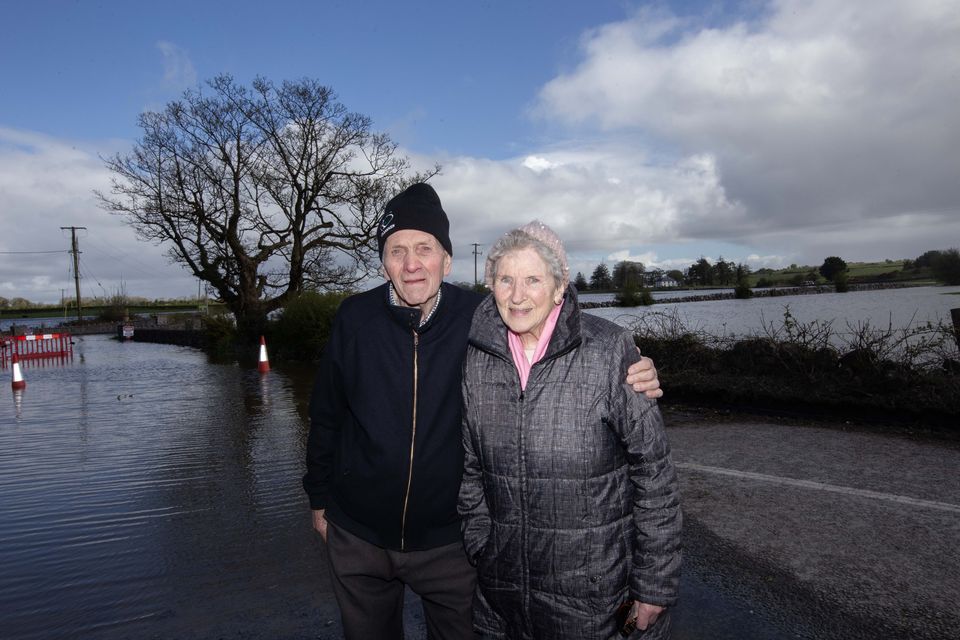
Brian and Mary Fallon had to vacate their home by Lough Funshinagh due to flooding. Photo: Brian Farrell
No people or livestock were harmed and no dwellings were damaged, but, in a county that is 12pc forest and has 70 bogs, the prospect of a blaze similar or greater in scale is very real.
What’s to be done then to help a rural county of 70,000 people when flooding, fires and storms come to their door?
Though climate policy is governed predominantly by legally binding EU regulations and national legislation, each local authority must produce and implement a plan for reducing their carbon footprint.
With a population of just over 70,000 people Roscommon is sparsely populated, with 28 people per square kilometre.
As a whole the county was producing 795 kilotonnes of carbon dioxide equivalent emissions in the baseline year of 2018, primarily from agriculture (43pc), transport (22), residential (13pc), commercial and industrial (16pc), and ‘land use, land use change and forestry’ (LULUCF) (16pc).
There are no multimillion-euro public works to be found in Roscommon action plan, which was passed by elected representatives in 2024.
Instead, it aims to reduce carbon emissions through retrofitting, improved public transport, and community-led biodiversity and climate projects.
There is a non-exhaustive list of 20 different stakeholder groups who’ll be involved in the implementation of the plan.
The document is full of aspiration. The word ‘engage’ is used 67 times in the plan, ‘potential’ is mentioned 59 times and ‘retrofit’ crops up 21 times.
Whether Roscommon can transition in a just and meaningful manner is far from certain
The plan places particular focus on Roscommon town. With about 6,500 residents, the town has been designated as Roscommon’s decarbonising zone (DZ).
To reduce carbon emissions in the town, the county council aims to “explore the most effective ways in which they can improve and promote public transport and active travel” through investment in electric vehicles and increased charging facilities in Roscommon town.
The local authority aims to also retrofit its local housing stock to a BER rating of B2.
“The challenge for this DZ area (and other areas),” the action plan notes, “is to allow for continued growth and improvement while reducing carbon emissions in a just and meaningful manner.”
With peat production and peat-generated power being gradually phased out, the midlands region where Roscommon sits is in transition.
Whether it can transition “in a just and meaningful manner” while enjoying continued growth and improvement is far from certain.
Funded by the Local Democracy Reporting Scheme