
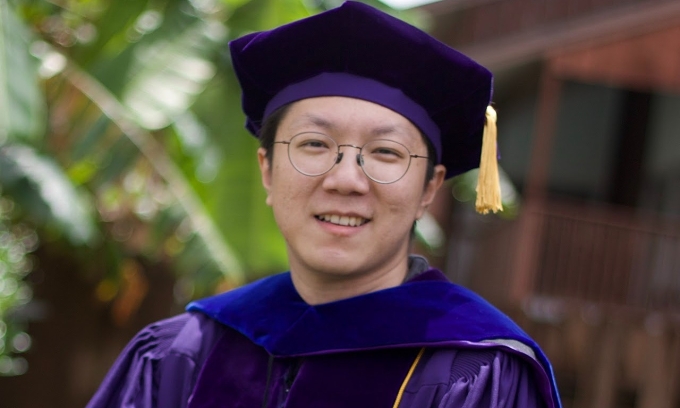
You, who was previously based at Louisiana State University (LSU) in Baton Rouge, is regarded as a rising figure in quantum sensing and precision measurement, fields of significant strategic importance.
He joined UESTC earlier this month, although his name has yet to appear on the university’s public faculty listings, the South China Morning Post cited Chinese media as saying.
His Google Scholar profile, however, now lists UESTC as his current affiliation.
At UESTC, Chenglong has joined the Quantum Physics and Engineering Laboratory, which was established in 2023 to support national efforts to develop high-density, high-precision quantum photonic devices and advance quantum measurement research, the report said.
After earning his PhD in physics from LSU in 2019, You remained at the university as a postdoctoral researcher in its quantum photonics laboratory and was appointed assistant research professor in 2023.
His doctoral and postdoctoral research focused on using light to push measurement accuracy to fundamental limits, with applications ranging from ultra-precise navigation systems to gravitational-wave detection.
His work has involved collaboration with major U.S. government facilities, including the National Institute of Standards and Technology, where he conducted experiments using multiple photons to detect extremely small changes more precisely than conventional methods.
His research has received international recognition, including the Emil Wolf Outstanding Student Paper Competition award from Optica and a research fellowship from Japan’s National Institute of Information and Communications Technology. He also holds multiple patents in both China and the U.S. and serves on the technical committee of the leading international optics conference CLEO, according to HK01.
Founded in 1956, UESTC is one of China’s leading engineering universities, known for strengths in electronics, information technology and communications, as well as for training specialists for the country’s defense and technology sectors.
The university has been on the U.S. Commerce Department’s Entity List since 2012, with U.S. authorities citing its work in advanced electronics and communications as grounds for restricting exports of certain American technologies to the institution, according to the U.S. Bureau of Industry and Security.