
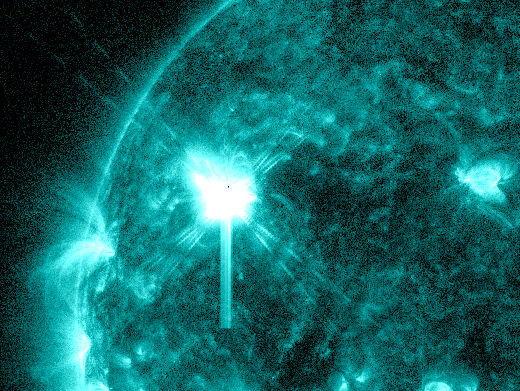
A sunspot that didn’t exist at the beginning of the weekend has since grown into a vast and active region, and it hasn’t taken long to make itself known. The new arrival has already produced a powerful solar flare, one that lingered rather than flashing and fading.
Extreme ultraviolet radiation from the flare ionised the upper layers of Earth’s atmosphere, leading to a shortwave radio blackout centred on the South Atlantic. The affected area reached the edges of South America and Africa, with signals below 20 MHz disrupted for hours around 1230 UTC. Ham radio operators across the region may have experienced an extended loss of signal during that time.
Not One Flare, But Three
This event didn’t arrive as a single surge of energy. It came in phases. First, an M7 flare. Then, an X1 peak. Then, another M-class burst, rated M6.
Together, the three peaks stretched the event beyond six hours. Rather than a brief spike, the Sun delivered a drawn-out release of extreme ultraviolet radiation, keeping conditions disturbed far longer than a typical flare.
The source was sunspot 4366. When the weekend began, it wasn’t there. Since then, it has expanded rapidly, growing to almost ten times the width of Earth. That kind of growth is striking on its own. What matters more is what’s happening inside it.
A Region That Isn’t Settling Down
Sunspot 4366 carries an unstable delta-class magnetic field. That instability is already evident. The extended, multi-peaked flare sequence shows that the region is actively shedding stored magnetic energy rather than calming down.
Images from the event show the flare erupting directly from this tangled magnetic area, leaving little ambiguity about the source. With the magnetic field still unsettled, further flares are expected.
CME: Still a Question Mark
One uncertainty remains. Was a coronal mass ejection launched along with the flare?
So far, first-look data suggest the answer is no. However, that conclusion isn’t locked in. Additional coronagraph data from NOAA and SOHO could still change the assessment.
For now, the Sun’s newest active region is being watched closely. It’s large, unstable, and already productive, and it has shown very quickly that it’s capable of more!
 Published by Kerry Harrison
Kerry’s been writing professionally for over 14 years, after graduating with a First Class Honours Degree in Multimedia Journalism from Canterbury Christ Church University. She joined Orbital Today in 2022. She covers everything from UK launch updates to how the wider space ecosystem is evolving. She enjoys digging into the detail and explaining complex topics in a way that feels straightforward. Before writing about space, Kerry spent years working with cybersecurity companies. She’s written a lot about threat intelligence, data protection, and how cyber and space are increasingly overlapping, whether that’s satellite security or national defence. With a strong background in tech writing, she’s used to making tricky, technical subjects more approachable. That mix of innovation, complexity, and real-world impact is what keeps her interested in the space sector.