
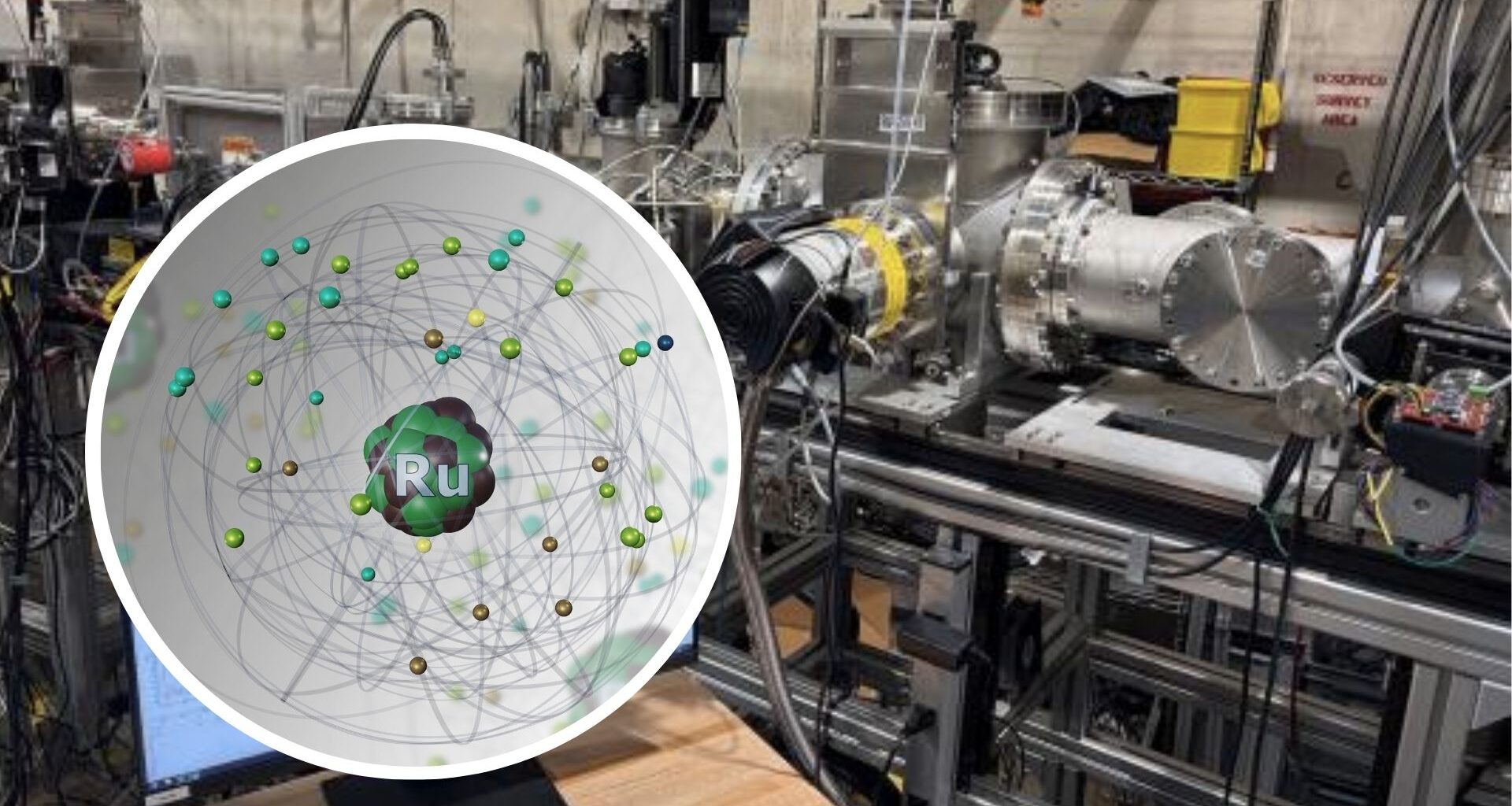
Scientists in the United States have made an extremely precise measurements of unstable ruthenium nuclei. The measurements are a significant milestone in nuclear physics because they closely match predictions made by sophisticated nuclear models.
Argonne researchers used the Argonne Tandem Hall Laser Beamline for Atom and Ion Spectroscopy (ATLANTIS) apparatus to make precise measurements of unstable ruthenium nuclei.
The team claimed that their findings are a significant milestone in nuclear physics because they help validate sophisticated models that can advance understanding of nuclear properties and the early universe.
Difficult for theoretical models to predict properties of unstable nuclei
Innovative technologies and techniques at Argonne, including collinear laser spectroscopy, enable accurate studies of rare isotopes. These advancements pave the way for future collaborations and groundbreaking discoveries.
“It’s very difficult for theoretical models to predict the properties of complex, unstable nuclei,” said Bernhard Maass, an assistant physicist at Argonne and the study’s lead author. ”We have demonstrated that a class of advanced models can do this accurately. Our results help to validate the models.”
Validating the models can build trust in their predictions
Researchers also highlighted that validating the models can build trust in their predictions about astrophysical processes. These include the formation, evolution and explosions of stars where elements are created.
Published in the Physics Review Letters, the study presents the first measurements with a new collinear laser spectroscopy setup at the Argonne Tandem Linac Accelerator System, utilizing its unique capability to deliver neutron-rich refractory metal isotopes produced by the spontaneous fission of 252Cf.
“We measured isotope shifts from optical spectra for nine radioactive ruthenium isotopes 106–114Ru, reaching deep into the mid-shell region. The extracted charge radii are in excellent agreement with predictions from the Brussels-Skyrme-on-a-Grid models that account for the triaxial deformation of nuclear ground states,” said researchers in the study.
Researchers show that triaxial deformation impacts charge radii in models that feature shell effects, in contrast to what could be concluded from a liquid drop analysis.
This indicates that this exotic type of deformation should not be neglected in regions where it is known to occur, even if its presence cannot be unambiguously inferred through laser spectroscopy, according to the study.
Ideal element to validate advanced theoretical models
Ruthenium is an ideal element to validate advanced theoretical models. This rare metal has isotopes — atoms of the same element with a different number of neutrons and varying stability — known to have nuclei with complex structures and shapes. There are a series of unstable, radioactive ruthenium isotopes believed to have a triaxial shape, similar to an almond or coffee bean, according to a press release.
Nuclear physicists are developing more advanced theoretical models to precisely predict the properties of unstable atomic nuclei with complicated structures, shapes and forces. Such models have potential to deepen our understanding of the inner workings of atomic nuclei.
However, it is essential to demonstrate the accuracy of these models before they can be used to push the frontiers of science. This requires the difficult task of collecting precise, real-world measurements of complex nuclei and comparing the measurements with the models’ predictions.