
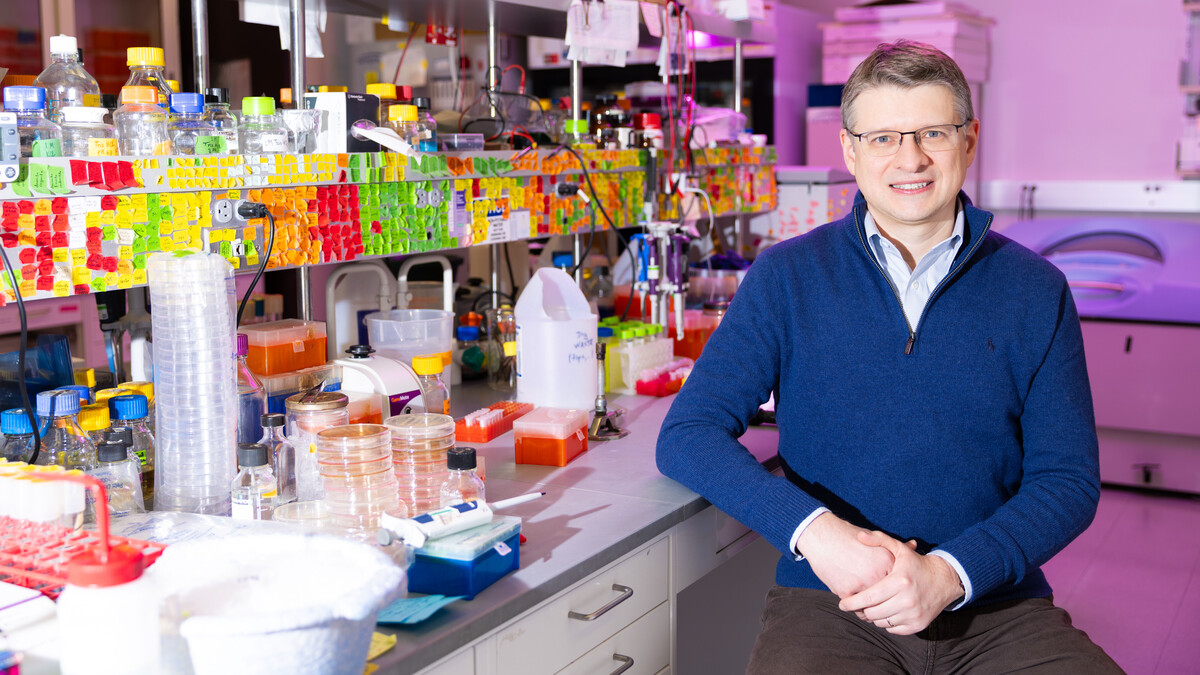
More than 150 human diseases — including Lou Gehrig’s, Parkinson’s and Alzheimer’s — are linked to mitochondrial failure, and one Nebraska scientist is working to decode why.
A five-year, $2 million renewal of Oleh Khalimonchuk’s Maximizing Investigators’ Research Award from the National Institutes of Health — one of the agency’s most competitive and prestigious funding mechanisms — has set the stage for the next chapter of his work.
Khalimonchuk, Willa Cather Professor of biochemistry at the University of Nebraska–Lincoln, is nationally recognized for his research on mitochondrial quality-control systems. Long known as cells’ “powerhouses,” mitochondria also play critical roles in immune signaling, stress responses and cell health.
The molecular bases of mitochondrial defects remain poorly understood — a gap Khalimonchuk is working to close.
“Without understanding the basic biology and basic biochemistry behind this, we’re not going to be able to move forward with drug development or treating disease,” he said. “We need to understand the mechanisms to know why treatments fail or cause side effects.”
Khalimonchuk’s research paints a clearer picture of the systems that govern mitochondrial health and stability. Much of his work, including the first five years of MIRA funding, has been devoted to OMA1, a protein that responds to mitochondrial stress and helps cells adapt. He also has worked to pinpoint OMA1’s role in maintaining mitochondrial membranes’ architecture, which is key for consistent energy production and other functions.
His team is investigating lesser-known proteins, like Afg1, using structural studies and experiments in living cells to determine how these proteins behave, interact and contribute to mitochondrial health.
With the renewed funding, Khalimonchuk will expand these bodies of work using advanced techniques and tools, including Nebraska’s CryoEM Core Facility. He will continue to explore OMA1, architectural changes to the inner mitochondrial membrane and age-related changes in mitochondria.
Khalimonchuk will also advance his work on the biosynthesis and transport of mitochondrial heme, a substance most notably found in the blood’s hemoglobin.
“This is all a heavily interconnected system,” Khalimonchuk said. “For that reason, it’s really important to understand all the pieces of the jigsaw puzzle that we have. We’re still missing quite a few, but it’s actually coming together quite nicely.”
The next five years will include strengthened collaborations with researchers at the University of Nebraska Medical Center. Khalimonchuk, an affiliate of the Fred and Pamela Buffett Cancer Center at UNMC, will continue working with Vimla Band, who chairs the medical center’s Department of Genetics, Cell Biology and Anatomy. The duo explores OMA1’s tumor-suppressive role in triple-negative breast cancer, or TNBC, a difficult-to-treat subtype that accounts for about 20% of breast cancers. He is also partnering with Rebecca Oberley-Deegan, a professor in UNMC’s Department of Biochemistry and Molecular Biology, to develop strategies for improving radiotherapy treatment for TNBC.
Khalimonchuk will continue work with Paul Trippier of UNMC’s Department of Pharmaceutical Sciences to evaluate mitochondrial proteins such as OMA1 and CLPP as drug targets for breast cancer and other diseases. In addition, he is partnering with a pharmaceutical company based at North Carolina’s Research Triangle in clinical trials for a drug originally designed as a lymphoma treatment. The compound appears to activate the OMA1 protein, triggering molecular cascades that could be vital to treating other diseases.
Khalimonchuk said that basic science, which is incremental by nature, can be a hard sell. But after a year of funding uncertainty, he is relieved to be back at work piecing together the mysteries of mitochondrial biology.
“I’ve been in the business long enough to have witnessed several big new technologies that don’t ultimately deliver,” he said. “In the end, getting the nitty gritty science is really the key.”