
Billionaire businessman and inventor Sir James Dyson has won his battle to install a helipad at his £25million Irish estate – despite claims that it would have a negative impact on local wildlife.
The 78-year-old entrepreneur – best-known for inventing the cyclone bagless vacuum cleaner – set an Irish property record with the 850 acre Ballynatray estate on the banks of the River Blackwater.
But an application by Britain’s fourth richest man for a new helicopter landing area to accommodate weekly flights angered some nearby residents, who fear the resulting noise will ruin their ‘little oasis’ of unspoilt nature.
David Orr, who lives nearby, claimed it would pose ‘a high risk of disturbance to wildlife within the surrounding area’, which is home to a large number of species of birds and mammals.
The 70-year-old asked why their peace and tranquillity should be ruined ‘for the sake of one person’s travelling convenience’.
He appealed against the local council’s decision to award consent, but its decision has now been upheld by Ireland’s national planning appeals body.
It paves the way for Sir James to make a total of 50 helicopter flights into and out of his estate every year.
Today Mr Orr said he was ‘disappointed with the outcome’ and would be asking how the cap on flights would be policed.

The estate on the Cork-Waterford county border is situated on the banks of the River Blackwater
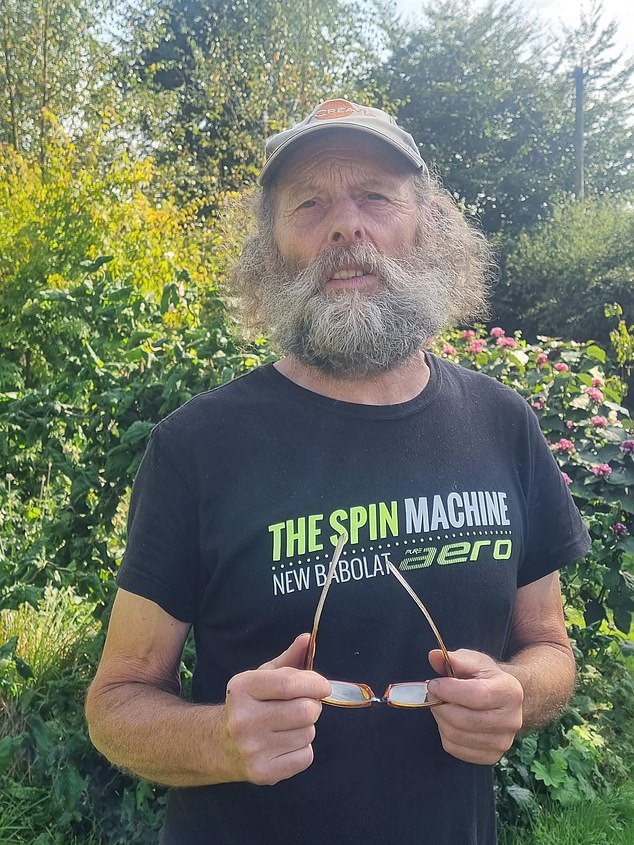
Protester David Orr said the local woodland ‘home to numerous birds and wildlife’
Sir James’s purchase of the Ballynatray Estate represents the latest addition to his astonishing global property portfolio which already saw him own more land in England than the King.
Under its previous owner, Henry Gwyn-Jones, the fully-staffed Georgian river-front mansion was available as an upmarket holiday rental and 120-guest wedding venue.
It has since undergone a major restoration project, with the classical-style house temporarily covered in plastic sheeting while work took place.
Sir James has already been granted planning permission to construct a tennis court as well as to make alterations to an existing folly.
But the planned helipad – along with wastewater treatment works – sparked opposition from residents of the sparsely-populated countryside on the Cork-Waterford border, home to species including ospreys, hen harriers and egrets, as well as otters.
Mr Orr last year told the Daily Mail his objections were ‘purely an environmental issue’, with local woodland ‘home to numerous birds and wildlife’.
‘When you have a little sanctuary, you try and minimise disturbance,’ he added.
His views were shared by other locals in their responses to the planning application, although ultimately only Mr Orr lodged an appeal.

Sir James Dyson (pictured) bought Ballynatray House and its 850-acre estate in 2024
Gary and Karina Ricken, who live directly opposite the estate, had warned: ‘The introduction of a helicopter landing area will fundamentally alter this natural soundscape, replacing birdsong and the sounds of nature with the intrusive noise of rotor blades.’
Meanwhile David Naylor said the Blackwater River was ‘continually under attack from more, bigger, better, be it housing, buildings, boats and jetskis and now helicopters’.
Waterford City and County Council initially concluded that helicopter flights may have ‘a significant disturbance effect’ on wildlife living in a protected area.
But a report by wildlife consultants submitted in response by the estate said there was ‘no likelihood of significant disturbance’ due to the modern design of helicopter involved and the height and routing of the flight path.
The application, submitted in the name of Ballynatray’s estate manager, was subsequently approved, subject to a list of conditions – only for Mr Orr to lodge an appeal.
He wrote: ‘This small area of land contains a very wide variety of species of both flora and fauna and is in serious need of protection.
‘It seems to be that for the sake of one person’s travelling convenience a large number of both human and non-human inhabitants of this area are going to be disturbed.’
Now An Coimisiún Pleanála – which deals with planning appeals – has upheld the council’s decision to grant consent.
It concluded that due to the ‘limited scale and nature of the works’ and the ‘modest frequency’ of flights, as well as the choice of specified flight paths, the helipad ‘would not… pose a significant risk to the protection of the local ecology’.
In addition it would not ‘unduly detract from the landscape, character or setting of Ballynatray’ or ‘significantly injure the residential amenities of the properties in the vicinity’.
The commission also concluded there was ‘no reasonable scientific doubt’ to think the development would impact the site’s conservation objectives.
In its ruling it said no more than 50 flights could take place annually, with no commercial use of the helipad.
The commission also ordered that no helicopter fuel storage is permitted, while a 10-metre windsock mast should be lowered when not in use.
It said the conditions were ‘in the interest of clarity and residential amenity and to prevent pollution and disturbance in the local environment.’
Sir James’s elder son Jake himself faced widespread local opposition to his plan to install a landing pad in the grounds of his 18th Century Somerset home in 2018.
A keen farmer, Sir James is estimated to own around 25,000 acres including huge tracts of Lincolnshire farmland bought from the Crown Estate, dwarfing the holdings of members of the traditional landed aristocracy.
He sparked accusations of hypocrisy after moving the headquarters of his company to Singapore in 2019 despite his support for Brexit.
In response, the father-of-three – valued along with his family at £20.8bn – has stressed that the company which bears his name is expanding operations in the UK where it continues to employ around 3,500 people.
A spokesman for Sir James declined to comment.