
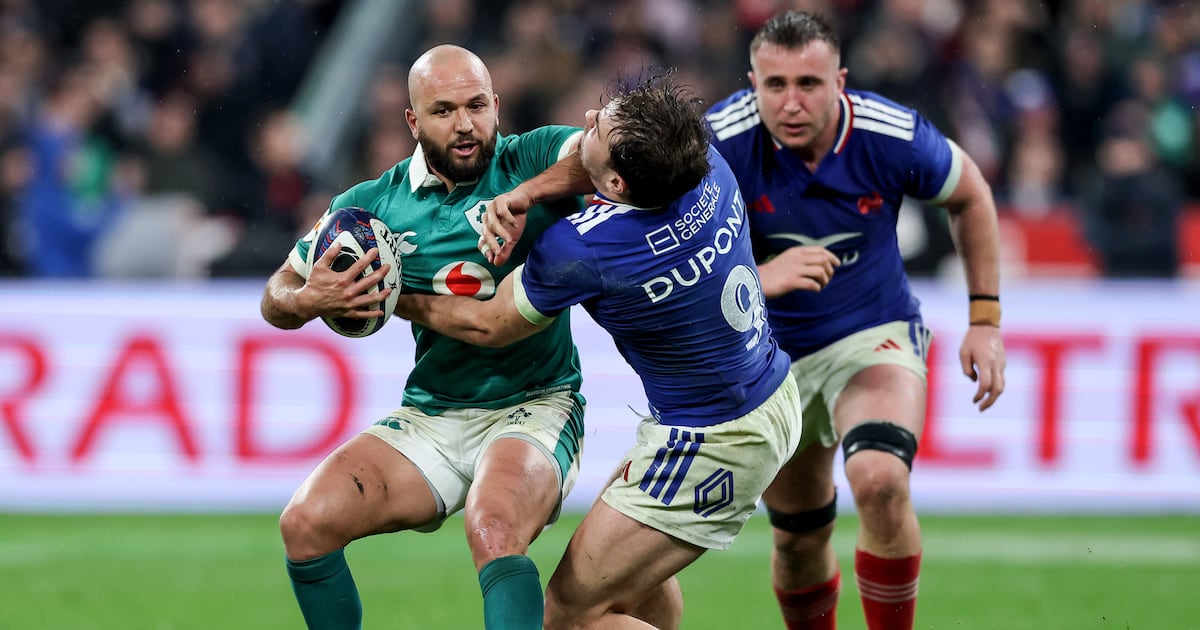
Will the real Ireland please stand up?
For 50 minutes, the move to mimic global trends of kick-heavy, transition rugby continued. The results were disastrous, Ireland gifting chaos to a French outfit that was already capable of finding it themselves.
Andy Farrell’s side was given a lesson in modern attacking rugby. The French transition was electric as always. Their ability to drag more and more such broken-field opportunities into the game was genius. They even showed an occasional desire to hold on to the ball, building through phases and creating opportunities via possession. Beating Ireland at their own, historic game.
In the final 30 minutes, more impact came from replacement forwards. Having Jack Crowley and Sam Prendergast on the pitch saw more holes being picked. Still, given France, England and South Africa’s style, you need to be adept in transition to compete at the top. Here, Ireland were caught woefully short.
Take both sides’ first attack. France’s should nearly have led to a zero-ruck try that was always going to be a threat. It was their gameplan in a microcosm: Antoine Dupont kicks from the floor. Theo Attissogbe/Nicolas Depoortère bat it back. Yoram Moefana throws one offload to open the whole thing up.
Thomas Ramos. Louis Bielle-Biarrey. Chip and chase – we’ve seen that before. Only Charles Ollivon’s spill while under pressure from Sam Prendergast prevented a try.
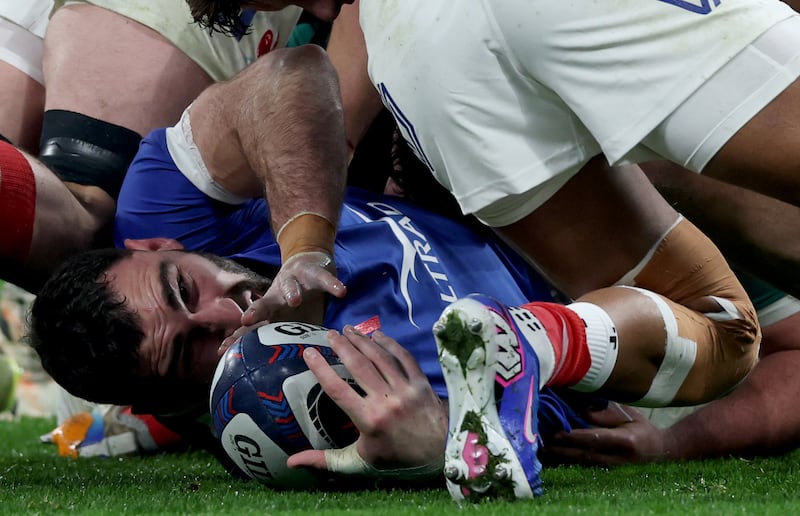 France’s Charles Ollivon. Photograph: Billy Stickland/Inpho
Exhibit B: Ireland’s first foray of note. To their credit, they tried to throw the same sort of offload that has become so key to unlocking modern defences. A clever strike-move – the welcome handiwork of Andrew Goodman – sent Prendergast through a gap inside the 22. He popped the ball into space before a jackal threat could arrive.
But the support, in this case Josh van der Flier, was already in ruck mode two or three metres out from what he thought was an incoming collision. He was not ready for a pass. Knock-on, chance gone.
Prendergast’s risk was the right call. Support was there. Had the ball gone to hand, van der Flier may not have been under the sticks, but Ireland would have had France scrambling metres out from their own line. Vital real estate at a stage when the game was still scoreless.
Where Prendergast can take blame was his skilful, yet ill-advised kick in the build-up to Bielle-Biarrey’s opener. Ireland were already bailing water, somehow surviving France’s successful attempts to create chaos. The last thing they needed to do was play into that. Exactly what Prendergast did.
He was, to be fair, trying to avoid a 50:22. The only way possible was to kick on the half-volley. Somehow, he kept the ball in play. That set Thomas Ramos off with Depoortère and Bielle-Biarrey in tow. We all know how that’s going to end.
Ireland’s impotent attempts to create and thrive off scraps failed to leave any mark on the kings of the transition. Box kicks did not lead to retained possession. Offloads either didn’t come or failed to stick. The odd good decision made by Jamison Gibson-Park to attack down the short side ended in inevitable team-mate errors.
Was it for this Ireland left behind their famed, intricate phase play? When they did try to hold on to the ball, Mickaël Guillard and co smashed back forward carriers. By trying to manufacture counter-attacks against this French side, Ireland were bringing a knife to a gunfight. When they tried to build phase attacks, they brought paper to a stone-throwing contest.
There were, to be fair, flashes. Prendergast’s cross-kick to Tommy O’Brien would have led to a try against a side with a slightly more sluggish back three, but the Ireland wing was unable to outpace Ramos after chipping ahead. Therein lies another Irish limitation – and O’Brien is their fastest man.
Meanwhile France kept manufacturing their favoured loose ball, almost at will. Jalibert’s chip over the top saw Ollivon finish things off. Dupont’s later kick saw a second score for the red-capped roadrunner.
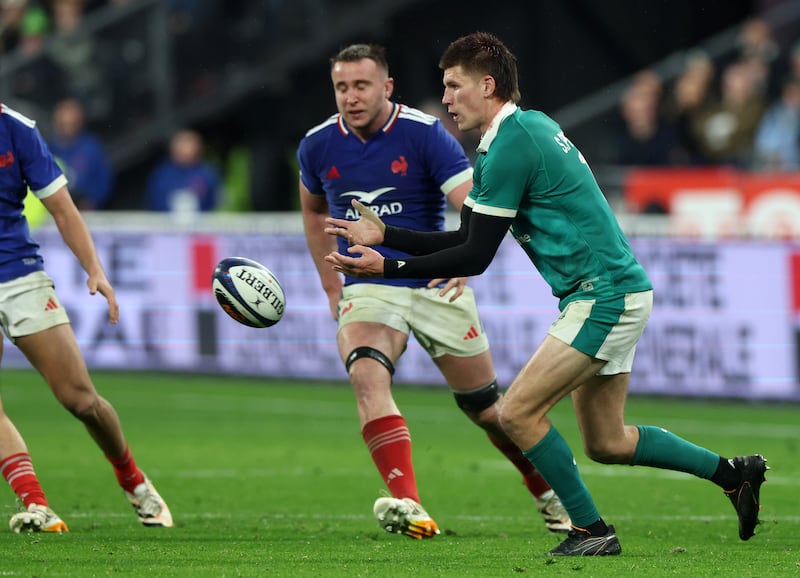 Sam Prendergast of Ireland passes the ball against France. Photograph: David Rogers/Getty
For 50 minutes, Ireland looked wholly ill-suited to the modern trends of kick-heavy, transition rugby. The aerial supremacy simply wasn’t there. Neither was the required mindset to manufacture space, nor the athletes to maximise it.
Granted, what happened thereafter serves as a warning against over-reaction. After Andy Farrell made four replacements in one go, suddenly Ireland’s attack found something approaching rhythm. Scraps stopped being sought. Phases were built. The gain line was broached and, surely enough, tries followed.
The introduction of Jack Crowley at first receiver, allowing Prendergast more time on the ball behind decoys and away from onrushing defenders, worked well. The Leinster outhalf’s range of passing was on full display.
One long ball over a defender dragged momentum Ireland’s way. Minutes later, a delayed pass to McCloskey – whose carrying was sensational in the second half – allowed the Ulsterman to offload to provincial team-mate Nick Timoney. Ireland troubled the scorers.
Michael Milne added carrying ballast that was previously missing. Proof, and it was needed, that Ireland have threats. But too many of them did not get required opportunities. Joe McCarthy carried just twice before being hauled off in the 50th-minute cull. Replacement Timoney got through more attacking work than all but one of the starting pack (Caelan Doris, for what it’s worth).
Ireland look caught between two stools. Everyone else is playing the kick-transition game, so clearly Irelandthink they should join them. Only it is still a foreign concept. Perhaps some pain is necessary to see improvement. At least in the second half, some of the old skill on the ball was found.
Time will tell whether that proves to be minimal comfort or clutching at straws.