
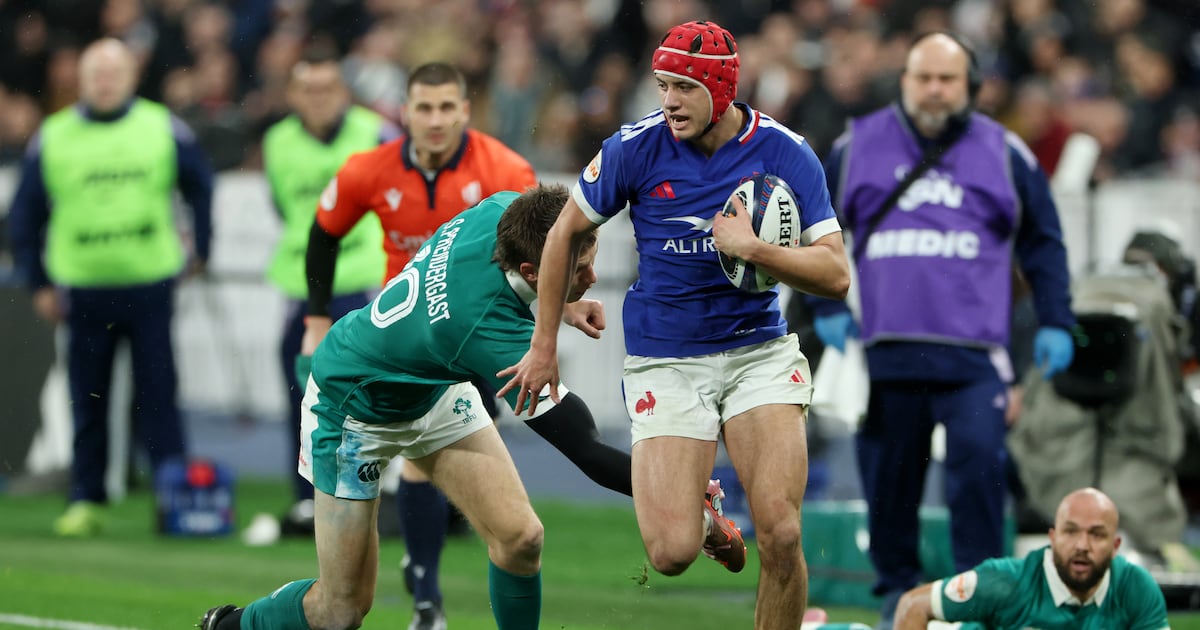
Beaten, battered, blown away. Having been completely overwhelmed by a sublime French team, Ireland must harness every ounce of resilience for their remaining four matches, starting with Italy. We can’t blame the referee for the events in Paris; no match is winnable when missing a shedload of tackles and kicking the ball away.
Englishman Karl Dickson was in charge. He was much quieter than usual and was the better for it. Nevertheless, some are questioning a few calls, most notably a pass just before France’s opening try by Louis Bielle-Biarrey. There was also a potential knock-on by Antoine Dupont at the base of the scrum immediately prior to Matthieu Jalibert’s try. Let’s have a look at what happened.
As France crossed the halfway line in a sweeping attack, there were three rapid-fire passes. The pass in question, the second one, was from Nicolas Depoortère to fellow centre Yoram Moefana. Depoortère was knocked backward in the tackle as he released the ball, which can visually make a pass appear to be forward. It certainly didn’t meet the clear-and-obvious criteria, so Dickson and his fellow officials were right to allow play continue.
Bielle-Biarrey then completely bamboozled the Irish defence. Considering that at one point he was on his knees, the cover defence should have mowed him down. The wonderful flying wing has become Ireland’s tormentor-in-chief, touching down with four tries in our last two matches against France.
In the case of the potential knock-on, while the ball did go forward all right, it was off number eight Anthony Jelonch’s foot, just before Dupont picked it up. So, the officials get a clean bill of health on both these issues.
 How far behind the leading pack are Ireland after defeat against France?
Quite amazingly, France did not concede a single first-half penalty, while they only conceded four in the second. Irish discipline was also much improved – six penalties, no cards and no evident narking at the officials. However, Joe McCarthy’s concession of a three-point penalty was in the mindless category. Overall, it was a bad, sad day for Ireland and there’s much work to do.
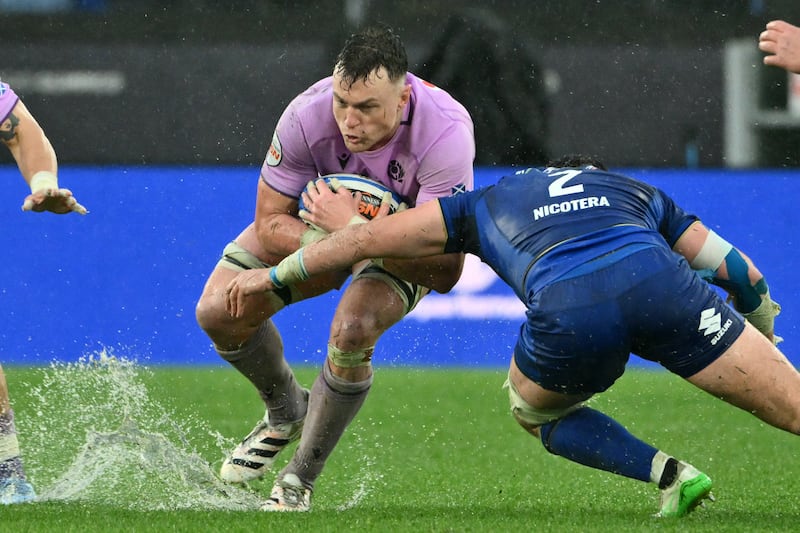 Scotland’s Jack Dempsey is tackled by Italy’s Giacomo Nicotera during Saturday’s Six Nations match at a soaked Stadio Olimpico in Rome. Photograph: Alberto Pizzoli/AFP via Getty Images
“It never rains in Durban.” That sentiment is untrue, of course. But that’s how referee Derek Bevan amusingly remembers the 1995 Rugby World Cup semi-final between South Africa and France. There has probably never been such a biblical heaven-sent deluge for a game of rugby. On Saturday, “it never rains in Rome” came close enough to that infamous day in Durban.
Italy squeezed out a win in a match which, more than anything, demonstrated how poor Scotland were. Italy were sweating the result at the finish, but they might have sewn things up earlier if referee Ben O’Keeffe had read an incident differently. When Italy went offside under their own posts, they quickly returned to an onside position. The supposed offence had no bearing on play whatsoever, yet it was penalised.
Another tap penalty against Italy quickly followed and Scotland crossed for the points. It can’t really be called a refereeing error, but these immaterial sanctions are easy to dislike. Later on, O’Keeffe did allow clearly offside Scottish players to go back without sanction, at both a ruck and a scrum, so there’s a consistency issue here.
Across the three matches, there were very few foul-play incidents. Scotland’s George Turner received a correct yellow card, about which Martin Johnson remarked that he didn’t see what else Turner could have done. Well, if that was the only option, then the player should have just stayed where he was.
Pivotal news on the cards issue came through last week. All foul play will now go to the bunker. The day of the straight, permanent on-pitch red is finally and officially over. This level of card will now only be given for the most egregious foul play, the sort of near-criminal assaults which are also outlawed in the MMA cage-fighting rulebook.
Headbutting, of course, is on the list, which brings up Ellis Genge’s foul play in England’s romp at Twickenham. Wales were alarmingly poor and ridiculously ill-disciplined, conceding 16 penalties, four yellows and a penalty try.
It was clearly a headbutt by Genge, bewilderingly interpreted by referee Pierre Brousset as a “push”. Any sort of headbutting brings the game into disrepute and there cannot be degrees of it, so Genge escaped very lightly – penalty only. Last July, South Africa’s Jasper Wiese copped a four-week suspension for something very similar after Irish referee Andrew Brace had rightly dispatched him permanently.
The disappearance of the straight red card, delivered by the referee, removes an extremely important deterrent to foul play. Those against this move have to accept that this particular horse has bolted and there’s little point in now trying to shut the stable door. However, some time ago, automatic four-week suspensions or more were on the table, to operate in tandem with the 20-minute replacement. It seemed a logical idea which, now that the replacement battle has been won, seems to have disappeared into the ether.
World Rugby’s oft-spoken mantra of the importance of balancing spectacle with player safety has now been completely skewed in favour of spectacle. The immediate on-pitch additional sanction, when a yellow card is upgraded, is only 10 minutes; normally followed by a paltry two- or three-week suspension. Neither represent any sort of deterrent.
If World Rugby’s leaders are at all serious about balancing the scales of justice, they can demonstrate it by introducing meaningful off-pitch sentences, giving players very serious pause for thought. And if they don’t, a very differently coloured message will be sent out. One way or the other, World Rugby must let us know.