

El Cavador is a Slugger reader from Belfast.
The Department of Education (DE) has published its draft attendance strategy, Attendance Matters: Supporting Children and Young People to Attend School Every Day. It runs to several dozen pages. It acknowledges a crisis. It proposes six priorities, including a welcome focus on Emotionally Based School Non-Attendance (EBSNA) — the phenomenon of children whose absence reflects distress rather than disengagement. It commits to data-driven early intervention. But it contains not a single line of sex-disaggregated attendance data at the post-primary level.
This matters because the DE’s own published data tells a story the strategy appears not to have noticed.
The Reversal
For every year on record prior to the COVID-19 pandemic, boys in Northern Ireland’s post-primary schools recorded higher absence rates than girls. The pattern was consistent and unremarkable. It aligned with the broader profile of male educational disadvantage that informed the A Fair Start and the New Decade, New Approach commitment to address the underachievement of working-class Protestant boys.
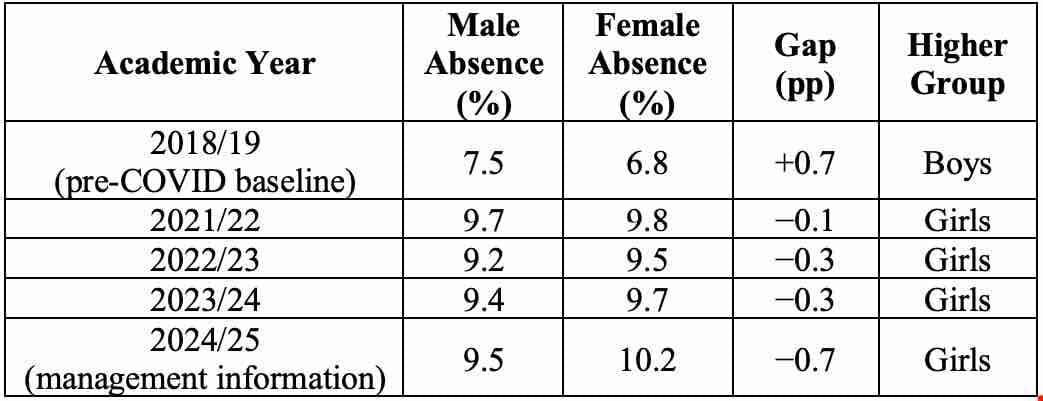
That pattern has now reversed. Analysis of the published statistical bulletins from 2008/09 through 2024/25 reveals a structural crossover in the gendered pattern of post-primary absence. Since 2021/22, girls have recorded higher post-primary absence than boys. The reversal has persisted across three consecutive academic years and is not narrowing.
Table 1: Post-Primary Absence Rates by Sex, Selected Years
Source: DENI Attendance at Grant Aided Primary, Post Primary and Special Schools, Statistical Bulletins 2008/09–2023/24; DENI Management Information 2024/25.
The most recent data show male post-primary absence at 9.5% and female post-primary absence at 10.2%, a gap of 0.7 percentage points, with girls the disadvantaged group. In a system of approximately 150,000 post-primary pupils, that gap is substantial. The direction of travel is clear: from a 0.7 percentage point male disadvantage pre-COVID to a 0.7 percentage point female disadvantage within five years. A swing of 1.4 percentage points.
Differential Rates of Deterioration
The reversal reflects not an improvement among boys but a sharper deterioration among girls. Between the pre-pandemic baseline of 2018/19 and the most recent full-year data, post-primary girls’ overall absence increased by approximately 2.9 percentage points. Boys’ overall absence increased by approximately 2.0 percentage points. The female deterioration has been roughly 45% greater than the male deterioration across the same period.
By 2024/25, the deterioration is continuing — and the gap between male and female absence is wider than in any previous year on record, in either direction.
Where the Absence is Concentrated
Disaggregation by absence type further sharpens the picture. The female excess is concentrated in authorised absence — the coding category that captures illness-related absence, medical appointments, and other reasons formally accepted by the school. The absence is occurring with parental knowledge and, in many cases, the school’s formal approval.
Unauthorised absence has also risen faster for girls than boys — an increase of approximately 1.9 percentage points versus 1.4 percentage points since 2018/19 — suggesting that the differential is not confined to a single absence category. However, it is the authorised component that drives the overall gap. The pattern is consistent with what clinicians and educational psychologists are reporting under the EBSNA heading: anxiety, somatic symptoms, school avoidance rooted in distress rather than defiance.
The strategy itself foregrounds EBSNA as the defining challenge of the post-COVID attendance landscape. It has not noticed that the challenge appears to have a gendered dimension.
An Adolescence-Specific Phenomenon
The gender reversal does not appear in primary school data. At the primary level, the traditional pattern — in which boys record marginally higher absence — persists throughout the post-COVID period. Whatever is driving the reversal is operating specifically on adolescent girls, emerging at or after the primary-to-post-primary transition.
Recent longitudinal evidence from the UK’s Millennium Cohort Study (Cameron et al., 2025) is relevant here. Analysing data from approximately 19,000 children born in 2000–2002, Cameron and colleagues found that girls who experienced disruption to their relationship with school — specifically, school exclusion — reported significantly lower subsequent school satisfaction (β = −0.50, p < 0.001). For boys, there was no equivalent effect. The study also demonstrated that school satisfaction at ages 7 and 11 was a statistically significant protective factor against exclusion and truancy at age 14, independent of individual and family characteristics.
If female pupils’ sense of school connectedness is more vulnerable to disruption, and if the pandemic represented a system-wide disruption to school connectedness without precedent in the data, the differential deterioration in girls’ post-primary attendance is not without explanation. The strategy acknowledges EBSNA. It does not acknowledge that the available evidence points to a gendered dimension of EBSNA vulnerability.
The Section 75 Question
The DE has a statutory duty under Section 75 of the Northern Ireland Act 1998 to have due regard to the need to promote equality of opportunity between men and women generally. A strategy that proposes to address a crisis in school attendance without examining whether that crisis affects boys and girls differently has not completed its own equality screening.
The Section 75 screening for the predecessor campaigns — the 2021 Educational Underachievement Suite / Play Matters screening — assessed the ‘Men and Women Generally’ category solely by reference to the established narrative that boys were the disadvantaged group. If the DE screens the current strategy on the same basis, it will be relying on a pre-pandemic assumption that the DE’s own post-pandemic data contradicts.
The Wider Context
The gender reversal sits within a broader picture of deterioration that the strategy acknowledges in general terms but does not quantify with the precision its own data permits.
System-wide attendance stood at approximately 94.3% in the pre-pandemic period. By 2023/24, it had fallen to approximately 91.5%. By 2023/24, 101 of 187 post-primary schools (54%) recorded attendance below 90%, collectively enrolling 73,650 pupils. Management information for 2024/25 indicates almost 5 million school days missed across all school phases.
The deprivation gap — the difference in attendance between FSME-entitled and non-FSME pupils at the post-primary level — has approximately doubled over the past decade. While all socio-economic groups saw attendance worsen post-COVID, the most deprived pupils have been affected approximately three times more severely than the most affluent. The strategy’s commitment to ‘close the attendance gap’ under Priority 3 remains an aspiration without a measurable baseline, because it does not quantify the gap’s current magnitude or trajectory.
Within this broader deterioration, there is a specific phenomenon affecting teenage girls that neither the strategy nor the equality machinery that is supposed to scrutinise it has identified.
What This is Not
This is not an argument that boys’ educational disadvantage has disappeared. It has not. The attainment gap, the exclusion rate, and the dropout rate all remain skewed against boys on most measures. Nor is it an argument for redirecting resources from one group to another. It is an argument that a data-driven strategy should interrogate what its own data shows — and that the evidence reveals a structural shift the strategy has not acknowledged.
A Fair Start was constructed around a specific commitment: to address the underachievement of Protestant working-class boys. That commitment was evidence-based and appropriate at the time. The evidence has since changed. The question is whether the DE’s analytical framework has changed with it.
The DE is consulting until 6th March 2026. It might be reasonable to ask whether a strategy that does not disaggregate its core metric by sex can satisfy the DE’s own statutory obligations under Section 75.
Sources: DENI Attendance at Grant Aided Primary, Post Primary and Special Schools, Statistical Bulletins 2008/09–2023/24; DENI Management Information 2024/25; Cameron, C., Smith, N. and Sheringham, J. (2025) ‘School absence and (primary) school connectedness: evidence from the UK Millennium Cohort Study’, British Educational Research Journal.

This is a guest slot to give a platform for new writers either as a one off, or a prelude to becoming part of the regular Slugger team.
Discover more from Slugger O’Toole
Subscribe to get the latest posts sent to your email.