
 The imprint of Haolong dongi displayed at the Anhui Geological Museum in Hefei, China. Credit: Thierry Hubin
A fossil discovered in northeastern China has revealed unusual skin structures in an ornithischian dinosaur that lived about 125 million years ago. The skin impressions on the specimen are remarkably well-preserved for such an old fossil, including small hollow spikes that have not been previously documented in dinosaurs.
The species, Haolong dongi, meaning “spiny dragon,” was an Early Cretaceous iguanodontian. Most members of this broader group are known primarily from bones. Soft tissues rarely fossilize.
In this case, researchers report that the specimen preserves “exquisitely fossilized skin,” including overlapping scales along the tail, small rounded scales across the body, and spikes integrated within the skin tissue, with microstructural detail visible under microscopy.
Spines-o-Saurus
The fossilized animal measured about 2.4 meters long and had unfused vertebrae, showing it was still growing when it died. Adults of related species may have reached roughly 5 meters, though much larger iguanodontians lived elsewhere during the same period.
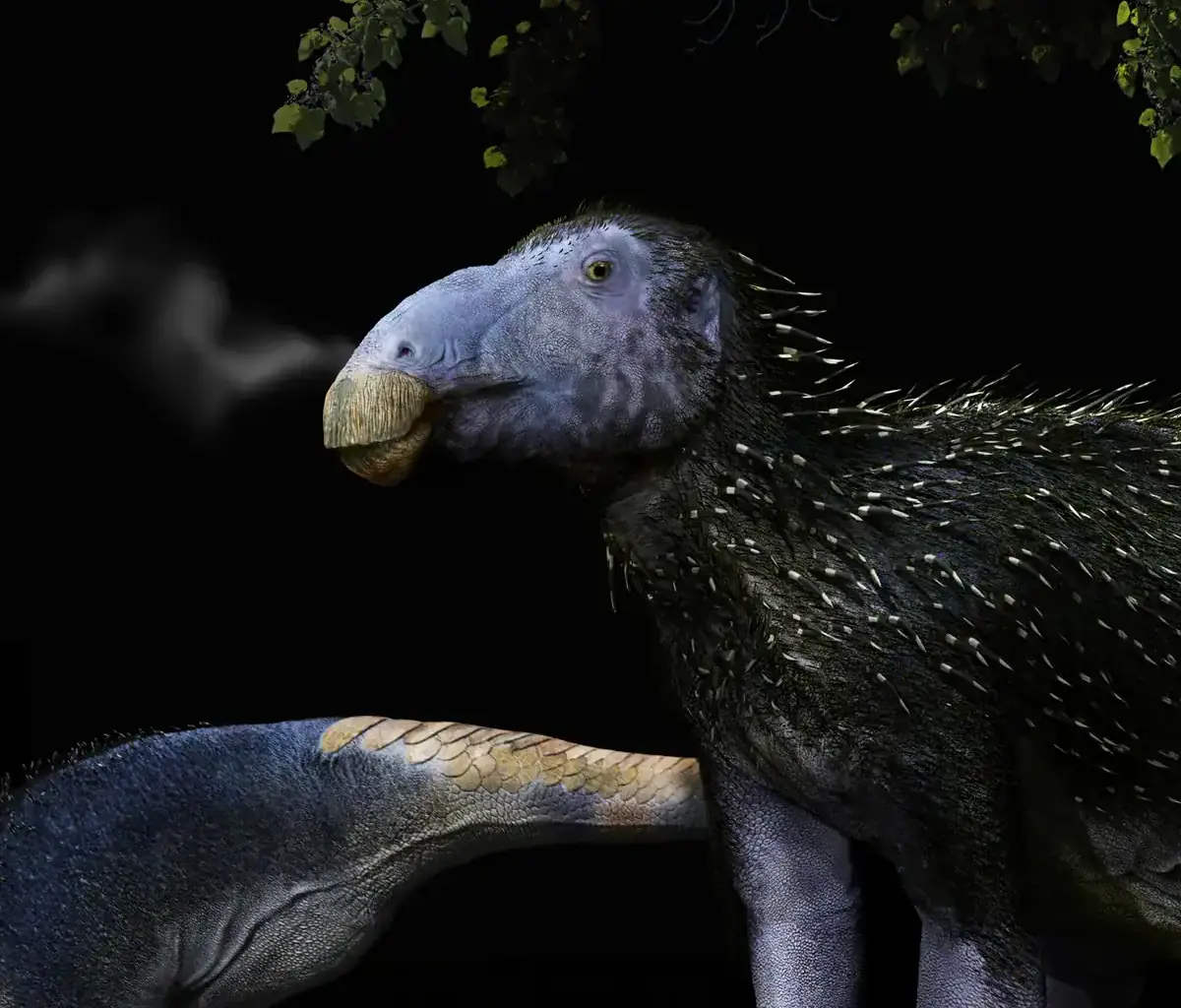
What set this dinosaur apart was its hide. Across the neck, torso, and base of the tail lay rounded, non-overlapping scales. Along the tail ran larger, shield-like scales arranged in rows. Threaded between these structures were spikes ranging from just a few millimeters to more than four centimeters long.
Microscopic analysis revealed that the spikes were hollow cylinders made of layered, keratinized skin surrounding a porous inner core. They were not bone, horns, or protofeathers. Instead, they represented a distinct evolutionary experiment in dinosaur anatomy. Perhaps the hollow spikes are much more common among dinosaurs, but this is the only specimen that preserved these features.
Indeed, such preservation is extremely rare. Using laser-stimulated fluorescence, X-ray imaging, and thin tissue sections, scientists could even observe cell-level structures in the skin.
“Maybe this shows that the diversity of skin coverage in dinosaurs was amazing, beyond a simple dichotomy involving just scales and feathers,” said Pascal Godefroit, a paleontologist and director of the Earth and History of Life Directorate at the Royal Belgian Institute of Natural Sciences in Brussels and co-author of the study, according to Discover Wildlife.
×
Thank you! One more thing…
Please check your inbox and confirm your subscription.
Why Spikes?
 Artist’s reconstruction of Haolong dongi. Credit: Fabio Manucci
Discovering a new structure is one thing. Explaining why it evolved is another. The researchers argue the spikes most likely served as protection. In the Early Cretaceous ecosystems of China’s Yixian Formation, many predators were relatively small, with jaws limited in how wide they could open.
Spines can make prey harder to swallow or attack. As the authors write, “These defences did not necessarily provide impenetrable protection against theropod teeth and claws, but they made the prey more difficult and time-consuming to kill and ingest and consequently reduced the likelihood of successful ingestion.”
Other possibilities remain. Because the region’s climate averaged around 10 °C, the spikes might have helped regulate heat, though they probably did not form a dense insulating coat. Scientists also considered sensory or display roles, but the structure and lack of pigment evidence make those explanations less certain.
In recent decades, discoveries of feathered dinosaurs, filament-covered ornithischians, and unusual skin structures have changed the paleontology game. Skin now appears as varied as the dinosaurs themselves. The new spikes differ from reptile spines, mammalian quills, and early feathers, suggesting multiple evolutionary pathways for skin appendages across vertebrates.
Because the only known specimen is a juvenile, scientists cannot yet say whether adults kept their spikes. Future fossils may reveal whether this was a fleeting childhood armor or a lifelong defense.
The findings appeared in the journal Nature Ecology & Evolution.