
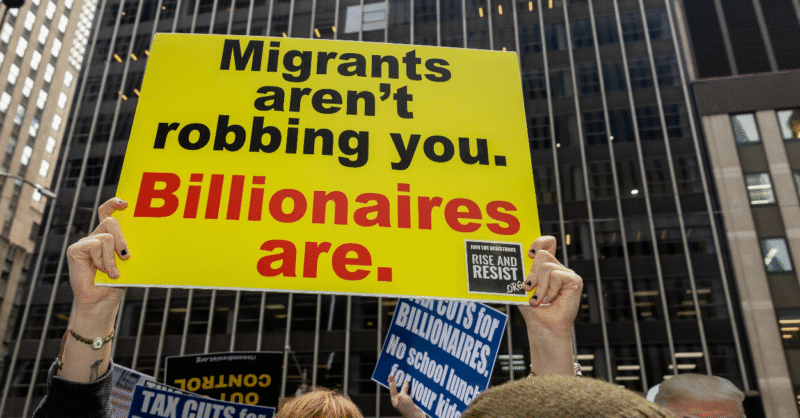
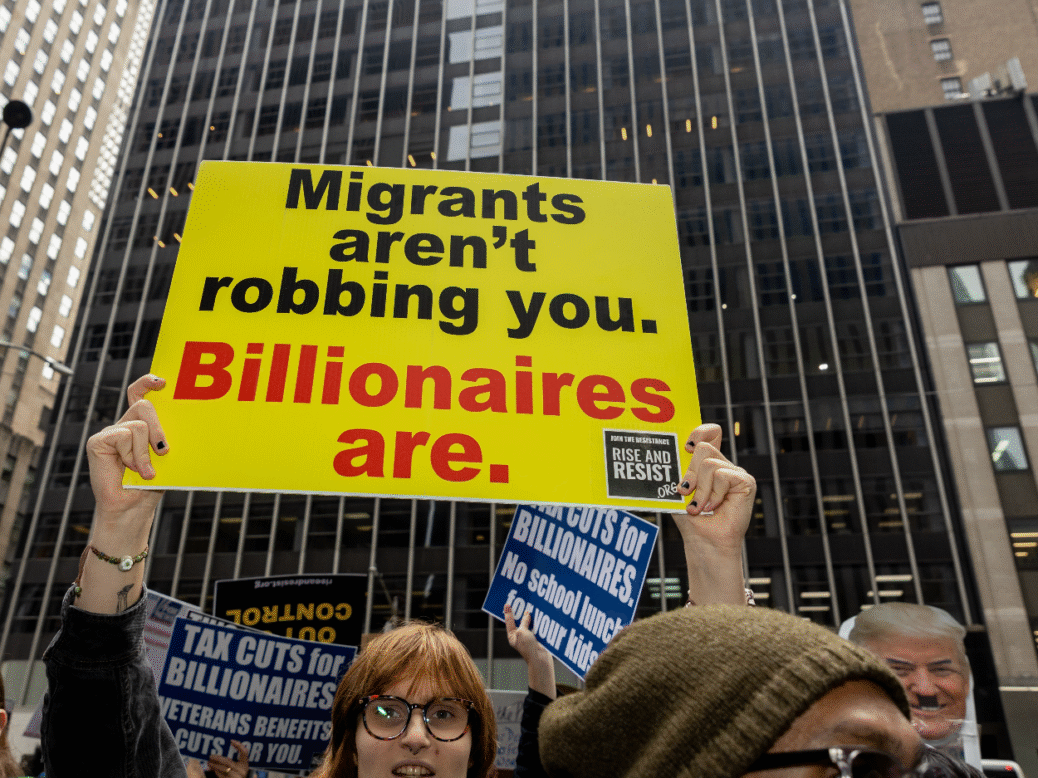
The ultra-wealthy are becoming the human face of inequality in an age of populist discontent // Image: Shutterstock, Richard Scalzo
Today’s populist discontent has many causes, but two groups are especially likely to be blamed: immigrants and billionaires. Heated debates around the first group have dominated the politics of the past decade. Politics in the next ten years will focus much more on the latter group. For billionaires, there is stormy weather ahead.
Many of the changes in the economy that have driven the rise of populism are structural: the China shock, skill-biased technological change and associated increases in inequality, just to name a few. But most voters don’t analyse the world according to a structural framework. Their interest alights on people with faces.
Immigrants represent, for some, economic competition; for others, cultural change. Billionaires represent inequality’s winners, but they are also the owners of the large corporations that dominate our economic infrastructure and our media. And that is why an angry public increasingly seizes on them as the root of our social ills.
[See also: Reputation in the age of AI]
I’ve written a book on the state of public opinion in rich countries, looking through the lens of corporate scandals to assess how opinion affects regulation. When voters see a case of corporate wrongdoing, they don’t see a few bad apples. They think the system must be rotten, but unless you’re a radical university student it’s hard to focus anger on the system. The human tendency is instead to focus on people or the organisation who represent the system.
Facebook and Mark Zuckerberg, for example, continue to suffer the reputational hit of the 2018 Cambridge Analytica scandal, which revealed that the company had been playing fast and loose with almost 90 million people’s data. By 2021, Facebook was less trusted than any other major institution in the United States, even the US Congress. Europe even passed two major laws regulating Big Tech companies as a result.
Our research shows that what is typically called ‘populism’ cleaves neatly into two strands of opinion: one dismissive of mainstream political leaders and institutions, which is simultaneously hostile to immigrants; and one that is focused on a perception that the system is rigged in favour of the economic elite. This latter view is not tied up with opprobrium towards minorities or the political system.
Content from our partners


If you were a candidate for a centrist political party, what would you do? Attack immigrants, which research shows would only increase the votes of extremist parties without helping your vote share? Or instead design a party programme that targets billionaires and large corporations with greater regulation as evidence of reasserted state control?
The electoral answer is pretty obvious. Given this remorseless logic, how should the ‘good billionaire’ respond? One answer, which many have pursued, is to pour money into politics, trying to remind political leaders on which side their bread is buttered. Let’s leave aside for the moment the question of whether it is good for democratic institutions to allow that (it’s not).
US President Donald Trump has been norm-breaking in many ways, but one of those ways is that he has shown that the heads of even the largest corporations fear decisive state action. They are aware of the damage the US government can inflict on large companies. Whoever succeeds Trump in the US will bear that lesson in mind, as will other political leaders. If that all seems a touch too technocratic, then answer this: who blinked first when there was a falling-out between Trump and Elon Musk (then the world’s richest person)?
There is another way. The public does not want to get rid of capitalist institutions. Reforming capitalist democracy continues to be the sweet spot with voters. Even billionaires have a role to play in that system. But it’s a limited one: they should stick to their knitting.
Billionaires should not allow their skill in one area to convince them that they are gifted at everything. Many human beings exhibit this hubris, but only billionaires have the massive economic resources to transform a misperception into a destabilising force for whole societies.
Billionaires typically split their time and their capital between homes in many places, whereas for most citizens their democratic systems are their only homes. Those fragile homes are in need of rebuilding. By all means, bring your economic innovation and skills at capital allocation with you. They are welcome. But leave the hubris on the yacht.