
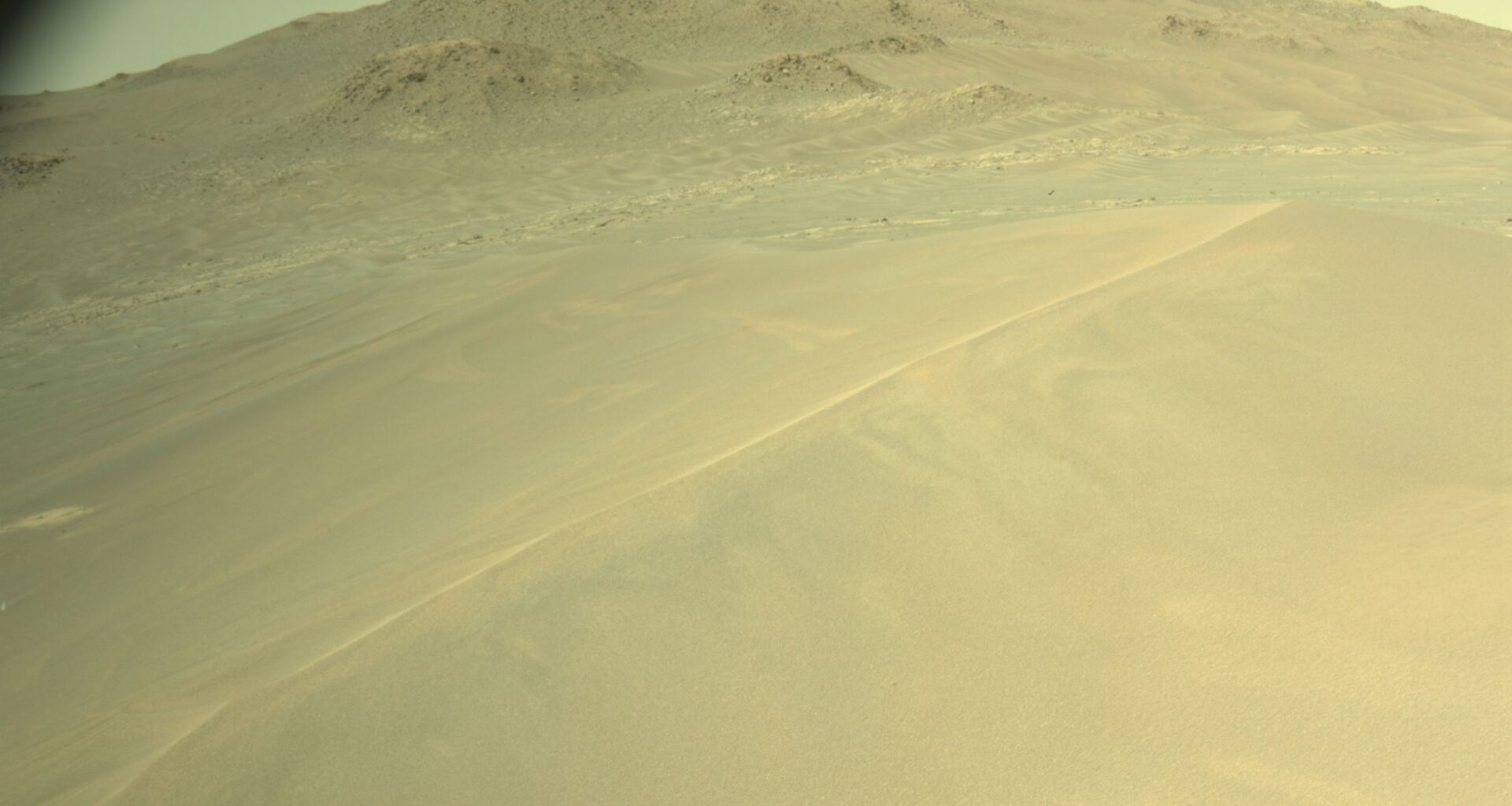
A 6.5-foot-high sand ridge on Mars has emerged as one of the clearest signs that powerful, steady winds once shaped the planet’s surface for long stretches of time.
Its sharply aligned crests preserve a record of atmospheric force and moisture that no longer operate in the same way, reframing how recently Mars may have reorganized its own landscape.
Close look at Hazyview

On the edge of a large ancient crater where the rover has been exploring, the ridge called Hazyview rises from a broad stretch of wind-shaped sand with tall, sharp edges that all run in the same direction.
Reading that alignment as a physical record of wind, Noah Martin, a Ph.D. student at Purdue University, documented how the crest lines trace a prolonged north-south airflow across the region.
Such consistency does not form during brief gusts, but during sustained periods when wind repeatedly rebuilt the same ridge faces over time.
That persistence leaves open a deeper question about whether today’s thinner air can still disturb the structure or whether it now stands as a fixed remnant of a different atmospheric chapter.
What makes a megaripple
Planetary scientists call these ridges megaripples, oversized sand ripples shaped mainly by wind, and they can stand out from the flats.
Wind pushes grains up a gentle slope, then drops them down the steep side, rebuilding the crest bit by bit.
Coarser pieces often collect on top, forming a rough cover that blocks smaller grains from lifting in mild gusts.
Once that cover forms, a ridge like Hazyview can hold its shape even while nearby dunes keep moving forward.
Honeyguide tells a story
Across the Honeyguide ripple field, crests ran higher and straighter than earlier patches Perseverance studied on its route.
Over long spans, winds from one direction align ridges, and this field kept a consistent north-south orientation.
At Kerrlaguna, the rover saw lower ripples with less uniform crests, suggesting winds there varied more often.
If stronger air once swept this rim, Honeyguide could mark one of the later periods in Mars climate history.
Testing Hazyview up close
During a close stop at Hazyview, Perseverance logged more than 50 observations while circling the ridge and scanning it repeatedly.
Cameras watched for grains creeping down the slope, while pre-dawn checks looked for frost and tracked wind bursts.
Evidence of even slight movement would set a limit on how often Hazyview can reset its own surface.
Why wind still works
With air about two percent as dense as Earth’s, Mars has a thin atmosphere that struggles to lift sand.
Once a few grains hop, they hit others and trigger more hops, spreading motion in a chain reaction.
Dust devils and regional storms add short bursts of force, and those peaks can disturb even coarse-topped ridges.
Because strong winds are intermittent, a megaripple can sit still for years and then change over days.
Locked grains on Mars
Wheel tracks across Jezero exposed hard soil crusts at 45 of 101 disturbed spots during early rover drives.
Salts can pull in moisture from humid air, and that hydration can cement grains until a wheel breaks them.
In that survey, hydrogen at the surface and salty minerals pointed to frost and humidity as key parts of crust formation.
If Hazyview carries a similar coating, ordinary winds may not expose its older layers without slow erosion.
Building on Martian sand
Future crews will drive, dig, and build in sand, so soil behavior becomes a practical problem, not trivia.
Hard crusts and loose pockets can sit side by side, and that mix changes traction, drilling depth, and dust plumes.
Soil chemistry and stickiness will shape how machines scoop, sieve, and store material, especially when crusts hide loose grains below.
Details from places like Hazyview can guide where robots scout for stable ground and where they expect loose sand.
Limits of a snapshot
One rover stop cannot prove Hazyview never moves, because motion may happen only during rare regional storms.
Long gaps between strong winds mean a rover can miss the few hours when crust breaks and grains slide.
Seasonal swings matter too, since cold mornings favor frost while warmer afternoons favor dry hopping grains.
Repeated passes, plus orbital images taken years apart, will be needed before scientists call the ridge truly dormant.
Reading Mars’s recent past
Orbital imagery in a 2020 analysis tracked some Martian megaripples migrating, showing modern winds can sometimes overcome their coarse cover.
Stronger gusts can strip fine dust, expose bigger grains, and raise the odds that sand hops instead of sticking.
At the same time, that paper argued a denser ancient atmosphere is not required to build or move these ridges.
If Hazyview still carries clues about a different atmosphere, the clue may be about timing, not just thickness.
What Hazyview adds
Hazyview links wind, dust, and crust chemistry into one landform that can be tested with cameras and weather data.
As Perseverance climbs new terrain, similar ridges will help narrow when Mars last built strong, steady winds near its surface.
—–
Like what you read? Subscribe to our newsletter for engaging articles, exclusive content, and the latest updates.
Check us out on EarthSnap, a free app brought to you by Eric Ralls and Earth.com.
—–