
With short-notice deployments and long training absences straining family life, acting wing commander Lt.-Col. JJ Verran says events like the 22 Wing Mental Health Expo help personnel recognize challenges early
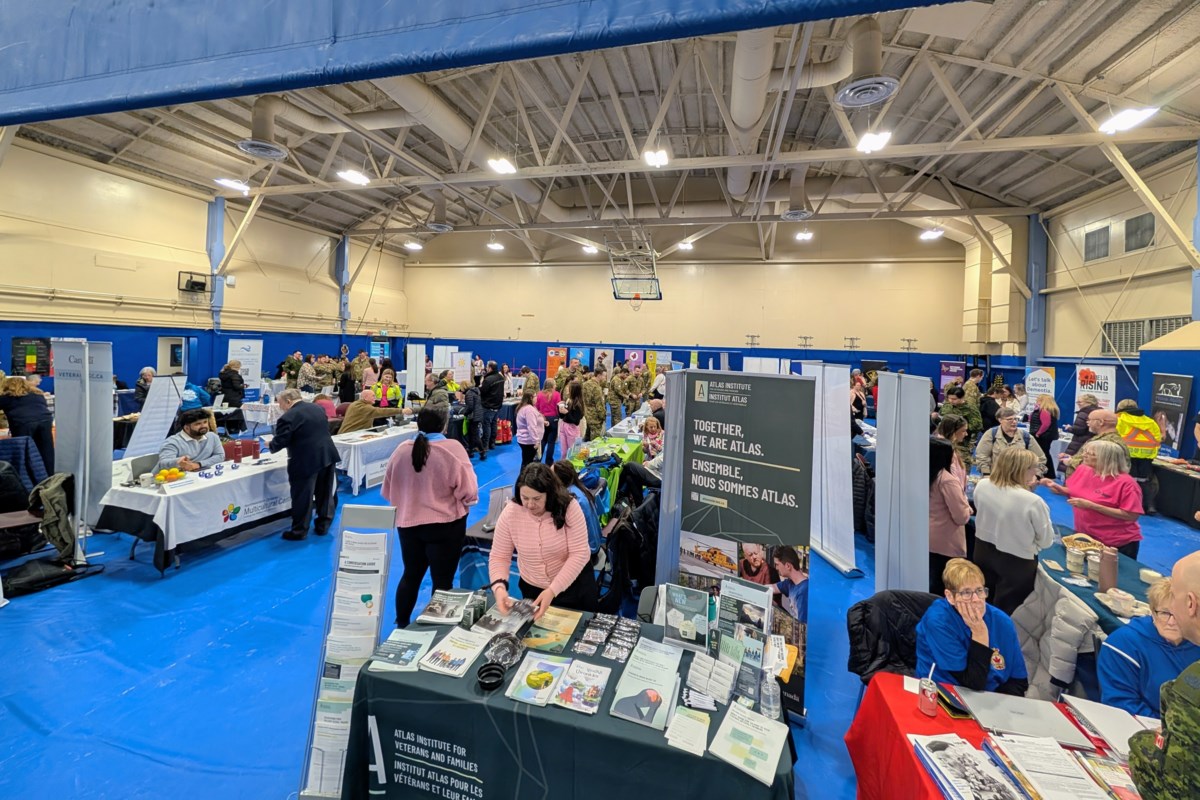
The Fitness and Wellness Centre at 22 Wing North Bay was alive with conversation on Wednesday afternoon.
Families and military members moved between more than 60 booths, asking questions, picking up pamphlets, and connecting with local organizations offering mental health and wellness resources.
From service dogs to childcare programs, the expo showcased supports designed to help families navigate the unique challenges of military life and more.
Attendees spoke with panellists and volunteers about everything from mental health services to balancing technology and social media in daily life.
The ninth annual 22 Wing Mental Health Expo aims to reduce stigma, provide education, and offer a “one-stop shop” for support.
Attendance reflected growing interest in wellness programs and strengthened ties between the base and the wider North Bay community.
“Working in the Canadian Armed Forces (CAF), it can be difficult at times,” acting wing commander Lieutenant-Colonel JJ Verran told BayToday.
“Short notice deployments, training that takes us away from our families for long periods of time … events like this help us recognize some of those challenges and build our personnel to be resilient and their families to be resilient.”
Verran says the expo also allows military members to connect with the wider community.
“We like to be good community members,” he said. “And events like this really make us feel a part of the community.”
Verran says about 400 uniformed members and roughly 100 Department of National Defence civilian employees are posted to 22 Wing, many with families living in North Bay.
The expo featured more than 60 tables from local organizations, offering information ranging from mental health services to family supports.
Discussions highlighted challenges unique to military families, including frequent relocations, accessing healthcare, and childcare.
Tessa Clermont, executive director of the North Bay Military Family Resource Centre, says these events help families navigate a complex system.
“It’s a lot of challenges associated with military life because of those relocations, because of absence, because of transition,” she explained to BayToday following her discussions onstage as a panellist, which kicked off the event.
Clermont says the expo provides a convenient way for families to find support.
“We want to give everyone the opportunity to have like a one-stop shop to find out all the resources that are available,” she said.
Clermont highlighted progress in mental health awareness during her 11 years at the organization.
“One of the biggest things that I’ve noticed is the CAF’s willingness to evolve,” she said. “Seeing them want to evolve and want to become more inclusive and think about different platforms and better ways to connect with their people.”
Clermont added that North Bay offers programs unique to Canadian Armed Forces families, including a family medical clinic on the base. She noted ongoing challenges, including work to address childcare waitlists.
“The resilience of our families is incredible,” she said.
“Eighty percent of families feel confident navigating those challenges of the military lifestyle. That’s a testament to how strong our community is.”
Another panellist, Capt. Mark Emmerson, discussed the importance of intentional technology and social media use in relation to mental health.
“Think to yourself, ‘Am I intentionally using this system?’ If yes, it’s fine,” Emmerson said. “If you’re engaging with these systems because you’re in the algorithm … then you probably want to take a step back.”
Emmerson echoed the broader changes in the Canadian Armed Forces regarding mental health.
“The fact that we’re doing a mental health expo today tells you how seriously we take it,” Emerson said. “Willingness to talk about it—you would never have seen 20 years ago.”
Emerson also emphasized how seeking help is becoming normalized.
“Once the stigma’s gone, people are way more willing to go do it,” Emerson said.
“If you’ve got a broken leg, you’re going to the doctor. Well, if your mental health is broken, you’re going to the doctor, and that’s okay. It’s perfectly fine.”