
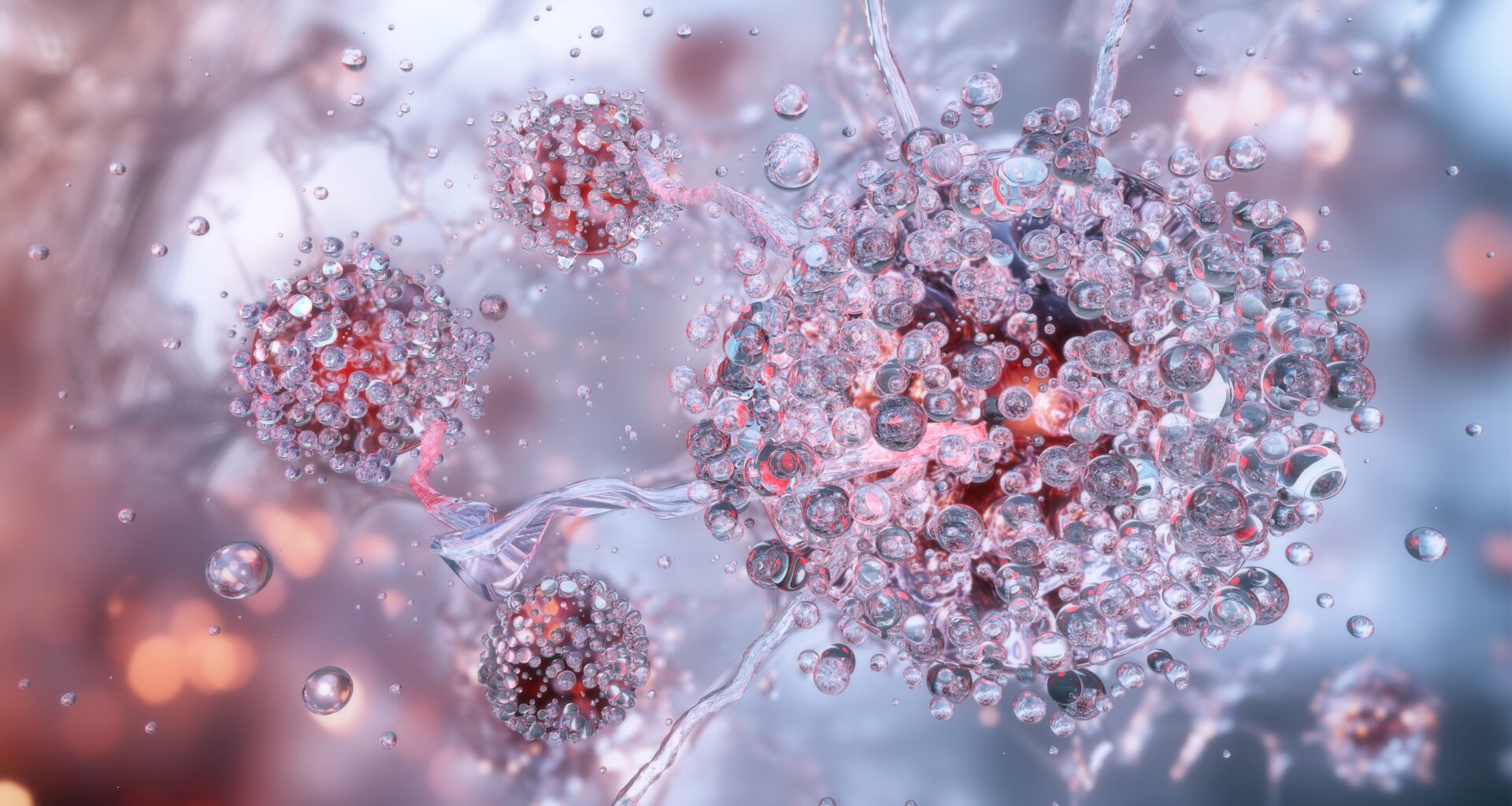
Scientists at Arizona State University have discovered that the way nanoparticles interact with water determines how they behave inside the human body, providing a new thermodynamic framework that could lead to more effective nanomedicines.
Researchers at Arizona State University have identified a fundamental scientific principle that could determine how engineered nanoparticles behave inside the human body. The study may help unlock the potential of nanomedicine, leading to therapies that are both safer and stronger.
Within the study, the researchers directly measured how water interacts with coated nanoparticles and how those interactions influence their biological performance.
Why water is important
“Water is necessary for all life,” said Alexandra Navrotsky, the lead author of the study, Regents Professor in the School of Molecular Sciences and Director of Arizona State University’s Center for Materials of the Universe. “And in medicine it is the first molecule that interacts with any nanoparticle surface in a biological environment. By directly measuring the energetics of water adsorption, we can quantify the interaction potential of the nanoparticle surface and better predict how it will behave in the body.”
Despite decades of research nanomedicine has struggled to deliver a new generation of safer and more effective treatments.
Despite decades of research nanomedicine has struggled to deliver a new generation of safer and more effective treatments. The human body presents many barriers making it difficult to ensure that drugs reach the right target at the right time. Conventional chemotherapy, for example, often spreads toxic compounds throughout the body while attempting to destroy tumours.
To address this, scientists have been developing ‘Trojan horse’ strategies, encasing medicines within protective nanoparticle shells. These particles are immediately surrounded by water and biomolecules when they enter the body, forming complex structures that dictate their stability, circulation time, immune response and uptake by cells.
Until now, researchers had not directly measured the energetics of water adsorption on biomolecule-coated magnetic nanoparticles.
Getting to the core
The researchers studied magnetite nanoparticles coated with three representative biomolecules: the protein bovine serum albumin, the polysaccharide potato starch and the fatty acid lauric acid. Using a highly sensitive calorimetry–gas adsorption system, they measured how water interacted with each coating and compared the findings with uncoated magnetite and free biomolecules.
Their results revealed that each surface coating dramatically altered hydration behaviour and biological interaction potential.
Uneven protein layer
Nanoparticles coated with bovine serum albumin, commonly used as a model in drug delivery research, showed the strongest initial interaction with water. The coating created powerful binding sites on the particle surface. However, total water uptake was lower than that of the free protein suggesting incomplete coverage and exposed patches of magnetite.
Nanoparticles coated with bovine serum albumin, commonly used as a model in drug delivery research, showed the strongest initial interaction with water.
“The protein coating increases the surface interaction potential of the nanocomplex,” said Kristina Lilova, Research Assistant Professor at Arizona State University’s Center for Materials of the Universe. “But the existence of exposed magnetite regions introduces heterogeneity that may promote protein corona formation and immune recognition.”
Patchiness like this might encourage the adsorption of opsonins – proteins that mark foreign particles for immune clearance – potentially shortening circulation time.
A starch shield
In contrast, starch-coated nanoparticles displayed a large hydrophilic surface area but weaker interaction potential. The starch formed a dense shell around the magnetite core that limited access to water molecules.
“The weaker interaction potential of the starch coating and its relatively large hydrophilic surface area suggest more dynamic and reversible binding,” said Lilova. “This may be beneficial in drug delivery where mobility along cell membranes and reduced cytotoxicity are desirable.”
Fatty acid coating
The most surprising findings involved lauric acid. Although free lauric acid does not adsorb water, when bound to magnetite, it reorganised into a partial bilayer structure that strongly interacted with water.
“The fatty acid rearranges into a partial bilayer with very strong hydrophilicity,” said Lilova. “That structure increases stability and may reduce immune activation compared to more hydrophobic surfaces.”
Towards rational nanomedicine
Across all three coatings, the researchers established hydration enthalpy as a key thermodynamic parameter governing surface hydrophilicity, heterogeneity and biological interaction.
Our findings show that surface functionalisation doesn’t just change chemistry – it fundamentally alters the thermodynamic landscape at the nano-bio interface.
“Our findings show that surface functionalisation doesn’t just change chemistry – it fundamentally alters the thermodynamic landscape at the nano-bio interface,” said Lilova. “By understanding primary hydration energetics, we can rationally engineer nanocarriers with tailored stability, immune interactions and drug delivery behaviour.”
It is hoped that these findings could inform the future design of targeted drug delivery systems, imaging agents and cancer therapies.
“This research provides a thermodynamic foundation for designing nanocarriers with predictable biological reactivity. It moves us one step closer to truly rational nanomedicine,” said Navrotsky.