
Recently, two different groups of scientists released research results looking into some very well known sounds. One group studied the whinnies of horses. The other studied squeaking sneakers. Both research projects revealed surprising explanations behind these ordinary sounds.
The Secret of a Horse’s Whinny
Humans and horses have lived together for thousands of years. But there’s still a lot we don’t understand about horses. For example, it wasn’t until 2015, that scientist Elodie Briefer discovered that when horses whinny, they’re actually making two sounds at once – a low sound and a high sound.
That has been a puzzle. We expect big animals like horses to make low-pitched sounds. But what’s up with the whistle? And how do horses do it?
https://newsforkids.net/wp-content/uploads/2026/03/padinko-biphob.wav
In 2015, scientist Elodie Briefer discovered that when horses whinny, they’re actually making two sounds at once – a low sound and a high sound. Recently, her team explored how horses make their high-pitched sound.
(Source: Elodie Briefer [CC BY-SA 4.0], Current Biology .)
Dr. Briefer and her team wanted to try to answer these questions. Using a small camera fed in through the horse’s nose, the researchers were able to watch the voice boxes of different horses as they whinnied.
They found that when the horses made low-pitched sounds, their vocal cords were vibrating, just like when humans talk.
But when the horses made the high-pitched sounds, their vocal cords didn’t move. Instead, the muscles around the voice box tightened, creating a small opening. The researchers believed the horses used this tiny opening to make a whistling sound.
 The scientists found that when the horses made low-pitched sounds, their vocal cords were vibrating, just like when humans talk. But for the high-pitched sounds, the muscles around the voice box tightened, creating a small opening, which allows them to make a whistling sound.
(Source: Elodie Briefer [CC BY-SA 4.0], Current Biology .)
To test their idea, the scientists ran an experiment using helium and air on voice boxes from horses that had died. Compared to regular air, helium will make a whistle sound higher, but it has no effect on vibrating vocal cords.
Sure enough, the whistling sound from the horses’ voice boxes went higher when the scientists blew helium through them. But vibrating the vocal cords with helium instead of air made no difference in sound.
Mice and rats also sometimes make whistling sounds, but horses are the only animals known to make both kinds of sounds at the same time.
Studying Squeaky Sneakers
Adel Djellouli is a Harvard scientist who studies materials. As he watched a Boston Celtics basketball game, he kept noticing the squeaking sound made by the players’ sneakers.
😕
This image has not been loaded because of your cookie choices. To view the content, you can accept ‘Non-necessary’ cookies.
As Adel Djellouli watched a Boston Celtics basketball game like the one above, he kept noticing the squeaking sound made by the players’ sneakers. He and a team of scientists decided to look into the squeaking.
Dr. Djellouli and a team of scientists decided to look into the squeaking. They slid a basketball shoe across a smooth glass plate. As the shoe slid, they took pictures with a super-fast camera and recorded the sounds that were made.
Stick-Slip Friction
Sneaker squeaking has a lot to do with friction. Friction is the force that happens when two surfaces rub against each other. Rubber shoe soles on a gym floor create “stick-slip” friction. That’s when two surfaces slide across each other, stick together briefly, then slip. Then stick. Then slip. And so on.
The researchers found that small areas of the shoe sole would slip and then grab again thousands of times a second. Though tiny, these vibrations were faster than the speed of sound. That repeating pattern of tiny slips causes the squeaks.
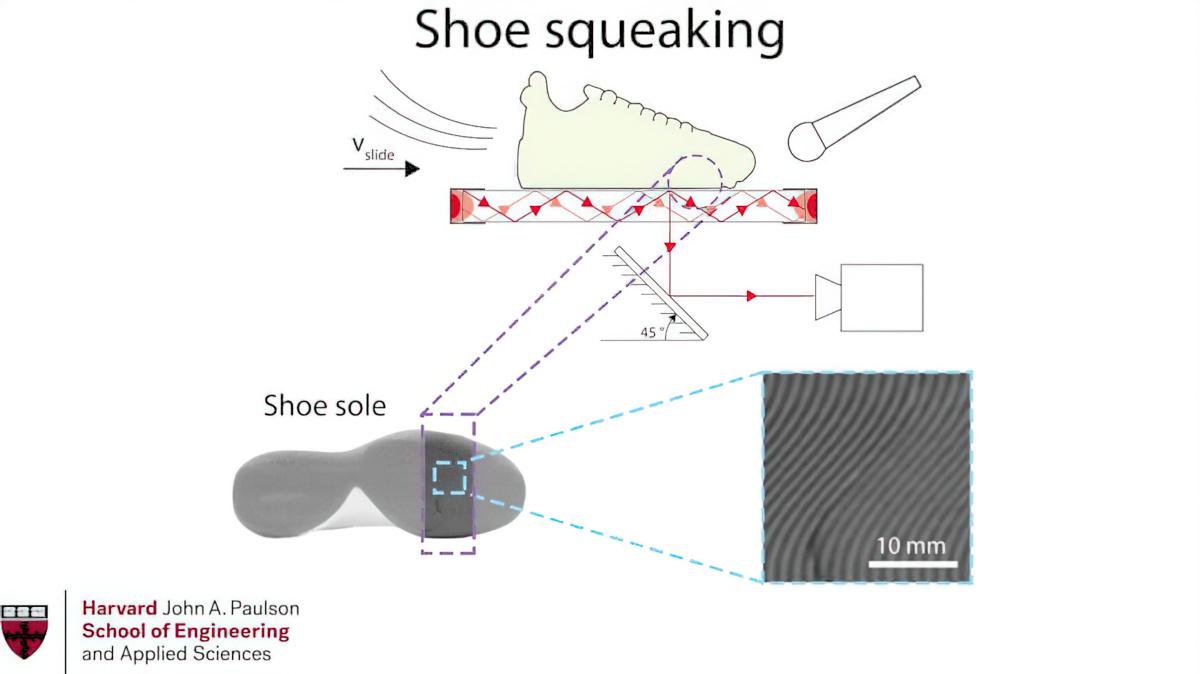 The researchers found that small areas of the shoe sole would slip and then grab again thousands of times a second. Though tiny, these vibrations were faster than the speed of sound. That repeating pattern of tiny slips causes the squeaks.
(Source: Harvard University.)
“That squeaking is basically your shoe rippling, or creating wrinkles that travel super fast,” Dr. Djellouli said.
Next, the scientists tested rubbing rubber blocks against the glass. Some blocks were smooth. Others had ridges like the bottom of a sneaker. Only the blocks with ridges squeaked. The researchers discovered that blocks of different thicknesses created different pitches. They were even able to play a tune from the movie “Star Wars”.
Sneaker squeaking may not seem like serious science, but it could actually help scientists better understand earthquakes, which also involve stick-slip friction.
Did You Know…?
The scientists studying the sneaker squeaking also found something else unexpected: Sometimes the squeaking sneakers would give off very small electric charges like tiny lightning bolts.