
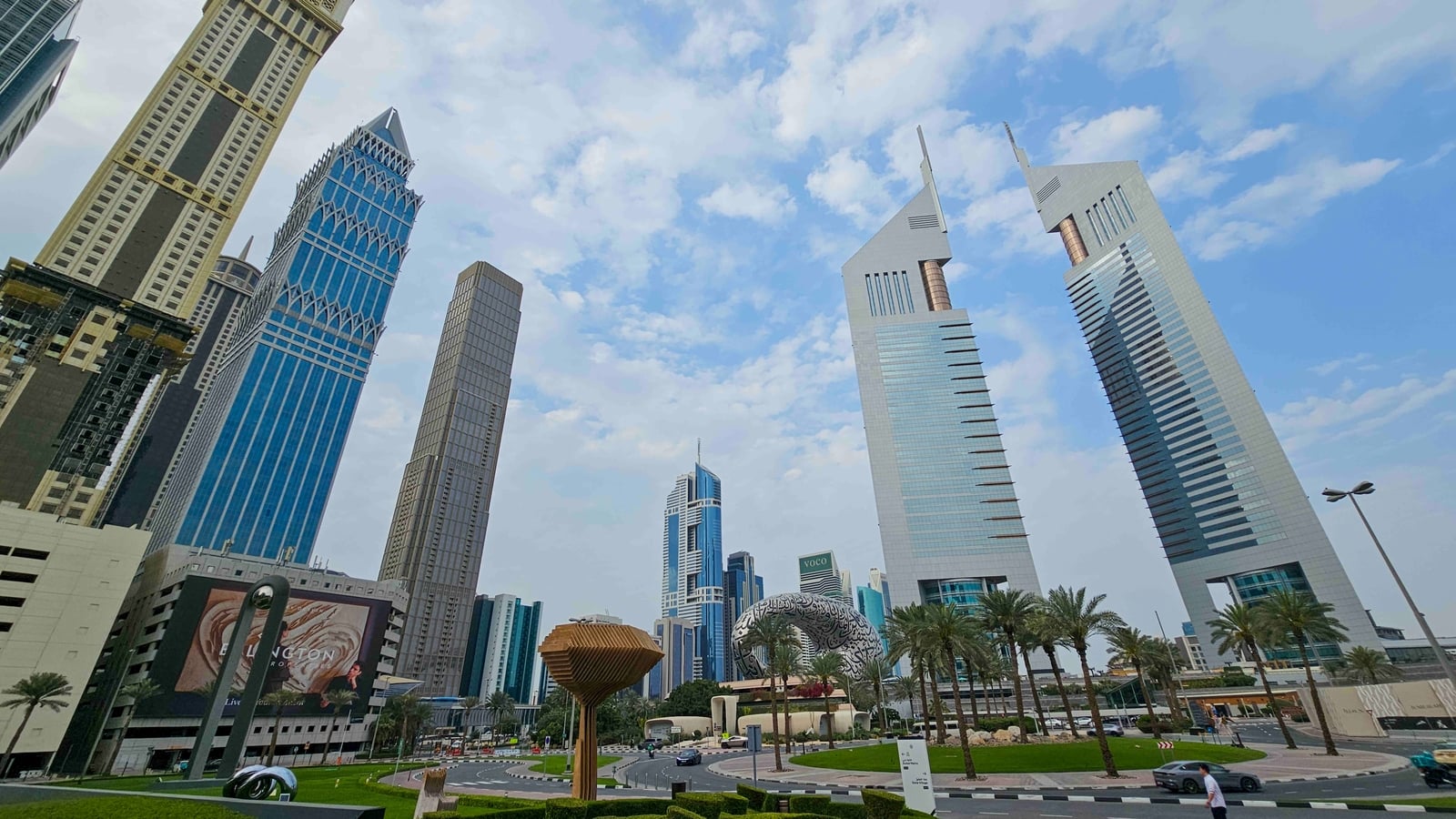
The United Arab Emirates and Qatar said they had intercepted drone and missile barrages as Iran pressed its campaign targeting its neighbours into a fifth day.
The UAE’s ministry of defence said its air defences “successfully engaged today with three ballistic missiles and detected 129 drones, of which 121 drones were intercepted while eight fell on state territory”.
Qatar’s military said it was targeted at dawn by ten drones and two cruise missiles “coming from the Islamic Republic of Iran”, with all of the projectiles intercepted by its forces.
The Gulf Defence Ministry has said that since the conflict started on Saturday, Iran has launched 189 ballistic missiles on the UAE, with 175 intercepted, 13 falling into the sea and one landing on UAE territory.
It added that in the five days, 941 drones were detected, with 876 of those intercepted and 65 falling within UAE territory. The ministry said eight cruise missiles were detected and destroyed over the five days.
Qatar has seen 101 ballistic missiles detected, with 98 intercepted over the last five days, the ministry said.
Some 39 drones were detected, with 24 intercepted. Three cruise missiles were also detected and intercepted, it added.
United Nations panel ‘deeply disturbed’ by death of Iranian schoolgirls
A United Nations panel of experts said it was “deeply disturbed” by the deaths of children in the bombing of the Shajareh Tayyebeh girls’ school in southern Iran, which occurred at the beginning of the war on Saturday.
US Secretary of State Marco Rubio said on Monday that US forces “would not deliberately target a school”, while Israel has said it is investigating the incident.
“The committee is alarmed by reports of strikes on civilian infrastructure, including schools and hospitals, which have injured and traumatised children, and claimed many young lives,” the UN Committee on the Rights of the Child said.
Children must be protected from war, the committee added.
Read more:
Live: Updates as they happen
Flight from Dubai to Dublin a ‘positive development’
Oil prices rise 1% as Iran crisis disrupts Middle East supply
Meanwhile, Iran’s Revolutionary Guards said it has total control of the Strait of Hormuz, a key waterway for global energy transit.
With energy prices already spiking, US President Donald Trump had said the US navy was ready to escort oil tankers through the crucial Gulf shipping route.
Earlier in the war, the IRGC warned ships against entering the strait, and major shipping firms have already suspended transit through the waterway with maritime agencies reporting several ships attacked.
Israel orders people in southern Lebanon to evacuate
Separately, the Israeli military has ordered the residents of southern Lebanon to move to north of the Litaani River.
“Residents of southern Lebanon – you must move immediately to areas north of the Litani River,” one of the military’s Arabic-language spokesman Avichay Adraee posted on X.
Lebanese state media also reported that the Israeli army had entered the southern Lebanese town of Khiam, about 6km from the border, marking its deepest entry since the fighting broke out.
The report comes a day after Israel’s military said it was creating a buffer zone inside Lebanon to protect Israeli resident.
An Israeli strike on a four-storey residential building this morning killed at least four people and wounded six others in the eastern Lebanese city of Baalbek with rescue teams working to pull families from beneath the rubble, state news agency NNA said.
Iran-backed Hezbollah said its fighters fired a salvo of rockets at a gathering of Israeli forces near the Metula area along the frontier in response to Israeli strikes on dozens of Lebanese towns and cities, including Beirut’s southern suburbs.
NNA also reported several Israeli strikes early this morning, including one on a hotel and another on an apartment in eastern Lebanon.
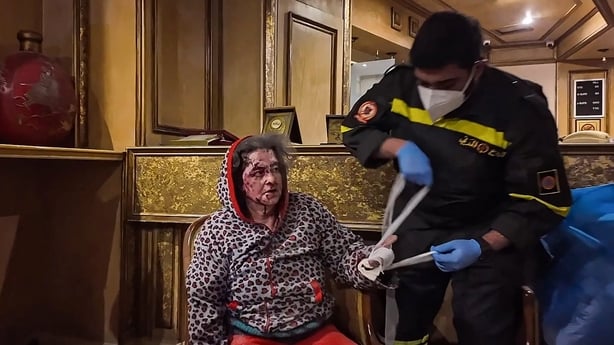
An injured woman is treated in the lobby of a hotel in Beirut which was damaged in an Israeli air strike
Iran announced that a state funeral for supreme leader Ayatollah Ali Khamenei, which had been planned for this evening in Tehran was postponed “in anticipation of unprecedented turnout,” state television reported.
“The farewell ceremony for the martyred Imam has been postponed.
“The new date will be announced later,” Iranian television reported after Mr Khamenei was killed in US-Israeli strikes over the weekend.
Watch: Explosions rock southern Beirut; planes take off from nearby airport
US Admiral Brad Cooper, who leads US forces in the Middle East as the head of Central Command, said the first 24 hours of the ‘Operation Epic Fury’ bombardment of Iran were “nearly double the scale” of the first 24 hours of the ‘Shock and Awe’ campaign that opened the Iraq War in 2003.
“We are seeing that Iran’s ability to hit us, and our partners, is declining, while our combat power, on the other hand, is building,” Adm Cooper said in a video briefing released yesterday evening.
“My overall operational assessment is that we are ahead of our game plan.”
Watch: Smoke rises over Tehran after air strikes hit Iranian capital
Here’s a reminder of some useful contacts for Irish citizens in the Gulf region.
Citizens Registration: citizensregistration.dfa.ie
DFAT Crisis Team phone number: 01-4082000
Travel advice for Irish citizens is available here
Adm Cooper said Iran’s air defences had been badly degraded, its navy had no operational vessels on key waterways after 17 were sunk, and that more than 2,000 Iranian targets had been hit.
Some 50,000 US troops were taking part in operations, and that “more capabilities” were on the way, he said.
Iranian state media said deaths from the attacks had reached 1,045, including 165 girls killed on the war’s first day when their school was bombed, the highest toll among several civilian sites reported to have been hit.