
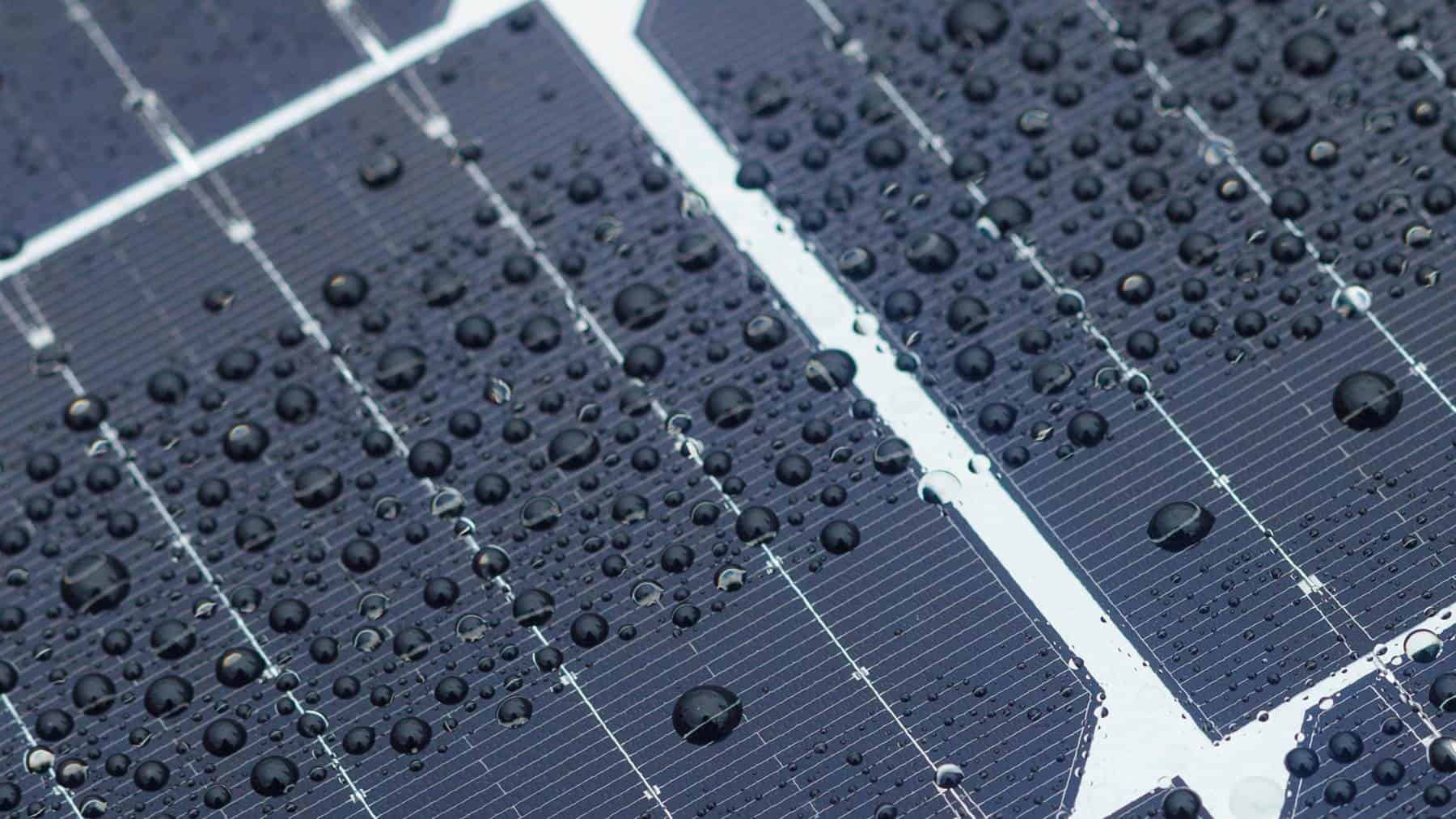

For as long as we’ve been capturing the sun’s rays, the clouds have been the enemy. When the sky turns gray and the first drops fall, the steady stream of electrons from traditional solar panels slows to a trickle. But a team of scientists in Seville, Spain, has decided that instead of fighting the rain, solar technology should embrace it.
Researchers from the Nanotechnology on Surfaces and Plasma Laboratory at the Institute of Materials Science of Seville (ICMS) have developed a hybrid device that actually feeds on downpours. By applying a specialized, “Teflon-like” film just 100 nanometers thick to a high-efficiency perovskite solar cell, they have created a panel that harvests light when it’s sunny and kinetic energy when it pours.
The new panel utilizes the triboelectric effect. When a droplet strikes and slides across the specially treated surface, it creates friction and has a charge difference. For instance, a droplet may leave behind a positive ion while the surface is negatively charged. The charge is then harvested and converted into electricity.
The Perovskite Paradox
To understand why this is a “game changer,” you have to look at the material inside. Halide perovskites are the darlings of the renewable energy world. They are cheaper to make than silicon and have seen their efficiency skyrocket from under 4% to over 25% in just a few years.
However, they are notoriously delicate. “The inherent vulnerability of halide perovskites to moisture and environmental stressors remains a critical barrier to their widespread deployment,” the researchers note in their paper published in Nano Energy.
Exposure to humidity usually turns these high-tech crystals into a yellowish, useless sludge of lead iodide within minutes. The obvious implication is that these solar panels are extremely vulnerable to rain, risking damage if their coatings don’t stop the water. This makes this recent work that flips the script all the more amazing.
An Energy-Harvesting Shield for the Storm
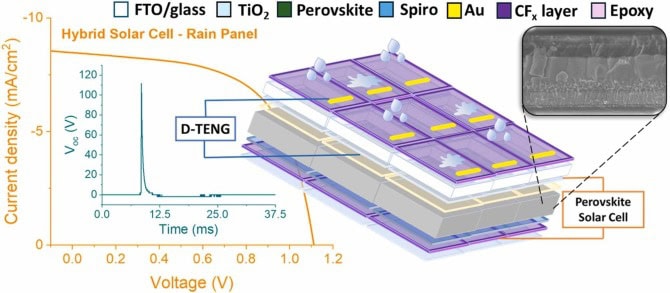 Schematic of the layering of their film-covered solar cell. Credit: Núñez-Gálvez et al., 2026.
The team at ICMS used a technique called Plasma Enhanced Chemical Vapour Deposition (PECVD) to grow a protective fluorinated polymer layer directly onto the cell. This process happens at room temperature and is entirely solvent-free. This means it doesn’t damage the sensitive layers of the solar cell during application.
This 100-nanometer coating performs a triple-duty. It acts as a hydrophobic shield, bumping the water contact angle to 110°, which effectively doubles the cell’s resistance to moisture. It reduces reflection and increases light transparency to over 90%, actually helping the cell absorb more sunlight than if it were bare. And it functions as a Drop Triboelectric Nanogenerator (D-TENG). When a raindrop hits the surface and slides off, the friction creates an electrical potential.
×
Thank you! One more thing…
Please check your inbox and confirm your subscription.
“Our work proposes an advanced solution that combines perovskite solar cell photovoltaic technology with triboelectric nanogenerators in a thin-film configuration, thus demonstrating the feasibility of implementing both energy harvesting systems,” explains Carmen López, a lead researcher at ICMS.
Turning Drops into Volts
The team demonstrated that the optimized coating can generate open-circuit voltage peaks of up to 110 volts when hit by a single drop of rain. While the total power density is relatively low — about 4 milliwatts per square centimeter — it is more than enough to keep low-power electronics humming without a battery.
In their lab, the researchers built a self-charging prototype that used a custom “boost converter” to step up the voltage. The solar-rain hybrid could continuously power an array of red LEDs using the sun, while a green LED array flashed intermittently with every “thump” of a falling drop.
The encapsulated cells retained over 50% of their initial efficiency even after 10 days of exposure to high heat and humidity. In a “torture test” involving liquid water immersion, the hybrid device maintained its performance for over 15 minutes, whereas unencapsulated cells failed almost instantly.
This technology isn’t intended to replace the massive silicon arrays on your roof just yet. Instead, it’s a direct shot at the growing “Internet of Things” (IoT). As we scatter millions of sensors across bridges, farm fields, and smart cities to monitor everything from pollution to structural integrity, we face a “battery crisis” — we can’t keep going out to change them.
“Its implementation in so-called smart cities is feasible, such as in signage, autonomous auxiliary lighting or monitoring,” says researcher Fernando Núñez. “It would also be applicable for distributed energy structures in remote, inaccessible or isolated areas, such as marine stations”.
By harvesting “kinetic energy from the kinetic impacts of rain,” these panels can provide a “rugged access to these tiny streams of energy” in places where wires or traditional batteries simply won’t work, the researchers added. It moves us away from a world where devices just sleep when the weather is bad, and toward a future of better energy autonomy.