
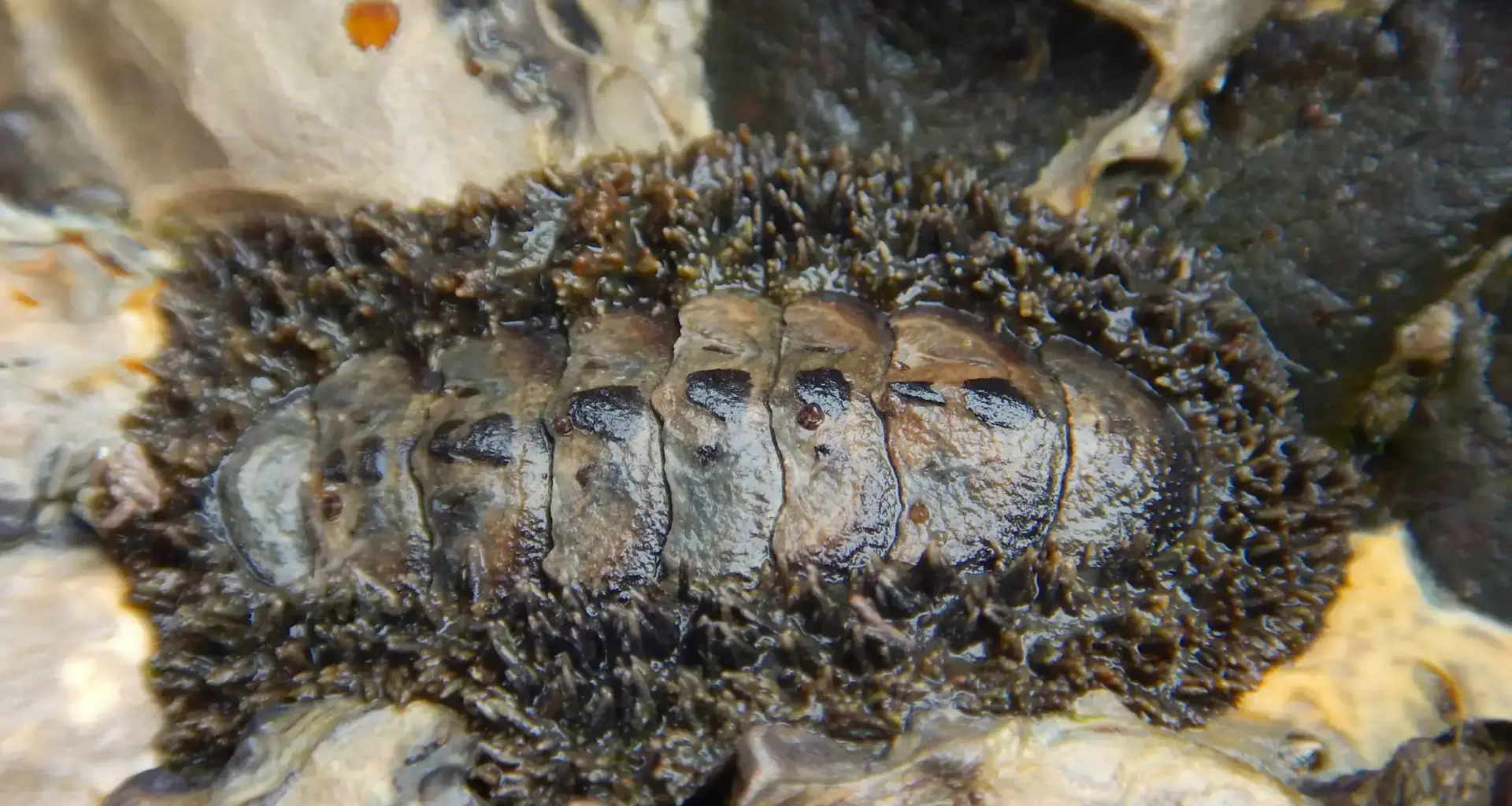
 Typical chiton (in this case Acanthopleura spinosa) in its natural habitat. Credit:
These creatures have watched the world go through bouts of radical change for 500 million years. They saw the rise and fall of the dinosaurs, the first hesitant steps of our ancestors onto dry land, and the shifting of entire continents. These are chitons, marine mollusks that look like a cross between an armored isopod and a prehistoric trilobite.
Chitons are often called “living fossils” because they have retained their basic ancestral blueprint for roughly 300 million years. They’ve changed very little in this time. They are the ultimate survivors, sporting eight overlapping dorsal valves that act like a suit of articulated plate armor. While over 1,300 species have been recorded throughout geological history, more of them are alive today than are found in the fossil record.
Now, scientists in South Korea have pulled back the curtain on a brand-new member of this ancient lineage of living fossils: Acanthochitona feroxa.
Ancient Armor Bearers
 Morphological comparison of five Acanthochitona species. Credit: Biodiversity Data Journal, 2026.
Chitons belong to a class called Polyplacophora, which roughly translates to “bearing multiple plates”. The name is apt, as chitons are classified as having eight plates on the back, made up of a tough calcium carbonate-based mineral called aragonite. These plates overlap slightly on both sides, providing an armour that protects the soft body and is flexible to accommodate movement.
Like other marine snails, chitons crawl along on a muscular foot that occupies the entire ventral (lower) surface and adheres to the hard substrate strongly.
Their size ranges widely from less than two centimetres to 30 cm long. The largest chiton, commonly called the gumboot chiton, measures over 30 cm, can weigh as much as 2 kg, and is believed to live up to 40 years.
While they lack functional eyes, some species have hundreds to thousands of tiny eyespots called ocelli. Ocelli are basically aragonite (calcium carbonate) lenses derived from the shell plates. They are like photoreceptor cells, capable of sensing changes in light. While incapable of true vision, these ocelli can sense shadows and differences in light intensity, allowing the chiton to perceive an approaching predator.
A “Fierce” Discovery in the Intertidal Zone
The new discovery, led by biologists I Hyang Kim and Ui Wook Hwang of Kyungpook National University, occurred right in the intertidal zones of the South Korean coast. Most chitons are found in such intertidal areas, although a restricted few species have also been observed near deep-sea hydrothermal vents at depths greater than 5,000 meters.
×
Thank you! One more thing…
Please check your inbox and confirm your subscription.
The name feroxa comes from the Latin ferox, meaning “fierce” or “bristling”.
It’s a fitting title. Members of the genus Acanthochitona are famous for the 18 tufts of sharp, aragonitic bristles that sprout from their fleshy girdle. These tufts make the chiton a “prickly pear” for any predator bold enough to try and pry it off a rock.
For all this time, A. feroxa likely hid in plain sight, mistaken for its close relative, Acanthochitona defilippii. To the naked eye, they look nearly identical. But when the researchers traded their magnifying glasses for scanning electron microscopes and genetic sequencers, the cryptic nature of the species was revealed.
“These molecular techniques have been proven potent in uncovering cryptic species within groups that exhibit morphological similarities,” the researchers noted.
Reading the Mitochondrial Map
 Haplotype network indicates three distinct genetic clusters corresponding to A. defilippii, A. rubrolineata, and A. feroxa sp. C The phylogenetic network tree, reconstructed using the neighbor-net algorithm without an outgroup, also shows three different genetic lineages. Credit: Marine Life Science & Technology, 2026.
Why is it so hard to tell chitons apart? Traditionally, scientists relied on physical traits like the structure of the shell plates (valves), the shape of the radula (the iron-clad “tongue” used to scrape algae), and the texture of the girdle. However, there are individual differences within a single species of chiton that can easily lead to taxonomic errors.
To solve the mystery, Kim and Hwang looked at the mitochondrial genome, the genetic blueprint passed down from the mother. Because mitochondrial DNA mutates at a predictable rate, it acts like a high-resolution clock for tracking how species diverge over time.
“The findings of this study can provide foundational data for future molecular investigations into Acanthochitona, offering insights into the complete mitochondrial genomes of these five species and their phylogenetic relationships,” Kim and Hwang stated.
By sequencing the genomes of five different species, they found that A. feroxa had distinct differences in its dorsal spicules — which were rounded rather than pointed — and unique geometric patterns in its radula and shell plates. This genetic data acts as a biological CAD file, hard-coding the specific instructions that build its body.
Deep Time and Rising Seas
The research does more than just add a name to a long list of chitons; it places A. feroxa into a much broader story of Earth’s history. By using a “molecular clock” model calibrated with fossil records, the team estimated that the Acanthochitona genus began to branch out during the Late Cretaceous period, about 92 million years ago.
This was a time of massive environmental upheaval. Global temperatures were high, and rising sea levels were creating vast, shallow marine habitats. These new underwater real estate opportunities likely allowed chitons to diversify into new ecological niches.
While A. feroxa prefers the muddy stones of South Korea’s intertidal zones, other chitons have conquered much more extreme environments. Some species can survive 7,000 feet below the surface, living in total darkness on sunken wood.
Crowdsourcing the Tree of Life
 Left: Habitus of the newly found deep-sea chiton Ferreiraella populi. Right: Close up photo of the worms on the tail valve of Ferreiraella populi. Credit: Senckenberg Ocean Species Alliance
The discovery of A. feroxa highlights a growing trend in biology: the use of advanced tech to find what we’ve missed. But science is also becoming more social. While A. feroxa was named by its discoverers, another recent chiton discovery, Ferreiraella populi, had its name chosen by the public.
In a collaboration between the Senckenberg Ocean Species Alliance and YouTuber Ze Frank, over 8,000 suggestions were submitted for a new deep-sea chiton. The winning name, populi, translates to “of the people.”
Whether found by social media fans or by biologists in a lab in Daegu, these discoveries prove that the “living fossils” of our oceans still have plenty of secrets to share. As Kim and Hwang’s work shows, there are likely many more species out there, blending in with the rocks, just waiting for their DNA to be read.
The findings were reported in the journal Marine Life Science & Technology.