

The dawn of a new era in space exploration is here with the launch of Mauve, the world’s first private space telescope. Developed by the London-based Blue Skies Space, this cutting-edge telescope promises to revolutionize the study of stars and potentially habitable exoplanets. Recently, Mauve completed its first successful observation of the star eta Ursa Majoris, marking the beginning of its mission to explore the universe.
The Evolution of Commercial Space Telescopes
Space exploration has long been dominated by government agencies, but the landscape is rapidly changing. Private companies are now stepping into territory once exclusively held by organizations like NASA and the European Space Agency. Blue Skies Space’s Mauve telescope exemplifies this shift, with its commercial nature providing more flexible, customer-driven science. Marcell Tessenyi, CEO of Blue Skies Space, explained to the strategy behind selecting eta Ursa Majoris for Mauve’s first observation, stating:
“We wanted to look at a stable star, which behaves in a constant way over time and for which there has already been high-quality spectra collected from other instruments in the past,” he told Space.com. This careful approach sets the stage for groundbreaking research, with Mauve providing continuous, targeted data on stars to supplement the work of larger, more complex space missions.
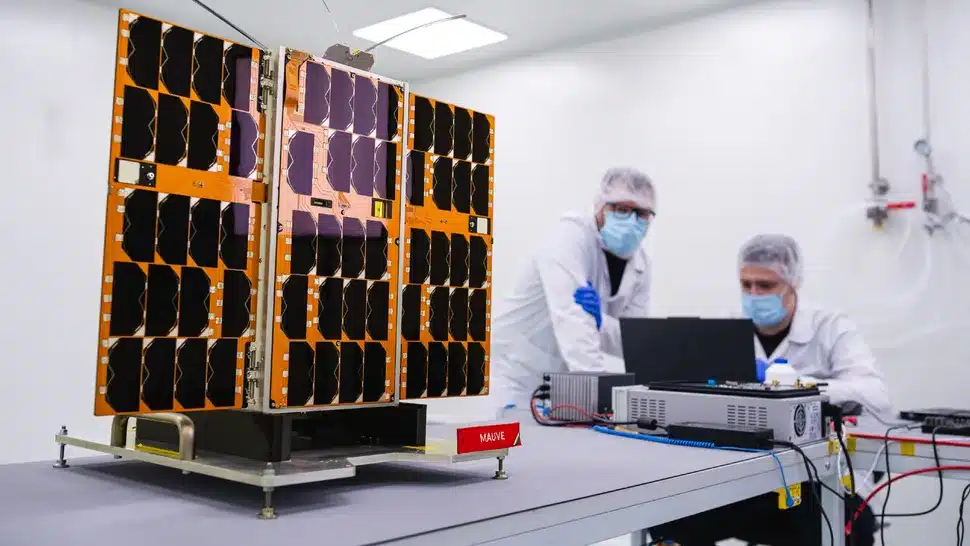 The Mauve space telescope is about the size of a small suitcase.
(Image credit: Blue Skies Space)
Unprecedented Observations: Ultraviolet Light and Stellar Flares
Mauve’s first scientific task was to measure the ultraviolet light emitted by eta Ursa Majoris, one of the brightest stars in the Ursa Major constellation. Unlike visible light, ultraviolet emissions can offer valuable insights into stellar flares, the bursts of high-energy radiation that can affect planets within a star’s habitable zone. These flares may even determine whether exoplanets around such stars could support life. Ultraviolet observations are crucial because they allow scientists to study the high-energy radiation that interacts with the magnetic environments of stars.
“We are now doing the same set of measurements with all kinds of different stars to work out the behavior of the instrument,” said Tessenyi.
By doing so, Mauve will help identify stars that are more likely to harbor planets with conditions suitable for life.
 The Mauve commercial space telescope measured ultraviolet light from one of the brightest stars in the Ursa Major constellation. (Image credit: ESA/Blue Skies Space)
The Role of Private Space Companies in Space Science
The rapid development of low-cost, small satellites like Mauve is reshaping how space science is conducted. Unlike the large, decades-long projects led by government agencies, commercial space telescopes can be developed and launched in a fraction of the time. The Mauve telescope, for instance, was built and deployed within just three years. This quick timeline stands in stark contrast to the typical decades-long wait for government-funded missions. Tessenyi believes this new model will create more opportunities for scientific exploration:
“It’s a fascinating opportunity that we have here because, obviously, the space sector has evolved a lot over the last decade, whether it is regular cost-effective launch opportunities or the commoditization of lower-cost platforms for low Earth orbit satellites,” he said.
Mauve’s development and future missions demonstrate that private companies are poised to contribute significantly to space science.
Collaboration Between Government Agencies and Private Enterprises
Despite the growing presence of commercial space ventures, Tessenyi emphasizes the importance of collaboration between private companies and government agencies. While companies like Blue Skies Space are pushing forward with innovations in cost-effective satellite technology, government missions still lead in terms of groundbreaking space research.
“The space agencies are doing an incredible job with pushing the technology, developing these incredibly clever and complex facilities like James Webb and others, which are really progressing knowledge and technological capabilities,” said Tessenyi.
This partnership between government and private entities could maximize the potential of space exploration, creating a harmonious balance that fosters scientific discovery.
The Future of Space-Based Data and Exoplanet Research
Looking ahead, Blue Skies Space is not stopping with Mauve. The company is already working on its next mission, called Twinkle, which will focus on observing exoplanets. Twinkle will be equipped with advanced capabilities to study the atmospheres of these distant worlds, providing crucial data on their compositions and potential habitability. The success of Mauve could open up new avenues for space research, allowing private companies to address scientific questions that were once too costly or complex for traditional space agencies to pursue. This trend towards privatization in space exploration is not just a technological evolution; it’s also a philosophical shift towards a more inclusive approach to scientific discovery.
The Power of Reusing Existing Technologies in Space
One of the most significant advantages of private space companies is their ability to leverage existing technologies from previous government missions. Rather than starting from scratch, companies like Blue Skies Space can build on the innovations and infrastructure developed by agencies like NASA. This approach not only saves time and resources but also accelerates the pace of space exploration. “We, on the other hand, are operating more in the domain of reusing existing components, benefitting from historic investments from the agencies into technologies, and reusing them in novel ways to try to increment the provision of data,” Tessenyi noted. By repurposing these tried-and-true technologies, private companies are able to contribute valuable data to the scientific community while keeping costs manageable.