
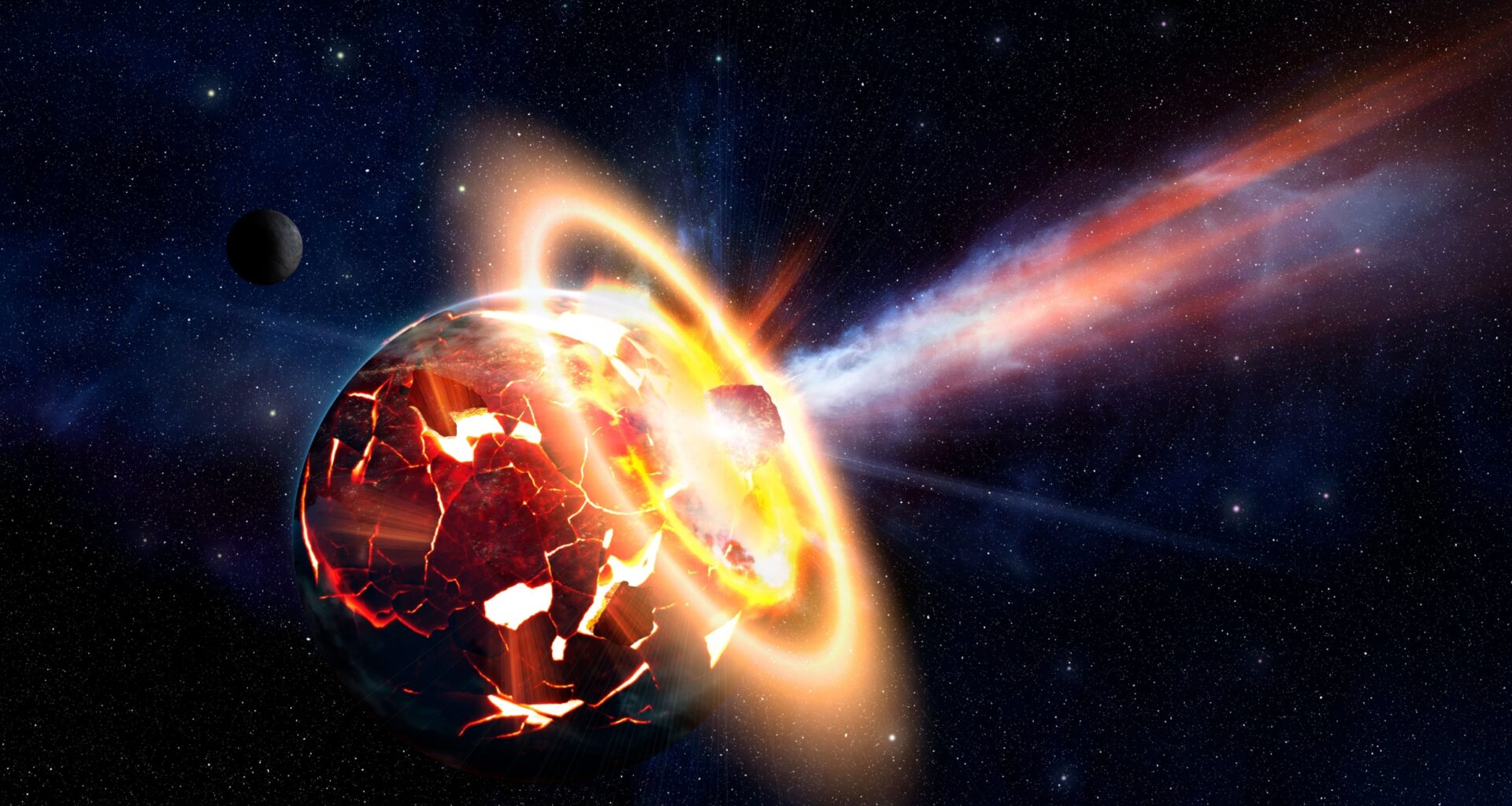
Tiny organisms hidden inside rocks blasted off a planet by an asteroid impact might survive both the violent launch and the long journey through space, according to a new lab study.
In experiments designed to mimic the ejection of debris from Mars, researchers found that a famously tough bacterium endured crushing pressures far beyond what many scientists expected.

The findings strengthen the idea that life could travel between planets and raise new questions about contamination risks during space missions.
Life hitchhiking between planets
The research, led by scientists at Johns Hopkins University, explores a long-debated concept called lithopanspermia – the idea that microbes could hitch a ride inside impact debris traveling from one planet to another.
Scientists already know that powerful asteroid strikes can blast rocks into space, and several meteorites discovered on Earth originated on Mars.
The lingering question has been whether any living cells could survive the extreme shock of being launched off a planet in the first place.
“Life might actually survive being ejected from one planet and moving to another,” said senior author K.T. Ramesh.
“This is a really big deal that changes the way you think about the question of how life begins and how life began on Earth.”
Testing an old space theory
Impact craters cover much of the solar system. Mars, in particular, is heavily cratered, which is one reason scientists keep returning to it when they discuss past impacts and the possibility of ancient life.
If an asteroid hits a planet with enough force, it can launch fragments into space. Some of that debris can eventually collide with other bodies.
That mechanism is not speculation. It is backed up by the existence of Martian meteorites on Earth. But the biological part of the story has remained murkier. Could a microbe survive being slammed, squeezed, and rattled as its host rock is blasted free?
Past experiments have not settled the issue, partly because they often used common Earth organisms, not something that resembles a plausible survivor in a Mars-like environment.
The Johns Hopkins team wanted a test that felt closer to the real stresses of a planetary launch. They focused on one main obstacle: pressure. If microbes can’t handle the extreme shock pressures of impact ejection, the rest of the journey doesn’t matter.
Choosing a tough microbe
To make the experiment realistic, the team selected a microorganism already known for thriving in conditions that would kill most life.
They chose Deinococcus radiodurans, a desert bacterium found in the high deserts of Chile. It has a thick outer shell and a striking ability to repair itself after damage.
It’s also famous for tolerating extreme cold, dryness, and high radiation – the kinds of stresses that come up when people imagine life enduring space-like environments.
“We do not yet know if there is life on Mars, but if there is, it is likely to have similar abilities,” Ramesh said.
This choice matters because it shifts the question. The study is not asking whether an average microbe could survive. It’s asking whether the kind of organism most likely to endure alien extremes could make it through the launch phase of lithopanspermia.
Simulating Mars impact pressures
The researchers built a setup designed to recreate the pressure spike that occurs when material is violently ejected during an impact.
They sandwiched the bacteria between metal plates. Then they fired a projectile at the plates using a gas gun. The projectile reached speeds of up to about 300 miles per hour, generating pressures between one and three gigapascals.
To give a sense of scale, they compared it with one of Earth’s most intense natural pressure environments. The bottom of the Mariana Trench sits at roughly a tenth of a gigapascal. Even the lowest pressure in this experiment exceeded that by more than ten times.
After each shot, the team checked whether the bacteria were still alive. They also examined the genetic material of survivors, looking for hints about what the cells endured and how they managed to remain viable.
A microbe that’s hard to kill
The microbe turned out to be stubbornly difficult to destroy. The bacteria survived nearly every test at 1.4 gigapascals. Even at 2.4 gigapascals, about 60 percent survived.
At the lower pressure level, the team saw no signs of damage. At the higher pressures, they did observe ruptured membranes and internal injury in some cells, but many still made it through.
“We expected it to be dead at that first pressure,” said lead author Lily Zhao. “We started shooting it faster and faster and kept trying to kill it, but it was really hard to kill.”
In a twist that underlines the point, the lab hardware failed before the organism did. The steel configuration holding the plates fell apart before the bacteria did.
The researchers note that when asteroids strike Mars, ejected fragments likely experience a wide range of pressures. Some may reach around five gigapascals, while others could go much higher.
In this study, the bacterium “easily survived” almost three gigapascals, a level the team describes as higher than what earlier work suggested was possible.
“We have shown that it is possible for life to survive large-scale impact and ejection,” Zhao said. “What that means is that life can potentially move between planets. Maybe we’re Martians!”
New concerns for Mars missions
The findings don’t prove that life has traveled between planets. They also don’t show what happens over long time spans in space, where radiation, vacuum exposure, and temperature swings can be relentless. But they do strengthen one key link in the chain: survival during the violent launch.
That has consequences for planetary protection. Space agencies already take precautions to avoid contaminating worlds that might support life.
Missions to Mars, for example, face strict controls meant to prevent Earth microbes from hitching a ride. And when samples are brought back to Earth, there are stringent containment measures in case something unfamiliar is present.
This study adds another complication. If material from Mars can naturally reach other places, it may also reach targets that have looser restrictions today.
The team points to Mars’s moons, especially Phobos. Because Phobos orbits close to Mars, ejecta that reaches it may have been exposed to less pressure than what would be required to reach Earth. That could make it an easier destination for surviving microbes.
Testing tougher microbes next
The researchers are not done with the question. Next, they want to explore whether repeated impact-like shocks could produce hardier microbial populations over time, or whether organisms can adapt to this kind of stress.
They also want to test other life forms, including fungi, to see if this resilience is unique or more widespread.
For now, the study offers a striking reminder. The boundary between planets may be less biologically sealed than we like to imagine. Under the right conditions, a small survivor inside a flying rock might just make the trip.
The study was published in the journal PNAS Nexus.
—–
Like what you read? Subscribe to our newsletter for engaging articles, exclusive content, and the latest updates.
Check us out on EarthSnap, a free app brought to you by Eric Ralls and Earth.com.
—–