
SINGAPORE – Seniors requiring long-term care services from different providers can now benefit from a one-stop service through a common touchpoint.
This means they no longer have to undergo multiple assessments to receive different long-term care services, even if these come from different providers.
“Such an approach will ensure seniors benefit from a seamless experience and better coordinated care”, said Senior Minister of State for Health Tan Kiat How during the debate on his ministry’s budget.
The Ministry of Health (MOH), together with the Agency for Integrated Care (AIC), had earlier reorganised the community care sector into 84 smaller sub-regions.
Each sub-region has about 8,000 to 16,000 seniors.
They may require a range of long-term care services depending on their care needs:
(a) active ageing or befriending services, typically delivered to the elderly who are well, by an active ageing centre;
(b) day care services, delivered to frail seniors, by a senior care centre;
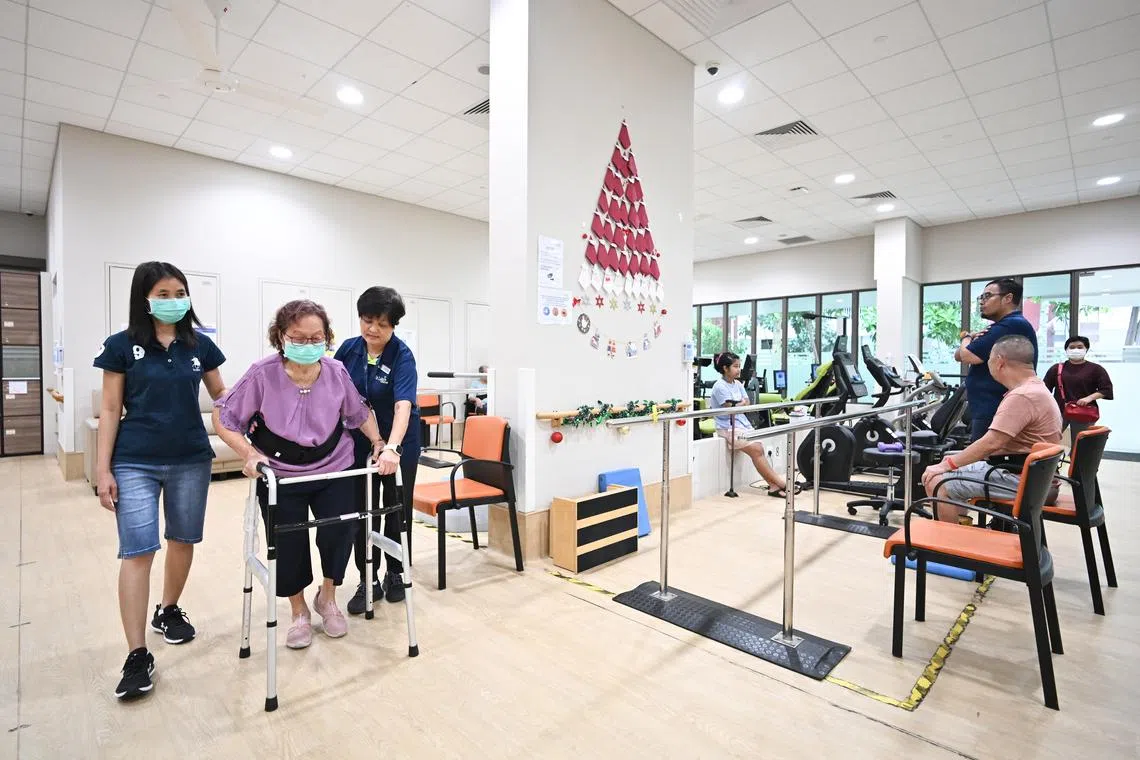
(c) rehabilitation services, for those who are frail, by a day rehab centre; and/or
(d) personal care services or support for activities of daily living, for home-bound seniors, by a Home Personal Care (HPC) provider.
This means that seniors and their caregivers might face challenges to find out the services they are eligible for, and which providers to approach. They may also be subject to care assessments by different providers, even if their care needs have not changed significantly.
MOH has now appointed an Integrated Community Care Provider (ICCP) in each sub-region, which will offer the suite of baseline services to all seniors, and help coordinate care for those who require multiple services.
In addition, from April 2026, seniors will be put through only one comprehensive assessment if they require long-term care services.
From October 2026, the ICCP will also help each senior with long-term care needs to develop a dedicated and holistic community care plan, which will inform different providers of the care goals of the senior.
In turn, this will ensure that if, and when, there is a new or different care need, the person can continue to receive timely care and support.
MOH also plans to leverage technology to improve delivery of community care and support seniors to age well in the community.
For instance, from April 1, 2026, eligible seniors can benefit from the enhanced Home Personal Care (HPC+) service by obtaining a referral from their healthcare providers, approaching HPC+ service providers directly, or contacting AIC.
HPC+ service supports frail seniors to age well at home through round-the-clock technology-enabled monitoring for falls and incidents.
Seniors will also receive assistance with activities of daily living, such as housekeeping and showering.
More than 5,600 seniors are expected to benefit from HPC+.
In January, the Government set out new legislation making it compulsory for all healthcare service providers, including private specialist clinics and dental clinics, to
contribute patients’ key health information to its national repository,
the National Electronic Health Record (NEHR) system.
As at Oct 31, 2025, about 70 per cent of the more than 2,000 general practitioner (GP) clinics have joined the effort, mainly due to the launch of Healthier SG in July 2023 where it was made mandatory for clinics to be part of the NEHR. As of February 2026, there were about 1,100 Healthier SG clinics.
To help providers meet the mandatory requirements under the Health Information Act, MOH has set aside up to $45 million over the next four years to provide one-off funding support.
In comparison, the Government set aside over $1 billion to establish Healthier SG, including giving GPs one-time support for the necessary IT enhancements and capability building.
From July 2026, providers can start to apply for funding through the NEHR Connect Grant, aimed at defraying the costs of adopting a certified health information management system, or enhancing their existing systems to meet the Act’s requirements.
Those who have previously received similar MOH funding support for NEHR data contribution will not be eligible for the new grant.
MOH said there is other existing funding support, such as those from Enterprise Singapore and the Cyber Security Agency of Singapore, to aid providers in meeting the Act’s cybersecurity and data security requirements.
Based on the typical set up of a clinic run by a single GP and with five employees, the total eligible funding across different schemes could reach about $20,000. This amount includes the fixed amount of $8,400 in MOH grant for a GP clinic.
Based on information on MOH’s website, the list of cyber and data security requirements includes installing software updates promptly, backing up and separately storing essential data, and equipping staff with cyber-hygiene practices as the first line of defence.
The revised list will be published in the first quarter of 2026. MOH is also developing resources like infographics to help providers meet these obligations.
The ministry has laid out the timeline for the various healthcare providers to start contributing to NEHR and comply with the requirements, based on the readiness of the different providers.
Hospitals, GP clinics and laboratories are to come onboard by September 2027; nursing homes and dialysis centres by September 2028; and outpatient dental clinics and retail pharmacies by March 2030.