
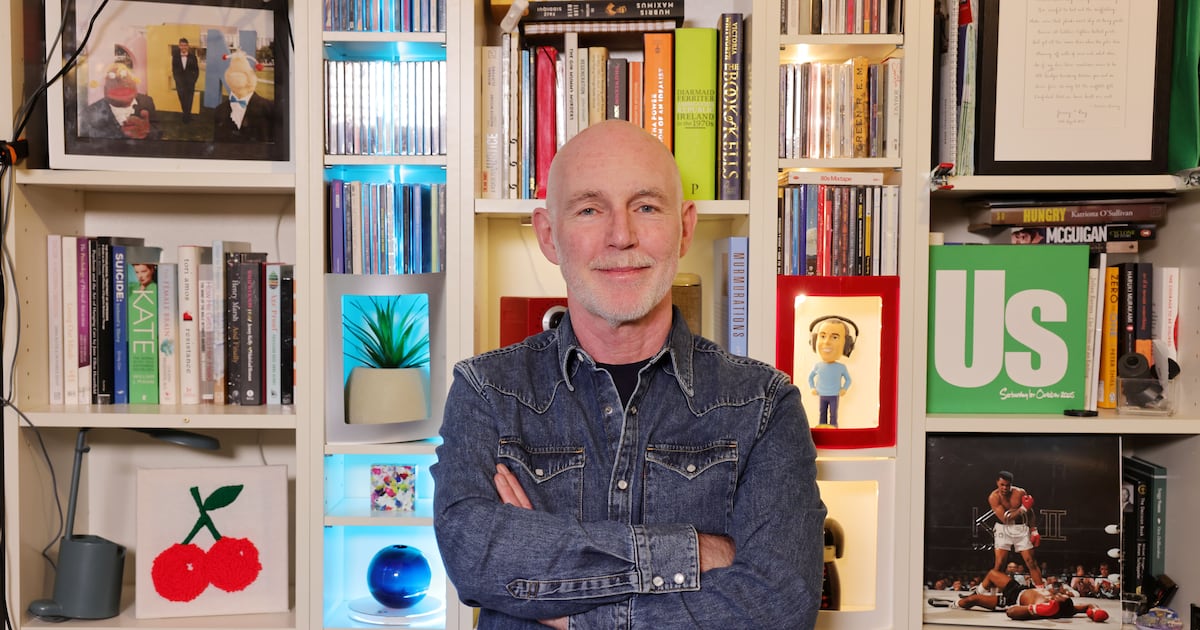
Ray D’Arcy says he is still hurt about how things ended for him at RTÉ last October. “It was a shock. I was disappointed. None of that has changed.” And yet, he is also excited to launch two podcast series, Ray D’Arcy Daily, from Monday, and Being Human, an interview series, a few weeks later. He’s gone from €250,000 a year to, right now, earnings unknown, but he thinks the change was a good thing.
We’re in his large, bright kitchen where an elderly dog sleeps in a basket nearby. Interviewing D’Arcy is like listening to him on the radio. He wears his heart on his sleeve. When he is passionate about something (like audio-technology or music or interviewees or his family) he sounds passionate. When he says he is hurt, he sounds hurt. He never really fit the guarded, carefully curated mode of the traditional RTÉ presenter. He’s blunter, perhaps a bit more emotionally open. It’s his thing. It’s possibly why he had to find his radio identity and his audience at Today FM, after eight years on RTÉ’s The Den, before being enticed back to RTÉ in 2014.
Last year was rough for D’Arcy. His mother, Mary, died in July. “I’ll start crying now, but my mother was just this amazing human,” he says. “There were nine of us. She was a particularly bright woman. She was a compassionate woman. My dad [a soldier] was a bit of a prick, a heavy drinker, other stuff as well, and she managed to raise us all. And we’re mostly normal, whatever normal is … She was this amazing community person, but not in that sort of hands-up way … In the eulogy, I went through everything she had done in her life, while raising us with a cleaning job at the big house down the road. Back in the days when it was an affliction to have brains, they would have said about us, ‘Oh, you’re one of the Darcys, brains hanging out of your ears.’ And the older people would say, ‘You got them from your mother’” He sighs. “You go, ‘things come in threes’ and these were major things. I’ve lost my job and my mother. What’s going to happen next?”
D’Arcy wasn’t particularly happy in RTÉ, he says now. “Jenny [his wife, producer and frequent on-air collaborator] knew, because she’s the person who knows me best. She was constantly saying to me, ‘Get out.’ But I would never have left of my own accord, because I’m risk averse. I thought that if I left RTÉ that the sky would fall in, but it didn’t. It was sort of an enforced liberation.”
What didn’t he like about being in RTÉ? “I thought they knew what they were getting [when they hired him]. I was myself on Today FM. We had developed this lovely relationship with our listeners, so they felt they could say anything to us … And I was very vocal. I hung up on one of the Healy-Raes because he was suggesting that people down the country should be allowed to drink and drive … It became quite obvious very quickly that a lot of people in RTÉ had never listened … It became very obvious very quickly that there were people just listening, waiting for me to say something [controversial].”
He says he sometimes found what he calls “the both-sidedness thing” difficult. There were complaints from listeners. “Some were justified,” he says. Some complaints about a discussion of abortion on his show were upheld by the Broadcasting Authority in 2016. “We would have had people on telling their stories about abortion … I’m not saying this as a badge of honour, but we got the most complaints in the smallest amount of time in RTÉ.”
He says he ultimately found the atmosphere stifling. “I was constantly checking myself to see what I was saying. [Management in RTÉ] are fearful … They don’t want to be caught out. They don’t want anything to happen on their watch … You’re working in a place where you’re judged on your results and yet you’re not given the agency to do what you want to do. My team were constantly having to refer upwards. ‘Can we do this?’ And it became slightly oppressive. Jenny kept saying that to me, ‘You’re not the person who you used to be’. And I said, ‘Well, I have to work within the constraints of the organisation.’”
RTÉ says it would “absolutely refute” the claim that management was “fearful”.
Despite his unhappiness D’Arcy says he was stunned to find himself being told by RTÉ’s head of audio, Patricia Monahan, that his show would not be continued in the new year. It was not the negotiation he expected, he says. “Imagine you’re in a hot-air balloon, and the floor falls out of it. I could feel myself going ashen faced. I had some things in my head that I was going to say, because I thought there was going to be a bit of argy-bargy about money. There was talk two years previously that they were aiming to make everybody staff. So I was prepared for that [conversation]. And I was prepared for somebody talking about the [listenership] figures and I had this thing that, when we started, we were on half of what Liveline had and when we finished, we were on two thirds. That was all in my head. But I didn’t say any of it because I was just so shocked.”
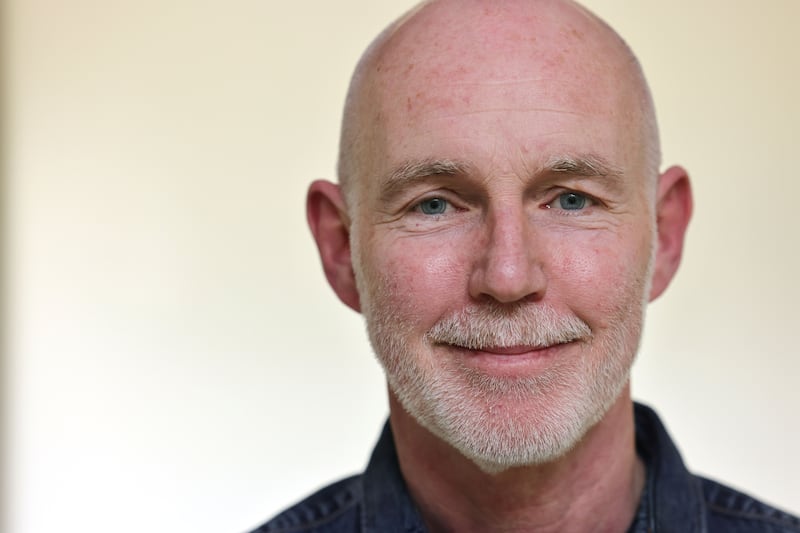 Ray D’Arcy: ‘I thought that if I left RTÉ that the sky would fall in, but it didn’t.’ Photograph: Alan Betson
In a statement RTÉ says: “RTÉ takes issue with the characterisation of events as outlined by Ray D’Arcy and had previously clarified these details with a number of media outlets (including The Irish Times).
“Ray was aware for some time, in the context of both his upcoming contract negotiation but also in context of changes coming to RTÉ Radio 1 that nothing was guaranteed post the end of his current contract.”
RTÉ maintains that this was communicated to D’Arcy on several occasions. “Initially at the time of agreeing his contract in 2023, Ray was told that the incoming director of Audio would likely want to make changes. From her initial meetings with Ray (the first of which was in November 2024), director of Audio, Patricia Monahan made it clear that everything was on the table in the context of changes to RTÉ Radio 1 and there were no guarantees beyond the end of the existing contract. Subsequent to that there were a number of similar communications with Ray. Those communications were acknowledged. Ray asked that, whatever the decision, it be communicated in good time.”
D’Arcy says the possibility of his contract not being renewed was not clearly communicated to him. “I came back after a long break because my mother had died,” he says. “The figures had been out and they’d gone down. I said to the producer in charge ‘What was the feedback?’ And they said, ‘They’re happy. Keep doing what you’re doing.’”
The RTÉ statement says that on September 29th, 2025, three months out from the contract end date, December 31st, “RTÉ communicated it would not renew the current contract but wished to explore other opportunities”.
D’Arcy says he asked for, and got, another meeting with Monahan. “I actually wrote down what I was going to say, because I didn’t want the emotion of the situation to carry me away … And the opening line was, ‘I encourage my children to call out bad behaviour, so I feel I have to say this …’”
He pauses. “I’m not going tell you what the rest was … They gave me an option to go on Gold [a digital station playing hits from the 1950s to the 2000s], and with respect to everybody who works on Gold, to me it felt like an insult. And in good conscience, I couldn’t have taken the amount of money they were offering me to go on Gold just to play music.” He says “it was so much, for Gold”.
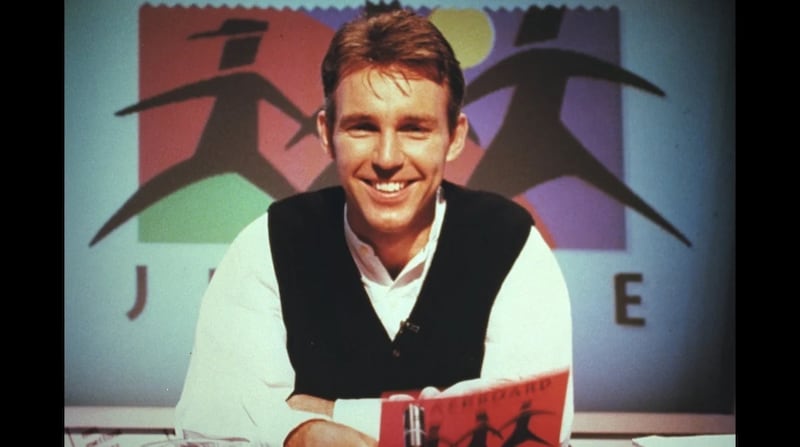 Ray D’Arcy in his younger days on Blackboard Jungle on RTÉ television.
He was very upset, he says. “I said to myself, ‘this is going to be a very challenging time for you as a person, as a husband, as a father’ … I just went in [to his home studio] and recited my version of events. I was looking to see how long it was the other day. It’s 17 minutes long … I’ve never listened to it. But it was very therapeutic at the time … It was handled very poorly and shouldn’t have been handled that way. And there were so many things that should have happened that didn’t happen.”
What does he mean by that? “I never got a phone call or an email or text from [RTÉ director general] Kevin Bakhurst. No conversation whatsoever. To this day. It’s bizarre. It’s a small country and organisation. I had worked there on-and-off for nearly 40 years. If I died tomorrow, would he issue a statement? I don’t know.”
That’s a dark thought. He laughs. “I think about death every day, Patrick. It’s not particularly dark in my world.”
How did he feel when the news of controversial payments to Ryan Tubridy emerged in 2023? “I said at the time I was angry. I still am angry, when I think about it … I knew a trust had been broken.”
How does he feel generally about the focus on star salaries? An external observer could work out his Today FM salary from looking at company accounts, he says, “but it wasn’t there in black and white once every two years. I don’t have an agent. At all times I have gone in and said, ‘What do you think is fair?’ I was coming from the commercial world where I was getting paid a certain amount. RTÉ wanted me. They paid a similar amount [as Today FM].” That amounted to payment of €400,000 in 2015 and €450,000 in 2016. D’Arcy also hosted a Saturday night chatshow, The Ray D’Arcy show, from 2015 to 2019. “I was doing more work for less money,” he says.
Does he think the level of RTÉ star pay was problematic? “I probably think that they didn’t readjust. You have to remember that Pat Kenny was nearly on a million. That’s 20 years ago. That’s mad money.”
Did any traditional broadcasters contact him after he left? “No. And did I contact any? No.”
So why a daily podcast? “Anything I’ve done, I’ve done it daily,” he says. “That’s why we’re really excited about what’s coming next. There are daily news podcasts, but there isn’t anything that isn’t strictly news.”
He’s been getting up every morning at six to go for a run before researching the podcast business, talking to contributors, preparing segments and recording demos. The daily podcast starts on March 9th. It will be 40 to 45 minutes long and will be “freshly baked”, recorded each weekday morning and put out at 10.30am. Collaborators will include Jenny as well as long time foil Mairead Ronan and comedian Bernard O’Shea (Jenny and Mairead Ronan had their own podcast, Jenny and Mairead Now, for a spell). He says he wants to highlight small businesses. He wants to build a sense of community.
[ The shrinking of RTÉ: ‘It feels like an increasingly neutered organisation’Opens in new window ]
The philosophical interview podcast, Being Human, will launch a few weeks later. The first interviewees are Katriona O’Sullivan, Panti Bliss, Mary McAleese, Siobhán McSweeney, Prof Brendan Kelly and Irish Times writer Róisín Ingle. Other projects will develop organically from the podcasting process, he says. Down the line they might look at establishing something like Gary Lineker’s Goalhanger in which they provide a platform for other podcasters.
He has a yen to be busy. Even as a young man, he mixed studying with DJing every night. He remembers telling his thesis tutor at the National Institute for Higher Education (now Dublin City University) about his schedule and, he says, the tutor said : “Jesus.”
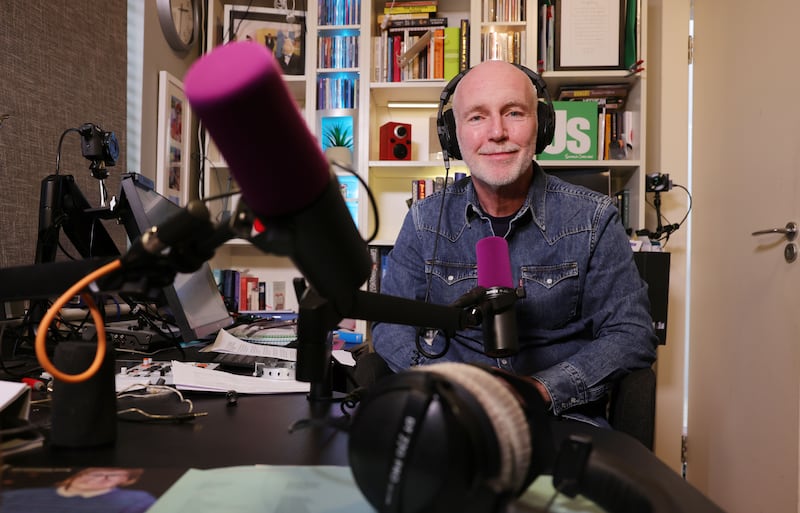 Ray D’Arcy in his podcast studio: ‘The thought of the new is very exciting.’ Photograph: Alan Betson
What was he studying? “I was doing a masters in personnel management … I’d done psychology and I thought, ‘Isn’t this great that organisations have this department which is responsible for the welfare of their staff?’”
What was his thesis on? He laughs. “It was on change in organisations.”
Before I leave, he tries out a quiz feature on me, one he’s planning for the podcast. He talks passionately about music. In his home podcast studio, amid microphones and “vodcast” cameras and musical instruments, he tells me about how he recently recorded himself (on drums) and his son Tom (on bass) playing The White Stripes’ Seven Nation Army. “It was the most joyous thing. I jumped up and down.”
He seems happy, if a little anxious, about where things have landed. “The thought of the new is very exciting,” he says. Once he believed that, after significant stints at the Den and Today FM, he was living out the third and final chapter of his career at RTÉ. Now he’s in an unanticipated “chapter four”. “The BBC did a documentary on John Peel when he celebrated his 60th birthday,” he says. “And there’s a scene in it where he’s living out in the country and he’s converted the stables into a studio. He’s walking across the courtyard of a morning with a steaming cup of coffee in his dressing gown to do his show. And I thought, ‘Jesus, I want to build that.’” He laughs. “Be careful what you wish for.”
Ray D’Arcy Daily is available on Spotify and Apple from next Monday, March 9th