
Salt used to remove ice from roadways is collecting in Simcoe’s watershed — a source of drinking water for hundreds of thousands of people
In February 2025, a small freshwater stream in Newmarket was saltier than the ocean. The source? Winter road salt, washing off local parking lots and highways into the Lake Simcoe watershed.
As a result, concentrations of chloride — one of two minerals that make up table salt — in Western Creek exceeded 26,000 milligrams per litre of water. Meanwhile seawater typically sits at 19,400 milligrams of chloride per litre of water, according to the local conservation authority.
For Christopher Wellen, an environmental scientist focused on hydrology and associate professor at Toronto Metropolitan University, this finding was not surprising: the Simcoe region, and many others across southern Ontario, have big salt problems.
“It washes away from the roads, but it doesn’t just disappear,” Wellen said. “It goes where the water goes — that’s our groundwater, it’s our lakes, it’s our rivers — and has effects there.”
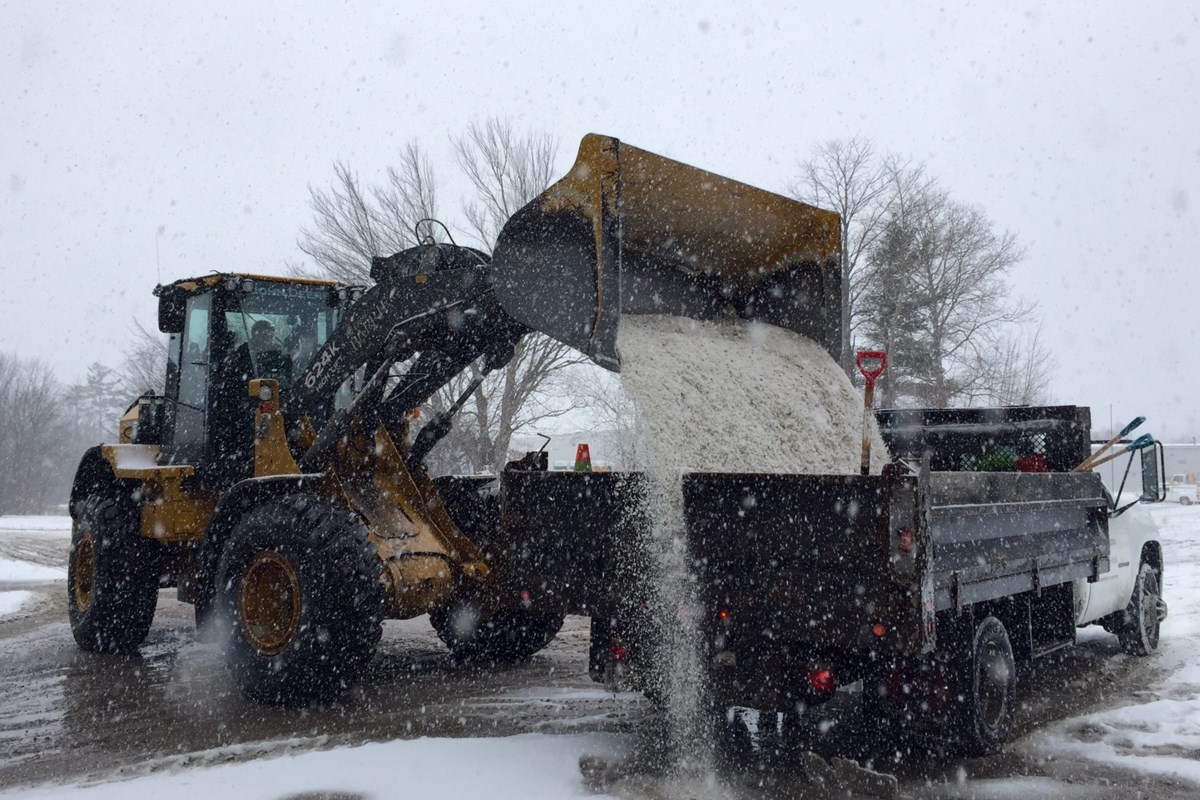
For decades, the concentration of road salt in Lake Simcoe has been on the rise: 120,000 tonnes of it are used by communities in the watershed annually, Lake Simcoe Region Conservation Authority has reported. That amounts to roughly 227 kilograms of salt per person in the region every year.
Heavy salting in winter is not unusual, but Lake Simcoe has been monitored for decades, so it can act as a case study of exactly what happens when this much road salt is being applied. And it illuminates the environmental impact across the province where high-traffic areas, surrounded by cities, towns and a dense network of roadways, are inundated with salt.
Road salt and fresh water
Road salt is primarily made up of sodium chloride and is used to remove ice from roadways in the winter. But oversalting has widespread impacts on ecosystems, harming aquatic life and depleting biodiversity year-round.
“Every organism that lives in streams and rivers and lakes … has tolerances for all sorts of things like temperature fluctuations and salt fluctuations,” Wellen said. “If the water becomes too salty, they can find it really difficult to reproduce and thrive and continue to exist, basically.”
All this chloride does not break down, or simply wash away. It accumulates over time.
“It’s quite possible that, if things don’t change, the food web could be quite affected,” Wellen added. The problem starts at the bottom of the food chain, he said, and makes its way up.
Since fish are mobile, they can generally avoid areas with high salt concentrations. The pronounced impacts are on the more stationary species, like critters that live in riverbeds. They also make up the base of the food chain, so when they are unable to survive the salty water, organisms higher up lose their food supply.
The Lake Simcoe Region Conservation Authority says on its website that winter salt has become a topic of “great concern” in the watershed, particularly because there isn’t an effective way to remove it. And Lake Simcoe, the largest lake wholly in southern Ontario, supplies drinking water for hundreds of thousands of residents — with hundreds of thousands more relying on groundwater aquifers in the watershed.
How salty is Lake Simcoe?
In Canada, the federal government provides long- and short-term guidelines for exposure to chloride before aquatic life is affected. At a concentration of 640 milligrams of chloride per litre of water for as little as 24 hours, aquatic life could be severely affected. For longer-term exposure, concentrations beyond 120 milligrams of chloride per litre of water would see harm to aquatic life such as a fish species declining over time.
David Lembcke, director of watershed science and monitoring at Lake Simcoe Region Conservation Authority, jokingly equates the latter threshold to a pack-a-day cigarette habit: “You’re going to have long-term impacts from that. There are some sensitive biota in the lake that will probably have reproductive, developmental, long-term impacts at those levels.”
The authority produced a report more than a decade ago that already showed chloride concentrations were impacting these aquatic species in 64 per cent of the Lake Simcoe watershed.
In the lake itself, the concentration in February was around 61 milligrams of chloride per litre of water, Lembcke said, which is about half of the long-term exposure guideline set by the province. But that level has been steadily increasing by 0.7 milligrams of chloride per litre of water annually, according to the conservation authority. Elsewhere in the watershed, especially in tributaries in urban areas like Hotchkiss Creek and West Holland River, concentrations regularly exceed both guidelines, Lembcke said, and long after winter ends.
“We have this incredibly persistent, relentless increasing trend in lake [salt] concentrations,” Lembcke said. “Certainly the potential is there: if we don’t curb the amount of salt that we’re using, drinking water could be impacted.”
For drinking water, the Ontario objective is 250 milligrams of chloride per litre of water, but this is based on taste, not health considerations. For people who need to limit their sodium intake for things like high blood pressure, or kidney or liver diseases, Health Canada recommends that salt in water shouldn’t exceed 20 milligrams per litre.
In Waterloo, Ont., groundwater and consequently drinking water has already been impacted; given high concentrations in some areas, the city has to mix groundwater from different wells to average out chloride levels across the region. They’ve campaigned hard for curbing road salt use, since current water and wastewater treatment doesn’t remove salt, and the municipality explains on their website that removing it requires expensive, energy-intensive treatment. And that would mean higher water costs for the community.
How do you solve a problem like road salt?
While some communities look to solutions such as replacements for road salt, they also carry their own challenges: alternatives like beet juice or sodium acetate can be prohibitively expensive, and their long-term effects on ecosystems aren’t entirely known.
Some experts and activists are looking to stop the problem at its source. Commercial parking lots are among the biggest culprits for oversalting, likely since they are liable for any injury that occurs on snow or ice on their properties.
“The problem that we keep seeing is that small businesses or big parking lots are oversalting, and it’s a perverse incentive structure where they feel like they have to do it to protect themselves against the slip and fall [lawsuits],” Jonathan Scott, executive director of the Rescue Lake Simcoe Coalition, said. Scott is chair of the Nottawasaga Valley Conservation Authority and a Bradford West Gwillimbury councillor.
“It’s not any safer. It’s worse for the environment. It’s worse for small businesses in terms of increased costs,” he said.
Proponents including Scott and Lembcke are arguing to modernize the law by offering limited liability, or a stronger defence against being sued, to those businesses who get an accepted certification such as Smart About Salt, and learn how to implement best salting practices for public safety and the environment alike.
“If you’re following best practices and if you’re doing the right thing as a winter maintenance operator, that should be a defence for the operator and the property owner against slip and fall claims,” Scott said. “It seems like such a simple pro-business, pro-environment legal reform that wouldn’t cost us anything.”
Scott points to New Hampshire, a state with comparable winter conditions to Ontario, as an example. The state reduced its salt pollution by 25 to 45 per cent by granting limited liability protection to certified commercial salt applicators.
Wellen and his team have done modelling studies to see what would happen if a legal reform like this was adopted in the Lake Simcoe area; he said the results are promising, finding it could decrease the concentrations in the lake significantly by the end of the century.
But the province, who would have to make that regulatory change, has yet to sign on.
“It seems to be one of those problems that’s entirely of our own making, in which case it should be something that we can fix,” Lembcke said. “I’m optimistic that it’s something that we can address.”
— Leah Borts-Kuperman is a federally funded Local Journalism Initiative reporter at the Narwhal; with files from Fatima Syed