
Most of the infectious diseases that trouble humans today actually began in animals. These are called zoonotic pathogens, meaning they jumped from animals to humans at some point in history.
Long before the infamous Black Death swept through medieval Europe, killing a third of its population, another strain of the plague bacterium, Yersinia pestis, haunted humanity.
This earlier strain emerged about 5,000 years ago in the Bronze Age, spreading across Eurasia for nearly two millennia before mysteriously disappearing. Unlike the medieval plague, it could not be transmitted by fleas, leaving scientists puzzled about how it could have spread so widely.
An international team of researchers, including University of Arkansas archaeologist Taylor Hermes, stumbled upon something extraordinary. While analyzing ancient livestock DNA from Arkaim, a fortified settlement in the Southern Ural Mountains of present-day Russia, the team discovered Y. pestis DNA in a 4,000-year-old domesticated sheep.
This was the first evidence of Bronze Age plague in a non-human host. It shows that animals were not just passive companions but active participants in the spread of deadly pathogens.
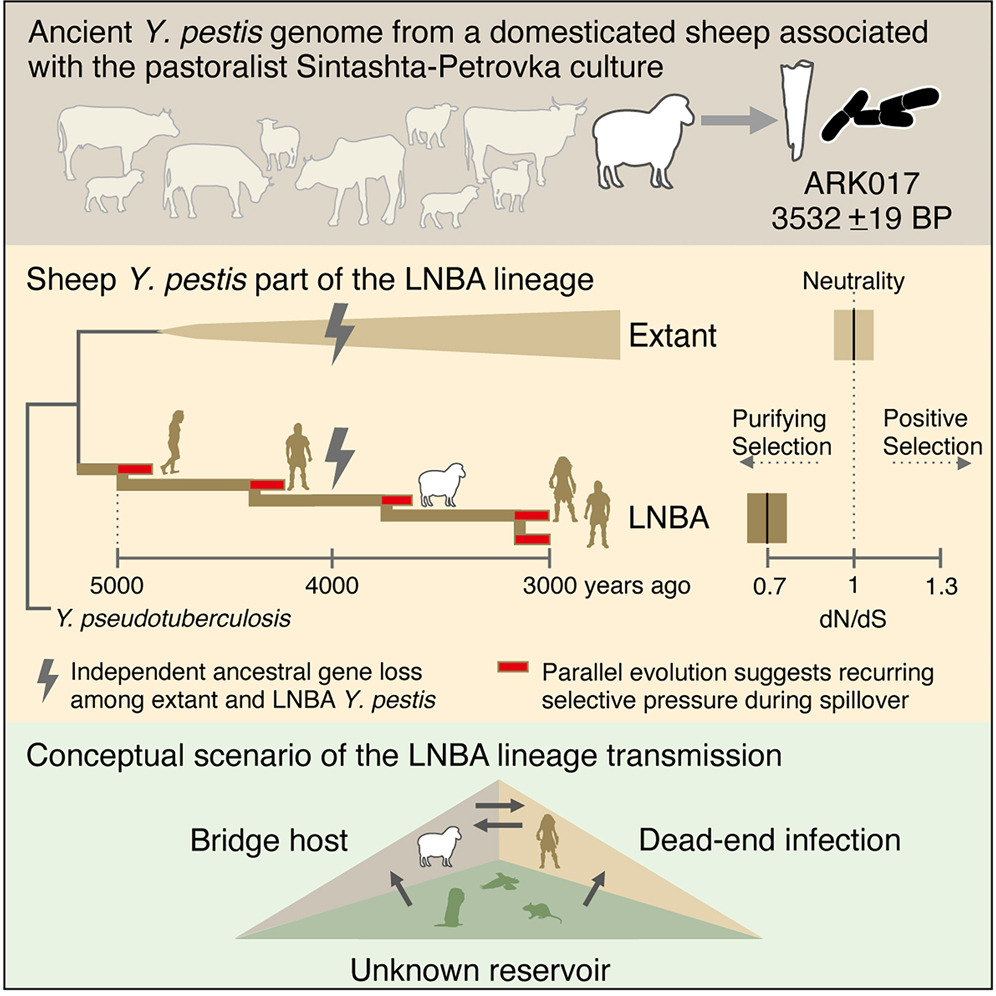 Graphical abstract. Credit: Cell (2025). DOI: 10.1016/j.cell.2025.07.029
University of Arkansas archaeologist Taylor Hermes said, “When we test livestock DNA in ancient samples, we get a complex genetic soup of contamination. This is a large barrier to getting a strong signal for the animal, but it also allows us to look for pathogens that infect herds and their handlers.”
While examining livestock samples excavated from Arkaim in the 1980s and 1990s, the team realized one sheep bone carried plague DNA.
“It was alarm bells for my team. This was the first time we had recovered the genome from Yersinia pestis in a non-human sample,” Hermes said.
Scientists had already found identical strains of Bronze Age plague in humans thousands of kilometers apart. But how did it travel so far without being transmitted by fleas? Hermes believes the sheep provided the breakthrough:
“It had to be more than people moving. Our plague sheep gave us a breakthrough. We now see it as a dynamic between people, livestock, and some still unidentified ‘natural reservoir’ for it, which could be rodents on the grasslands of the Eurasian steppe or migratory birds.”
Unlike the later Black Death, the Bronze Age plague did not spread via fleas. Rather, it spreads through direct contact or other channels. It spread to sheep and other domestic animals from an unidentified animal reservoir. Those animals acted as bridges once they contracted the infection. They facilitated the bacteria’s spread throughout Eurasia and infected people. This made everyday life much more dangerous, allowing the plague to spread across Eurasia without the help of fleas.
By analyzing ancient DNA from animals, scientists are expanding the field of paleomicrobiology into the zooarchaeological record. This means we can now study how diseases moved between humans and animals thousands of years ago, offering fresh insights into the origins of epidemics.
Journal Reference:
Ian Light-Maka, Taylor R. Hermes, Raffaela Angelina Bianco et al. Bronze Age Yersinia pestis genome from sheep sheds light on hosts and evolution of a prehistoric plague lineage. Cell. DOI: 10.1016/j.cell.2025.07.029