
For decades, astronomers searching for extraterrestrial technology have focused on extremely narrow radio signals. Such signals rarely occur naturally, making them attractive targets in the hunt for alien transmissions.
But a new study suggests these signals may change shape before they even leave their home star system.

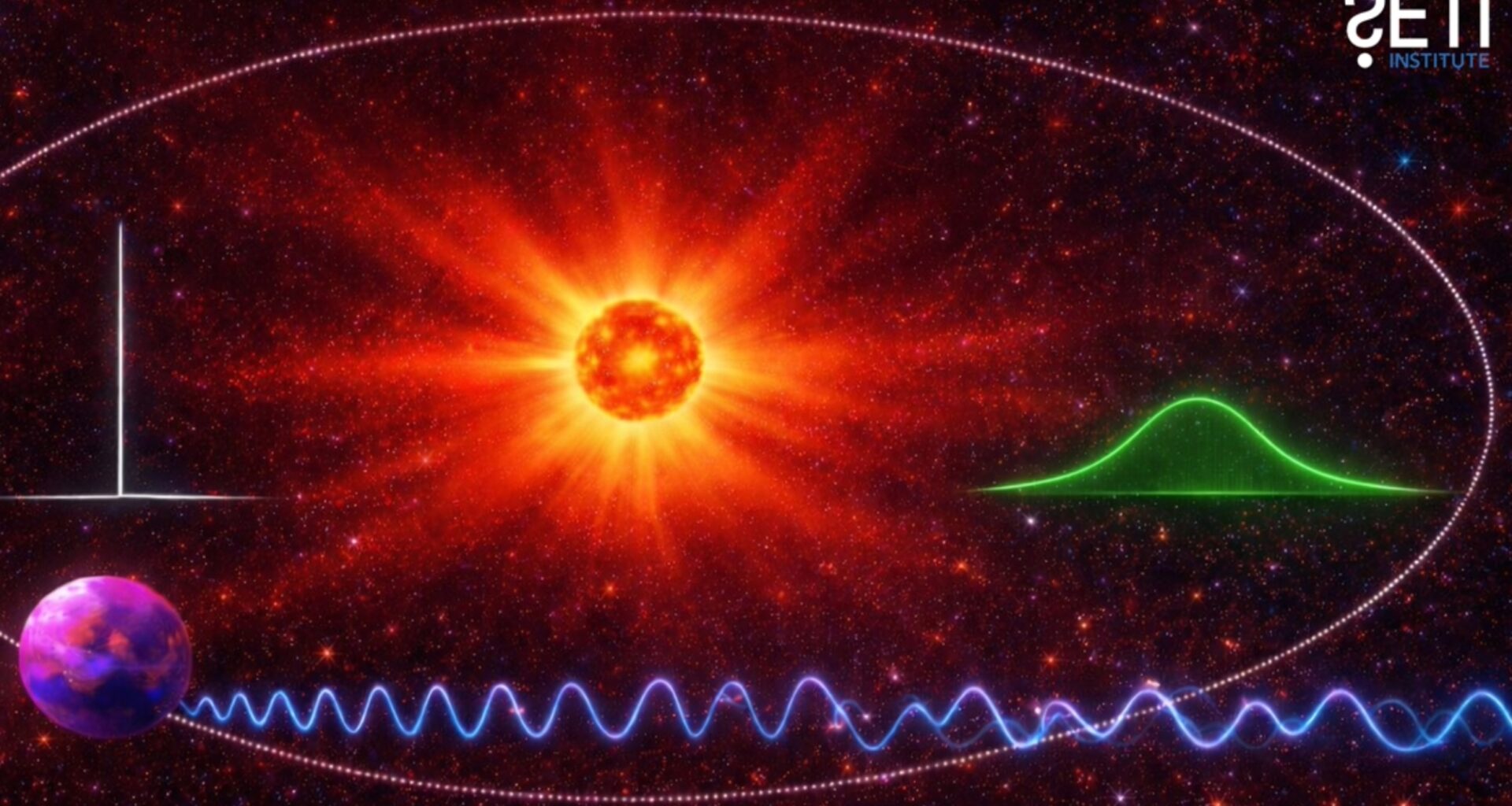
Turbulent plasma around stars can spread a tightly focused transmission across nearby frequencies, turning a sharp radio tone into a wider, weaker band.
That distortion means a real signal could reach Earth looking far less distinct than expected, potentially slipping past detection methods designed to find razor-thin spikes.
Stellar plasma reshapes radio signals
Close to an active star, turbulent plasma – hot, electrically charged gas surrounding many stars – can stretch a sharp radio tone into a broader, weaker band before the signal escapes the system.
Working from decades of spacecraft radio transmissions recorded within our own solar system, Dr. Vishal Gajjar at the SETI Institute demonstrated how stellar plasma can impose this broadening on signals near their point of origin.
Evidence drawn from those observations shows that even a perfectly narrow transmission can emerge from its home system significantly widened.
Such distortion means a detectable signal may arrive at Earth looking weaker than expected, helping explain why many searches could be missing it.
Wider signals become harder
Most radio searches still look for extremely narrow peaks because nature rarely produces them, while engineers might.
Astronomers call this spreading spectral broadening – the smearing of one signal across nearby frequencies by moving turbulent material.
Once the energy fans out, the top of the signal drops, so the detector sees less contrast against background noise.
A signal widened to about 10 hertz – meaning its energy spreads across a wider slice of radio frequencies – can keep its total energy yet lose about 94 percent of its peak brightness.
Solar probes reveal distortion
Spacecraft operating around our own Sun provided the clearest real-world evidence. Their radio transmissions travel through the same turbulent stellar wind – the stream of charged particles flowing outward from a star.
As those signals passed closer to the Sun, their frequencies spread out more. This pattern showed that the broadening effect becomes stronger near a star.
Instead of relying only on theory, the researchers used this solar system record as a reality check. The observations gave their calculations firmer grounding when they extended the analysis to stars beyond our own.
Small stars complicate detection
Among all likely targets, M-dwarfs raise the biggest concern because they make up about 75 percent of Milky Way stars.
These stars are small, cool, and dim compared with the Sun, yet they often whip up fierce magnetic weather. Close-in planets circle them at short distances, so any transmitter would spend more of its path inside dense, churning material.
In the team’s framework, more than 70 percent of simulated systems at one gigahertz produced at least one hertz of signal broadening. Over 30 percent crossed 10 hertz, enough to sap peak strength from the narrow spikes most pipelines prefer.
At 100 megahertz, nearly 60 percent of systems reached 100 hertz of signal broadening or more, spreading the transmission across many nearby frequencies and making low-frequency searches even harder.
Those percentages do not prove signals are common, but they do show how often stellar weather could hide one.
Stellar eruptions scramble signals
Trouble spikes during coronal mass ejections (CMEs), giant blasts of magnetized stellar gas that shove extra turbulence across the line of sight.
When the team modeled those eruptions, almost every direct encounter added broadening by several orders of magnitude. Luckily, the geometry stays unforgiving, so fewer than three percent of ordinary observations should run into one.
Lower radio frequencies suffer more because turbulent plasma disrupts slower radio waves more strongly than faster ones. That is why the simulations showed far stronger distortion at 100 megahertz, where signal broadening often spread into the hundreds of hertz.
Observations taken near superior conjunction, when a planet passes behind its star, fare worst because the path cuts closest. Higher frequencies and cleaner viewing angles will not solve the problem, but they can blunt its sharpest edge.
Alien signal search must adapt
Software can answer this challenge by testing many signal widths instead of betting on one ideal shape.
Search tools that compare signals across several widths and resolutions can recover power that broadening hides, especially when the signal drifts.
“We can design searches that are better matched to what actually arrives at Earth,” said Grayce C. Brown, a research assistant at the SETI Institute and co-author of the study.
That approach asks engineers to search for what a star lets escape, not only for what a civilization may send.
The quiet sky reconsidered
The study does not solve the Great Silence – the decades-long lack of confirmed extraterrestrial radio signals – but it does narrow one important blind spot.
“If a signal gets broadened by its own star’s environment, it can slip below our detection thresholds,” said Dr. Gajjar.
His point is not that hidden signals explain everything, only that missing the wrong signal shape can mimic emptiness. Through that lens, the quiet sky may reflect a mismatch between the signal shapes astronomers expect and the signals stars actually release.
Once that possibility is on the table, old null results look less final and future surveys look more interesting.
Researchers can now test the idea by widening search filters, choosing smarter observation times, and revisiting archived data for signals that may have slipped past earlier detection methods.
The study is published in The Astrophysical Journal.
Image Credit: Dr. Vishal Gajjar
—–
Like what you read? Subscribe to our newsletter for engaging articles, exclusive content, and the latest updates.
Check us out on EarthSnap, a free app brought to you by Eric Ralls and Earth.com.
—–