
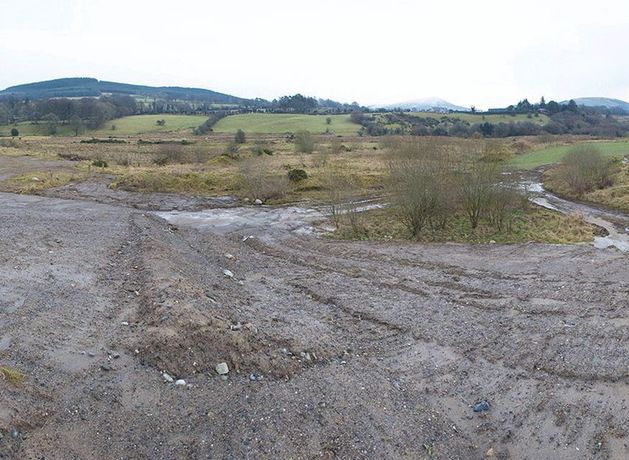
During the local authority’s March monthly meeting Ms O’Gorman indicated that the contractor is mobilising to be on site shortly,
The Whitestown saga is one of Ireland’s most notorious environmental scandals, involving a massive illegal dump near Baltinglass, where more than 1.4 million tonnes of waste were buried between the 1970s and 2001.
While WCC claimed to “discover” the site back in 2001, court proceedings revealed they had been aware of it since the mid-1990s.
The High Court found that WCC was a major polluter at the site, having dumped vast quantities of road-making materials (like toxic tarmacadam) and even paying contractors who were delivering waste to the illegal facility.
Investigations uncovered hospital waste (syringes, drip bags, surgical gowns), industrial chemicals, and commercial debris, all leaching into the groundwater near a Special Area of Conservation (SAC) and the River Slaney.
In 2014, WCC claimed to have remediated the site at a cost of €3.9 million.
In 2017, the High Court described this effort as “botched,” finding that 93pc of the waste remained on-site. The judge ordered the council to completely remove all waste and contaminated soil.
Remediation is now estimated to cost at least €45 million, though some estimates suggest it could exceed €100 million if hazardous waste is found.
The Department of the Environment has provided funding (including €15 million for 2026) to support the work, which is expected to continue until at least the end of 2027, followed by long-term monitoring.
The funding, provided by the State’s Landfill Remediation Grant Scheme, is strictly for capital works only and does not cover legal fees.
Between 2013 and 2025, the council obtained over €7.2 million in grants through this scheme to cover preliminary management and assessment costs.
The bulk of the funds is dedicated to the massive physical task of digging up approximately 175,000m³ of waste and contaminated material.
Excavation around ESB 110kV powerlines requires a phased approach using “manageable bays” and replacement with stable fill or lean mix concrete to prevent structural failure.
While the State is currently funding these works, WCC is under instruction to seek cost recovery through the courts from the original polluters.
The site’s current owner, Brownfield Restoration Ireland Ltd, has been in a decade-long legal battle with the council over cleanup responsibilities and costs.
The estimated cost for full remediation has risen to at least €45 million, with some projections suggesting it could reach €60 million or more as the full extent of the contamination is handled.
The local authority’s budget for 2026 includes significant provisions for environmental and ICT infrastructure to support the ongoing statutory obligations related to the site.
Full remediation of the site is currently expected to be completed by the end of 2027, following the 2017 High Court order that required the council to remove all waste and contaminated soil.
Once physical removal is finished, the site will require at least one further year of intensive groundwater and surface water monitoring.
The site sits in a sand-and-gravel pit directly in contact with groundwater that feeds the River Slaney, a protected salmonid river and Special Area of Conservation.
Identifying exactly where the 1.4 million tonnes of waste will go is currently one of the project’s biggest hurdles, as there is no single destination yet confirmed for the entire volume.
The disposal strategy involves a mix of on-site cleaning and off-site transport to licensed facilities. Organic waste would be separated and treated for composting. Residual, non-hazardous waste would be cleaned and then buried in a modern, engineered landfill cell on the same site. Material that cannot be treated on-site will be moved to authorised landfills within Ireland.
Drehid Landfill in Co. Kildare is a primary regional facility for large-scale waste disposal. Other commercial landfill operators in the Midlands are typically used for such large-scale remediation projects.
As Ireland has extremely limited facilities for hazardous waste, toxic materials (like hospital waste or industrial chemicals) will likely be exported for incineration or treatment, typically to specialised plants in Germany, Denmark, or the Netherlands.
Ireland is facing a national shortage of landfill space, making it difficult for WCC to move the massive volume of Whitestown waste quickly.
If the site still poses a threat after the primary waste is removed in 2027, several mechanisms are triggered under the current High Court mandate and EPA licensing requirements.
If toxic leachate levels (like ammonia or chlorides) don’t drop significantly in the wells near the River Slaney, the cleanup cannot be signed off as complete.
The team must prove that landfill gases (methane/CO2) have dissipated to safe levels before the site can be re-profiled for public or agricultural use.
Under the Landfill Remediation Grant Scheme, if the independent assessor finds that “residual contamination” remains in the soil the council may be forced to dig deeper or wider.
If pollutants continue to migrate toward the site the court can then order the installation of Permeable Reactive Barriers—essentially underground “filters” that clean groundwater as it passes through.
Funded by the Local Democracy Reporting Scheme