

In the remote corners of the Amazon, a hidden world teems with life, where thousands of creatures gather in secretive locations along riverbanks. One of the most remarkable discoveries in recent years is a massive nesting site on the Guaporé River, home to over 40,000 animals. Using advanced drone technology, scientists uncovered this astonishing congregation, which belongs to the endangered giant South American river turtles. This discovery offers a new way to monitor wildlife and protect species that are at risk.
The Significance of the Discovery
The discovery of this massive turtle nesting site is not just a remarkable finding in itself; it represents a significant breakthrough in wildlife conservation. Giant South American river turtles (Podocnemis expansa) are among the largest freshwater turtles in the world, reaching up to 90 cm in length and weighing as much as 80 kg. The fact that such a large number of these endangered creatures are found nesting in one area highlights both the ecological importance of the region and the critical need for precise population monitoring.
The turtles gather along the sandy banks of the Guaporé River each year during the nesting season. Yet despite legal protections, these turtles remain under severe threat from poaching and habitat destruction. Without an accurate count of the population, it becomes challenging to assess whether conservation efforts are working or if the species is in decline. As lead author Ismael Brack explains,
“These numbers vary greatly, and that’s a problem for conservationists. If scientists are unable to establish an accurate count of individuals of a species, how will they know if the population is in decline or whether efforts to protect it are successful?”
This study, published in the Journal of Applied Ecology, is vital in providing a clearer picture of the turtle population, allowing for more effective and targeted conservation strategies.
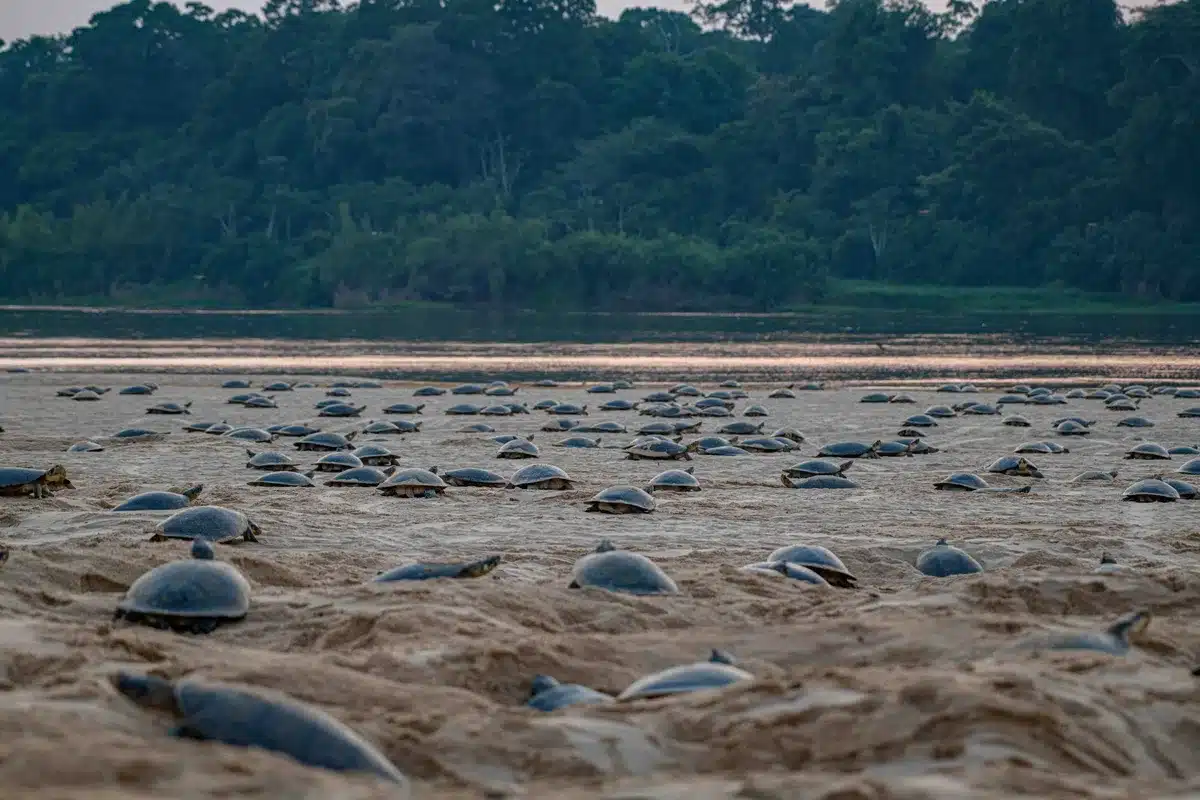 The study documented more than 41,000 giant South American river turtles along the Amazon’s Guaporé River.
Credit: Omar Torrico, Wildlife Conservation Society
How Drone Technology Revolutionized Turtle Population Monitoring
The use of drones in this study marks a crucial step forward in the way scientists monitor wildlife. Traditional methods of counting, such as on-the-ground surveys, are often time-consuming, invasive, and can result in inaccurate data. The innovative approach used in this study combined aerial drone footage with detailed statistical analysis, significantly improving the precision of population counts.
Each day, drones flew over the nesting site, capturing around 1,500 images per flight. These images were then stitched together to create high-resolution composite pictures of the nesting area. The researchers marked the shells of over 1,000 turtles with white paint to track their movements and nesting behaviors, ensuring that they were accurately counted. The technology allowed for a much more efficient way to monitor these turtles in their natural environment, minimizing human disturbance.
Brack emphasizes the significance of this new method, stating, “We describe a novel way to more efficiently monitor animal populations. And although the method is used to count turtles, it could also be applied to other species.” This revolutionary approach could be used for a wide range of animals, helping scientists gather accurate data to inform conservation efforts across different ecosystems.
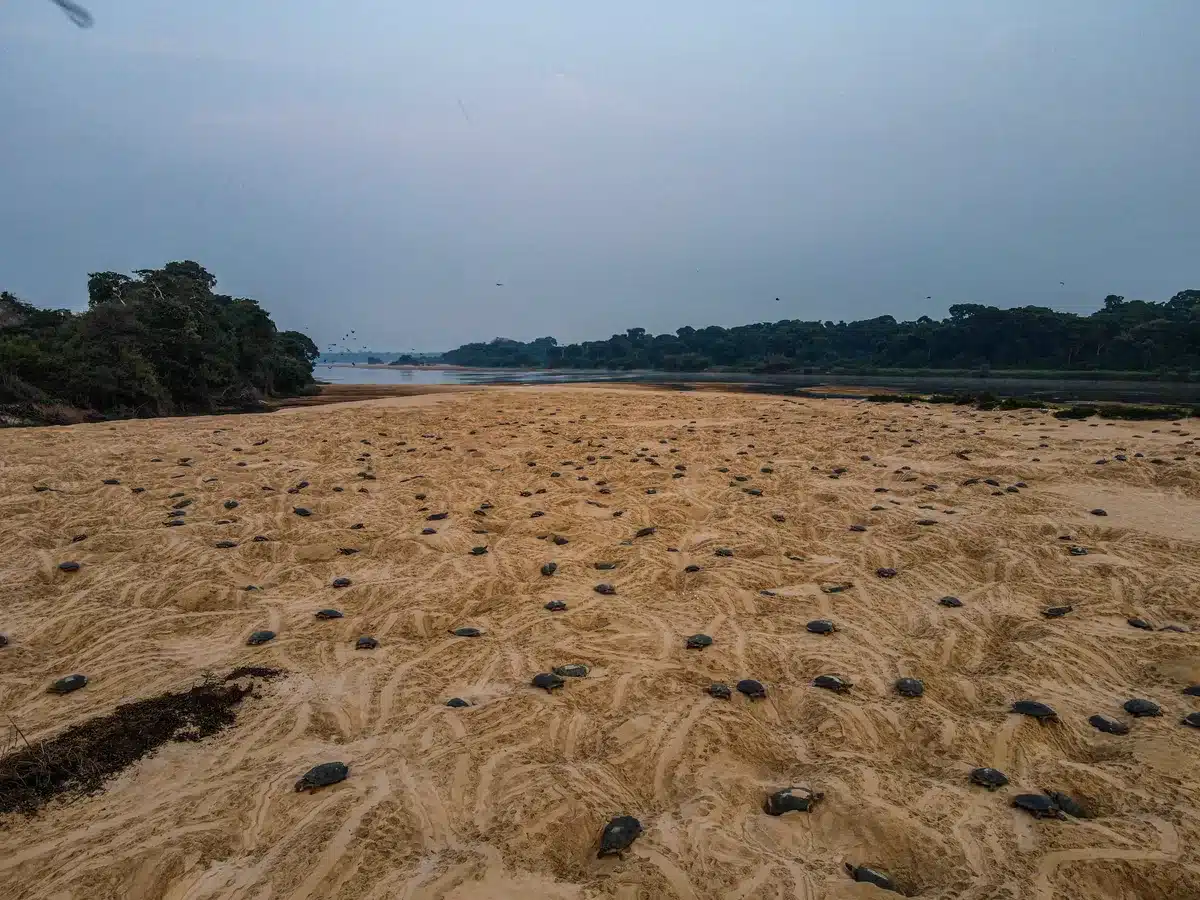 The study documented more than 41,000 giant South American river turtles along the Amazon’s Guaporé River.
Credit: Omar Torrico, Wildlife Conservation Society
The Challenges of Accurate Wildlife Counting
One of the major hurdles in wildlife conservation has always been the difficulty of accurately counting animal populations, especially for species like the giant river turtle, which nest in large groups. In the case of this study, previous methods of population estimation had produced widely varying results. For instance, ground surveys conducted by human observers recorded only about 16,000 turtles, while drone-based counts without accounting for animal movement tallied nearly 79,000 turtles. The study’s refined approach, combining drone images and a statistical model that considered movement patterns, led to an estimate of 41,000 turtles.
This inconsistency in wildlife population data is problematic for conservation efforts. Without an accurate and reliable count, scientists are left with limited information to assess the health of a species and its environment. The new method employed in this study offers hope for overcoming this issue. +, “By combining information from multiple surveys, we can detect population trends, and the Wildlife Conservation Society will know where to invest in conservation actions.”