
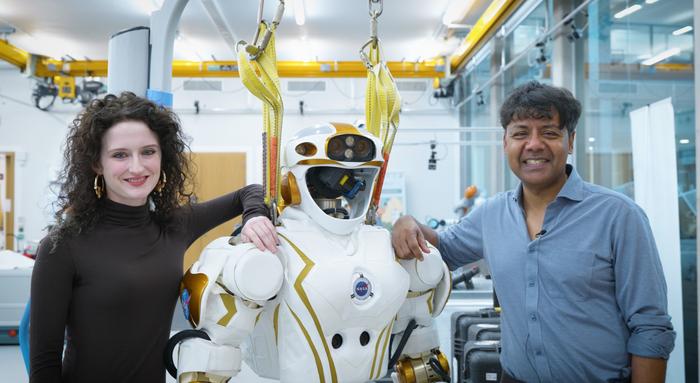
A humanoid robot developed by NASA for future Mars missions is set to return to the United States after spending a decade at the University of Edinburgh in Scotland.
Named Valkyrie, the 1.8-metre-tall machine weighs about 275 pounds (125 kilograms) and is one of only three prototypes in the world.
Inspired by Norse mythology, the robot supported humanoid robotics research before returning to Johnson Space Center in Texas for further development and future planetary missions.
“Hosting NASA Valkyrie at the University of Edinburgh was a rare privilege at a time when humanoid robots were not commercially available and only a handful of research prototypes existed worldwide,” said Vladimir Ivan, a former student at the University of Edinburgh who worked on Valkyrie, and is now Chief Technical Officer at a robotics start-up, Touchlab, based in Edinburgh, in a statement.
NASA robot progress
The humanoid robot Valkyrie was among the most advanced robots of its kind when it arrived at the University of Edinburgh in 2016 as part of a research collaboration with NASA. Developed to support future missions to Mars, the robot was envisioned to perform early deployment tasks and maintain infrastructure on the Red Planet before astronauts arrive.
Valkyrie features a human-like design that allows it to operate in spaces built for people or undertake dangerous tasks in environments unsuitable for humans. Its hardware includes Series Elastic Actuators and a range of sensors that enable safe physical interaction with people while maintaining balance and precision.
When first delivered, Valkyrie could walk on flat surfaces and perform basic actions, such as grasping and manipulating objects. Over the past decade, researchers have enhanced its capabilities through artificial intelligence and machine learning to help the robot better understand and respond to its surroundings.
Scientists improved its walking stability, manipulation skills, and sensor-based perception, enabling it to navigate more complex environments. The research focused on helping Valkyrie adapt to changing conditions, traverse uneven terrain, and quickly connect visual information with physical actions for real-world robotic operations.
NASA’s Valkyrie humanoid robot helped shape modern robotics, with its architecture influencing Apptronik’s Apollo robot, now moving humanoids from research labs into industry and future space missions.
Human-robot collaboration
Hosting the NASA Valkyrie humanoid robot at the University of Edinburgh provided researchers with a rare opportunity at a time when humanoid robots were not commercially available and only a few experimental systems existed worldwide.
The platform enabled scientists to advance fundamental research in mobility and stability, helping shape the development of modern humanoid robotics while training a new generation of roboticists.
Valkyrie’s presence also contributed to Edinburgh’s emergence as a leading robotics hub, supporting world-class research, thought leadership, and a growing ecosystem of robotics innovation and startups.
Research into humanoid robotics at the university continues using the Talos humanoid robot, a 1.75-metre-tall platform delivered in 2020. Scientists use Talos to study how humanoid machines walk, maintain balance, and use tools in complex environments. The research also explores how robots apply machine learning to adapt to constantly changing surroundings.
A key focus is human-robot collaboration through dyadic human-robot interaction, in which robots and people work together to complete tasks. Advances from this work could support a range of real-world applications, including assisted living technologies and robotic systems designed for healthcare and rehabilitation environments.
“In hindsight, this bold decision has contributed to the exciting wave of data-driven humanoid robot research that is now taken for granted,” said Sethu Vijayakumar, Personal Chair in Robotics and Director of the Edinburgh Centre for Robotics at the University of Edinburgh, in a statement.