
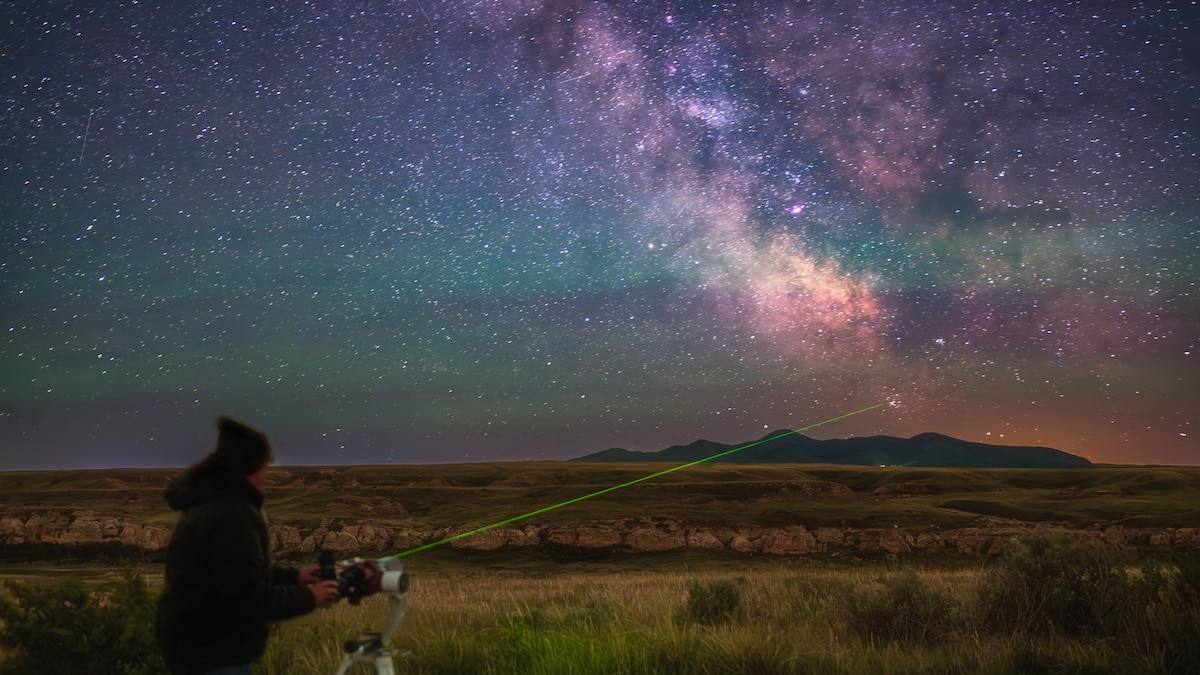
The Messier catalog includes some of the most famous deep-sky objects visible from Earth, each designated by the letter M followed by a number. Among them are the Andromeda Galaxy (M31), the nearest large galaxy to the Milky Way; the Orion Nebula (M42), a glowing stellar nursery visible within Orion’s Belt; and the Pleiades (M45), an open star cluster of blue stars often called the Seven Sisters.
(Here are 10 weird things you (probably) didn’t know about the Milky Way.)
Most Messier objects can be seen with modest backyard telescopes or even binoculars under dark skies—and some, like the Orion Nebula, are bright enough to be seen with the naked eye.

For curious minds of all ages
Subscriptions starting at $39/year
What is the Messier Marathon?
That catalog eventually inspired one of amateur astronomy’s most demanding observing challenges. Completing the marathon used to be significantly harder before the invention of digital sky maps and “GoTo” telescopes, which have computerized systems that automatically locate and point toward celestial targets, says Gallaway.
“When I started, the marathon was an exercise in ‘star-hopping,’ a slow, meditative, and often frustrating crawl across paper star charts,” says Gallaway, who admits he never completed a full Messier Marathon. “Now I’ve got a lot more free time and much better equipment, including two smart and three robotic telescopes,” says Gallaway, “I will give it a go again after a 35-year break!”