
I was walking with Dad. It was last winter during a light and sound festival that brings tourists and locals together to amble about Sydney. United by a passion to clog paths by fanning out five abreast and a chance to practise spatial unawareness. This is the Olympics for people who love standing in the way and shoving in front just to crane their neck up at a digital overhead projector flicking coloured animations on a building. It was cold so I was wearing a thick wool coat and my father was wearing his winter attire which is traditionally a slightly thicker T-shirt. Because jumpers are a symptom of “getting soft”, an irreversible degenerative condition feared by men of a certain age.
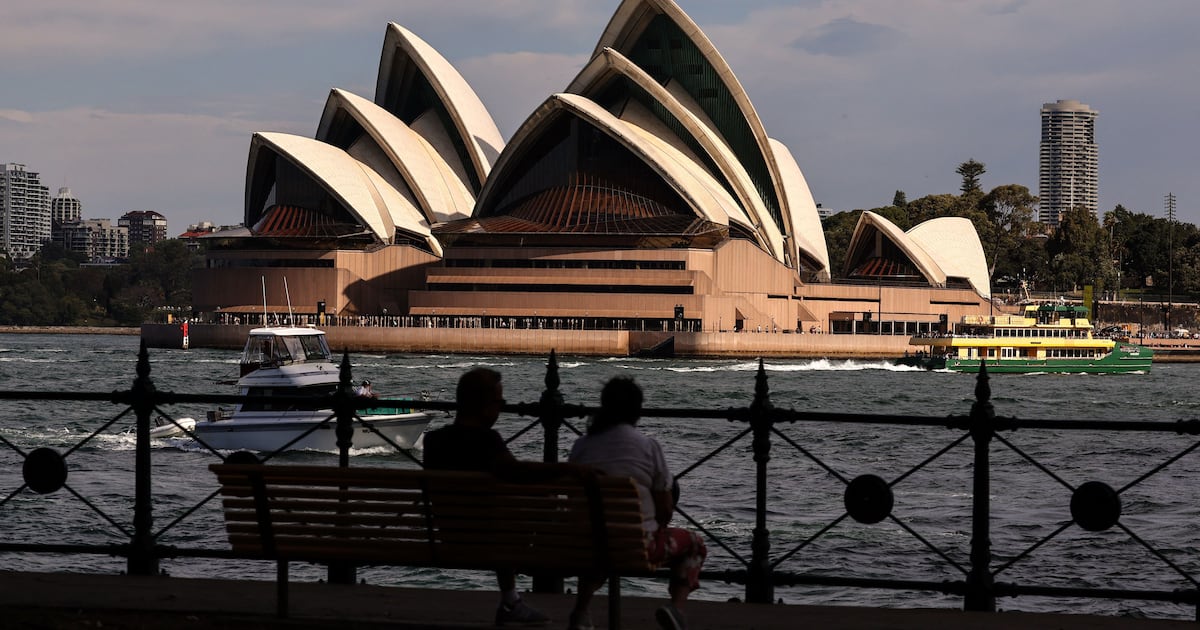
We broke free of the crowds to do a loop of the Sydney Opera House. The sails that to me look like they’re covered with pool tiles in need of a good power wash. I am of the age where power washing surfaces has become a deeply reliable and effective source of personal satisfaction. Life is complex and disappointing, but videos on the internet of strangers spraying moss from outdoor pavers are not, and that’s why they have a special place in my heart. Which explains the entire genre of social media content built on making unclean things clean for the gratification of other people ignoring their washing to scroll on the couch. I was lost in thought, counting how many views I would get if the opera house people let me have a little go with the power washer.
Then my dad said something that made me stop in my tracks. “I’ve never been inside,” he said, pointing to the side ribs of Australia’s most famous building. My father is 65. He has lived in Sydney for his entire life. But he has never set foot inside the Sydney Opera House.
The reason made no sense until it did, all at once. Then it was familiar and crushing. This has nothing to do with the tendency to be bad tourists in our own city. My father is endlessly fascinated with how stuff works and what it’s made of. He has consumed many “made-for-dads” documentaries on the architecture and build of the “Nuns in the Scrum”. The opera house hosts opera, talks, comedians, New Order and Fontaines DC. There’s a gig for everyone. It’s not a lack of interest that keeps him out of the concert hall. It’s the invisible boundary working-class people live within. It’s the quiet and persistent internalised message that some things are just for other, richer people to enjoy. They were not meant for us, so there’s no point even looking, you’ll only be disappointed.
The force field keeping working-class people out of posher pursuits can be real and monetary. Often by design. Think skiing, anything that involves horses and eating organic. In Australia, Rugby Union was the preserve of men who don’t use their body for work on Monday morning so they could risk it in a weekend scrum. With Rugby League being for blokes who couldn’t hide their injuries sitting behind a desk. Now Rugby League players earn more than their Union counterparts, but it reinforces the same divide – talented kids who need cash for their families now and not in 10 years tend to get snapped up by League, regardless of which code they prefer.
The reasons for divisions fade over time until things simply become “not for people like us”. For me that list included braces, using the car air conditioner/heater, olives, investing, the arts and describing wine as anything other than red or white. For my parents it was “schooling after the age of 15” and “going to university”.
My parents could have attended university for free, but it was still inaccessible. They had no way to pay their living costs. Their families could not financially support them to study full time. But the biggest barrier was the lack of encouragement. University was not for people like them. They were not going to swan about reading books when everyone else was out earning an honest wage. Teachers thought it was a waste of time educating kids of factory workers. Discrimination saw my dad graded as “illiterate” – the man who considers Moby Dick a fun beach read.
[ Brianna Parkins: Give me abrasive honesty over Irish plámásing any timeOpens in new window ]
The same fleeting intimidation we all get from going into a fancy shop or restaurant, based on an irrational fear someone will tell us we’re too poor to be there is constant when you’re working class. It can take longer than a lifetime to undo. But this weekend my dad will take his seat next to mine and together we will squint at the subtitles of Turandot in the opera hall he knows so much about but has never sat in.