
By
Alexandria Carolan
/
Published
March 13, 2026
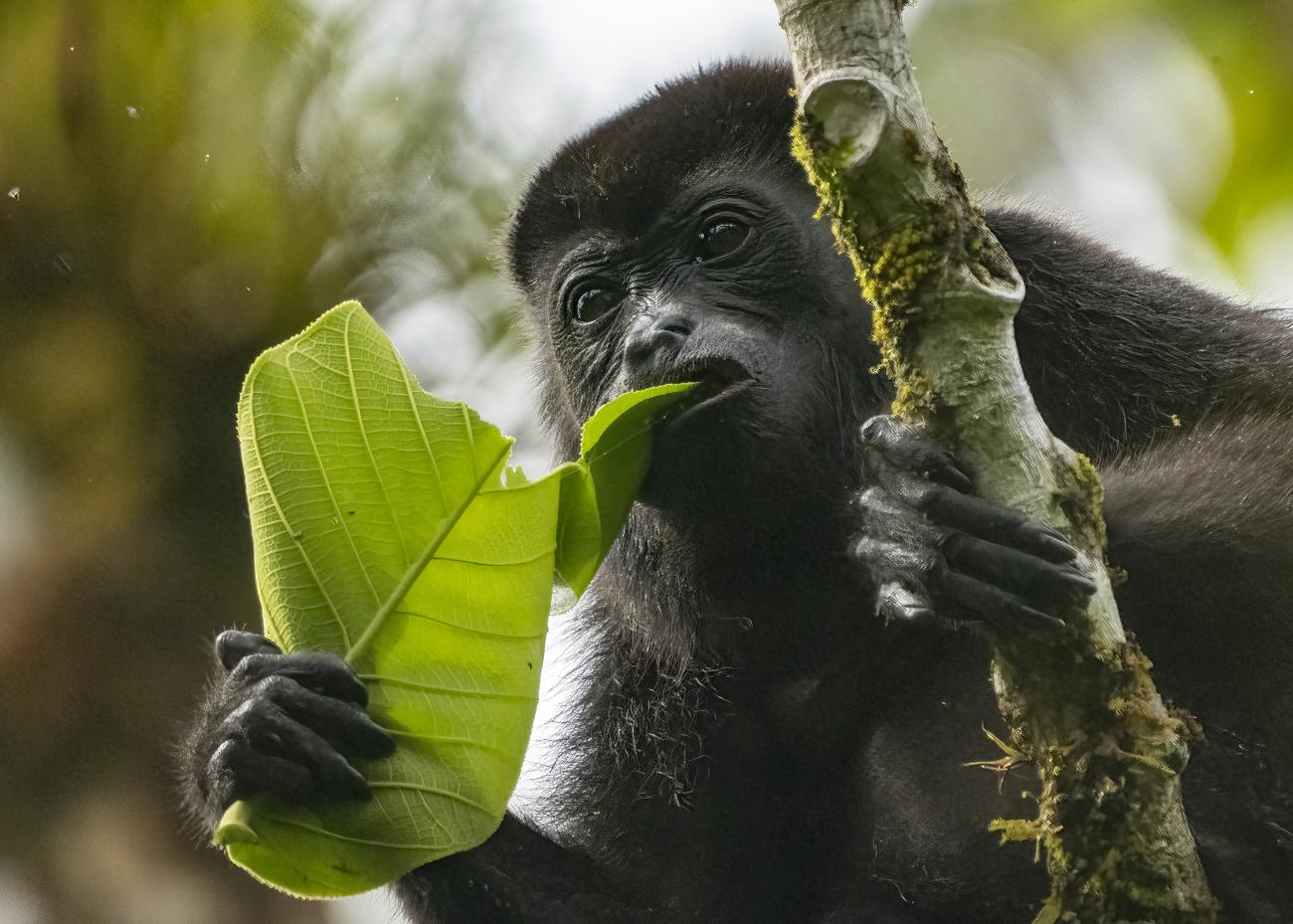
Thirteen million years ago, a medium-sized monkey known for guarding its territory among the treetops with a fearsome “howl” started doing something new. This monkey, one of the oldest known ancestors of the modern howler monkey, started eating leaves, causing them to evolve a larger body size and differentiate themselves from other primates, says a team of researchers led by a scientist at Johns Hopkins Medicine.
“This can help us answer important questions about ecological evolution in one of the most biodiverse areas of the planet.”
Siobhán Cooke
Associate professor, School of Medicine
“Before the discovery of Stirtonia, we didn’t have any evidence of leaf consumption in South American primates,” says Siobhán Cooke, associate professor in the Center for Functional Anatomy and Evolution at the Johns Hopkins University School of Medicine. “This can help us answer important questions about ecological evolution in one of the most biodiverse areas of the planet. What new things were occurring in the development of the proto-Amazonian rainforest when these monkeys were alive?”
A report of the findings, led by Cooke, was published March 2 in PaleoAnthropology. In the paper, scientists analyzed two mandible fossils from the Stirtonia victoriae species, an ancient relative of the modern howler monkey.
The findings pinpoint when these monkeys shifted to a leaf-based diet, expanding beyond fruit—a change that allowed them to grow larger and ease competition with other primate species, the researchers say.
Key Takeaways13.3 to 13.6 million-year-old fossils from an extinct relative of the howler monkey show signs of being the first leaf-eating primate in South and Central America.Fossils from jaws of Stirtonia victoriae may have space for a specialized bone that may have acted as a resonating chamber, indicating how the modern howler monkey got its eponymous “howl.”Analysis of jaw fossils indicates how modern monkeys from biodiverse Amazonian basin began differentiating from one another millions of years ago.
Cooke’s collaborators, brothers Andrés and Rubén Vanegas, who lead a paleontological museum in Colombia, South America, first uncovered the specimens in 2016 from a fossil-rich site known as La Venta in the Tatacoa Desert of Colombia. In a prior study published in 2024, a team of researchers including Cooke analyzed the fossil of a terror bird found in the same desert.
Millions of years ago, the ancient monkeys climbed from tree to tree in what is now the Tatacoa Desert, but which was once full of swampy grass, forests, and riverbanks, Cooke says. They lived among the Amazon basin’s long-extinct fauna, including giant sloths and large armored armadillos.
Previously, researchers had few other fossil finds from Stirtonia victoriae to learn from, relying only on a few fragments of bone from their face and head.
In addition to providing key information about biodiversity, diet, and body size of these monkeys, the most recent discoveries may also reveal when the howler monkey acquired its eponymous “howl,” giving it a claim as the loudest land mammal.
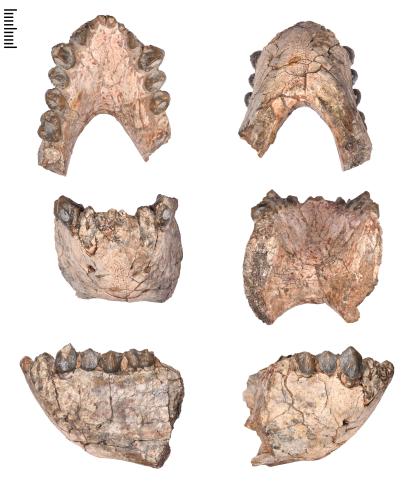
Image caption: The mandible of Stirtonia victoriae
Image credit: Siobhán Cooke
“The jaw had a wide, deep mandibular body, which may have allowed for the hyoid neck bone to balloon the same way as modern howler monkeys, resulting in their iconic call,” Cooke says. “However, we cannot be certain that they engaged in this behavior.”
Led by Cooke, the team of scientists scanned the jaw fossils and created a 3D model of the bones to analyze them. From the structure of the lower molars, the researchers can determine what Stirtonia victoriae ate, how large they were, and how this species differentiated itself from the other primate families living as the Amazonian basin was forming.
Cooke worked with collaborator Ryan Knigge, a researcher at the University of Minnesota Medical School, who created a dataset of information on the jaws of platyrrhines (monkeys that live in South America, Central America, and Mexico). With this information, scientists compared the Stirtonia victoriae fossils to 3D model jaws of other South American primates that lived during that time, including the smaller Stirtonia tatacoensis species, another howler monkey ancestor. The scientists also took a close look at the jaws of modern howler monkeys and their closely related living ancestors, including rainforest-dwelling spider monkeys and woolly monkeys.
Like modern howler monkeys, Stirtonia victoriae had relatively large molars with protrusions that act as “shears” when they ground against one another to help break down carbohydrates, which are adaptations associated with leaf-eating primates.
The researchers also reconstructed the body mass of Stirtonia victoriae and determined that these monkeys weighed between 17 and 22 pounds.
“This tells us that these monkeys had a plentiful food source, mainly leaves, that allowed them for the first time to evolve and occupy an ecological niche that allows for larger body mass.”
Siobhán Cooke
Associate professor, School of Medicine
“Prior to this, the South American monkeys we have in the fossil record are much smaller,” Cooke says. “This tells us that these monkeys had a plentiful food source, mainly leaves, that allowed them for the first time to evolve and occupy an ecological niche that allows for larger body mass.”
Stirtonia victoriae marks the very beginning of a large, diverse group of primates in South America.
“Now, we can begin to pinpoint when different modern lineages started to evolve,” Cooke says.
In addition to Cooke, Knigge, and Andrés Vanegas, the project’s other researchers include Savannah Cobb from the Johns Hopkins University School of Medicine; Melissa Tallman from the NYCEP Morphometrics Group; Laura Stroik from Grand Valley State University; Brian Shearer from University of California, San Francisco; Stephanie Palmer from Lake Erie College of Osteopathic Medicine; Zana Sims from the University of Minnesota; and Luis Ortiz-Pabón and Andrés Link from Universidad de los Andes.
This work is supported by the Leakey Foundation, the National Geographic Waitt Grants Program, the Grand Valley State University Center for Scholarly and Creative Excellence, the National Science Foundation, and the University of Minnesota Graduate School.