
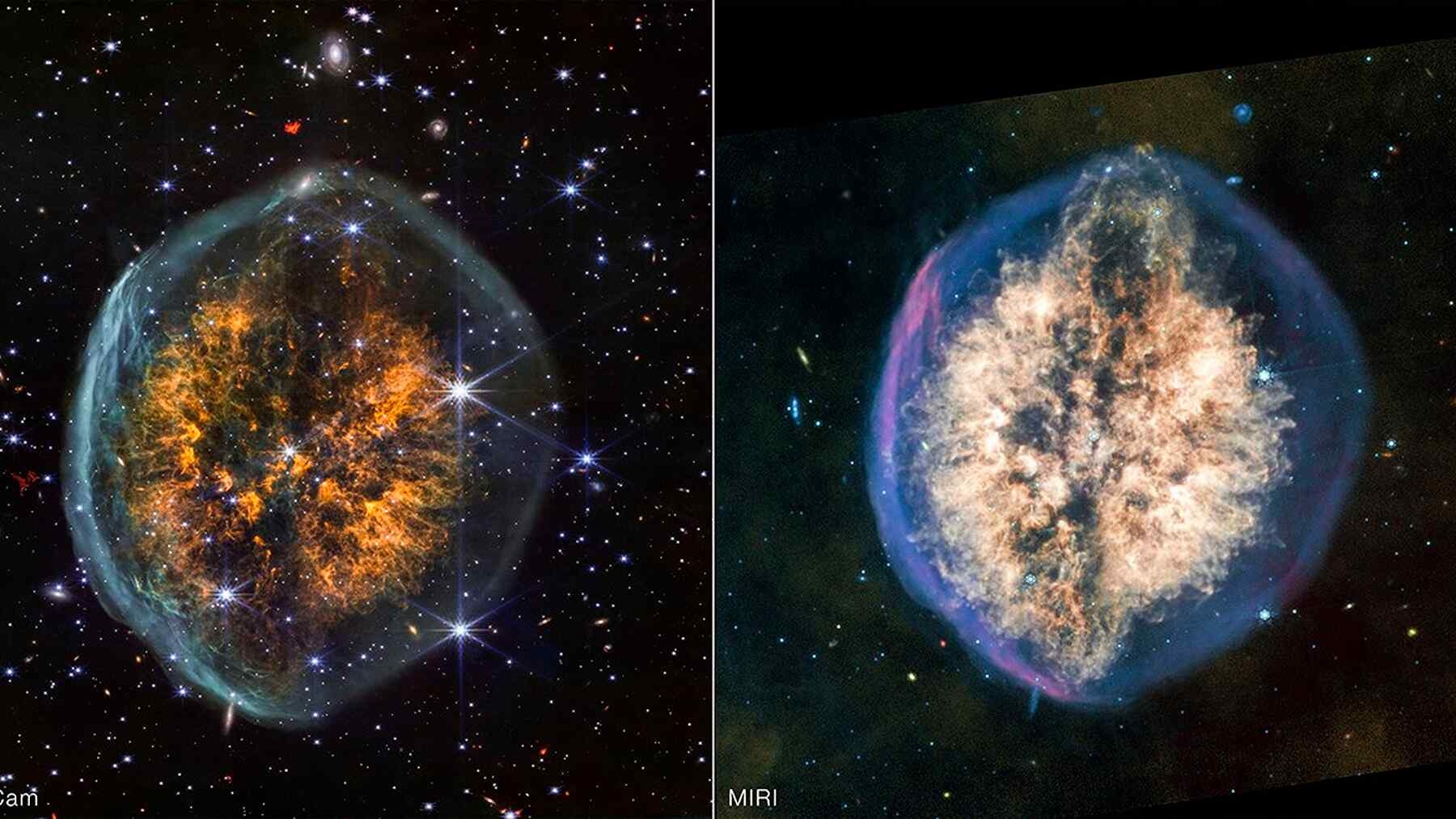
Deep space is filled with violent stellar events.
For generations, the inky darkness of space has been an unweilding treasure trove of mysteries. But as institutions like NASA develop their latest technology that enables astronomers to gaze into the deepest parts of the universe, what they are finding is shocking to say the least.
What exactly is this cosmic brain that NASA has found in deep space?
How NASA has changed the world of science over its long history
NASA was first created in 1958, during the height of the Cold War and the Space Race.
Since then, the agency has developed a wide range of astonishing technologies that have impacted every aspect of our daily lives. Recent data has revealed that since 1958, one in every 1,000 patents granted was to an individual working at NASA.
The medical industry has benefited from NASA tech. The MicoMed-DebBakey Ventricular Assist Device was based on NASA’s Space Shuttle fuel pump technology.
Digital imaging of the moon contributed to the creation of CAT scans and MRI technology that we use today. The climate crisis has also been affected by NASA as the agency has over 20 satellites orbiting the Earth, which are used to monitor climate change across the world.
NASA leads the race to unearth the mysteries of space
The now iconic Apollo missions to the moon were a landmark achievement for mankind.
The moon has recently come into focus as NASA plans its next lunar mission, Artemis. But as one recent discovery has shown, there are significantly violent events taking place in the deepest parts of the cosmos.
So we need to keep a close eye on events happening outside our solar system.
NASA’s Voyager 1 and 3 missions were the first, and so far the only, objects sent into interstellar space by humans. The Hubble and James Webb telescopes have enabled astronomers to study the earliest galaxies in time.
All these advancements in space exploration and study have catapulted NASA into one of the most important agencies anywhere in the world.
Many of us took the time to view the last lunar eclipse, which would not have been possible without the data and predictions from NASA. But the question after all these years of studying the universe is, what else is out there for NASA and others to find?
A lot, according to a recent NASA announcement.
NASA has detected a “cosmic brain” of interstellar gas and dust
Through the use of NASA’s astonishingly powerful Earth-based telescopes, the agency has detected a strange planetary nebula that has been officially designated as PMR 1.
The more colloquial name for PMR 1 is the “Exposed Cranium” nebula.
This “cosmic brain” consists of a massive cloud of gas and space dust that was created by a dying star nearby. When a star dies, it expels the outer layers during the final stages of its life.
The appearance of this “cosmic brain” resembles a familiar shape to us as humans.
The “brain” is the inner cloud of gas and space dust, while the ghostly “skull” is the hydrogen gas that surrounds the exposed cranium nebula. As we know, stars have a limited lifespan and cycle, and when that cycle runs its course, astonishingly violent events take place in space.
Where exactly has the Exposed Cranium nebula been detected by NASA
The “cosmic brain” is located in the Vela constellation, roughly 5,000 light-years away from us here on Earth.
NASA has noted that a distinct dark vertical line separates the “cosmic brain” into two cerebral hemispheres. As astromoers around the world discover rare events like wind bubbles in space, the NASA discovery might reveal the future of our own star, in a couple of billion years or so.