
Damage to pipelines carrying gas to Ireland from the UK would take a minimum of six months to repair, lead to potential rolling power outages and cost the economy about €4.6 billion for each 30-day interruption of supply, the State company that operates the interconnector facilities has indicated.
Gas Networks Ireland (GNI) warned Government in a submission on its new maritime security strategy that a threat to Ireland’s subsea gas interconnectors was “very much a realistic possibility”.
It said it considered “critical undersea and maritime infrastructure being seen as potential targets for sabotage, or for criminal/terrorist groups seeking to cause disruption as a significant emerging threat”.
On Friday, Taoiseach Micheál Martin said Ireland and the UK would increasingly focus on maritime security co-operation to protect undersea infrastructure.
Speaking after a UK-Ireland summit, he said a renewed defence agreement meant “we would co-ordinate more in terms of protecting subsea cables, protecting gas connectors and other connections under the water, which is critical to economic security”.
Martin, who hosted UK prime minister Keir Starmer in Cork, said: “We know that certain elements have been observing cables and other vital infrastructure.”
In a submission to the Department of Defence, GNI said it was “aware that in the recent past there have been instances of foreign vessels loitering in Irish waters, potentially mapping subsea assets, gathering intelligence that could be used for a future attack/disruption and this increased presence of foreign vessels and surveillance aircrafts requires greater intervention capabilities by Ireland”.
“The recent damage to the Nordstream and Baltic gas interconnectors in Europe highlights the potential for physical damage to critical undersea infrastructure, and the threat to Ireland’s subsea gas interconnectors is very much a realistic possibility.”
“Ireland’s gas network today supplies more than 30 per cent of primary energy needs and over 40 per cent of the country’s electricity generation. In turn, approximately 80 per cent of Ireland’s annual gas demand is supplied through two subsea interconnectors between Ireland and Scotland. ”
It said any disruption to gas supplies would significantly impact the Irish economy.
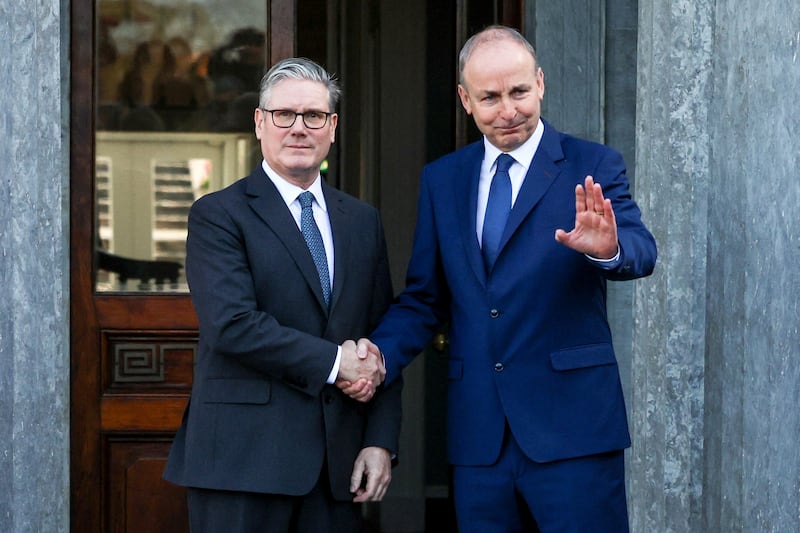 Ireland and the UK will increasingly focus on maritime security co-operation to protect undersea cables after signing a renewed defence agreement. Photograph: Cathal McNaughton/Getty Images
GNI’s submission said the Economic and Social Research Institute had estimated in 2011 the cost of losing three months of gas-fired power at €80 billion or 50 per cent of GDP (at the time) and that losing gas for heating for three months would add another €8 billion on average.
In a statement on Friday, GNI said a 2024 report for the Department of Energy found that a 30-day interruption to gas supply, without alternative sources or supporting infrastructure, could cost the Irish economy an estimated €4.6 billion.
GNI said its own analysis, part of its preliminary business case for the Government’s planned strategic gas emergency reserve project, “suggests the economic impact would be multiples of this figure, if there was an outage lasting six months”.
“An outage of the largest interconnector alone would take, on average, six months to repair and could lead to a shortage of up to 35 per cent of peak gas supply during that period. In effect this would result in rolling power outages across the six-month period, in particular days of low wind,” it said.
The planned strategic gas emergency reserve project is aimed at providing a temporary natural gas facility in an emergency.
The governments said in a joint statement that a series of live exercises would be carried out to test readiness, with the first next September.
Minister for Defence Helen McEntee said: “We’re militarily neutral but we’re not neutral to any of the threats that exist at the moment, and the threat in our maritime domain, space that is seven times the size of our land mass, is there, it’s real.”