
Photography was a man’s game in the 20th century — but that didn’t stop Carole Latimer who, from the mid-Sixties until her death in November last year, aged 82, shot some of the biggest names in the cultural world. Born in 1942 to two actors, Hugh and Sheila Latimer, she grew up in Hampstead, London, before working in film publicity. It was an encounter on the Austrian film set of John Huston’s A Walk With Love and Death in the Sixties that led her to try a career in film photography. Eve Arnold — who in 1951 was the first woman to join Magnum Photos — saw her snapping and told her she could become a professional. Her first job was in 1967 at a party for a band called Grapefruit at the Hyde Park Hilton where she mingled with the pop stars of the day, including the Beatles, and took a photo of John Lennon.
“I kept praying that I had remembered my instructions correctly as I milled and clicked, pretending to be a dab hand as a party photographer,” she writes in her memoir, published posthumously this month. “I snapped on in such a state of euphoria that I hardly noticed the weight of the power pack on my shoulder.”
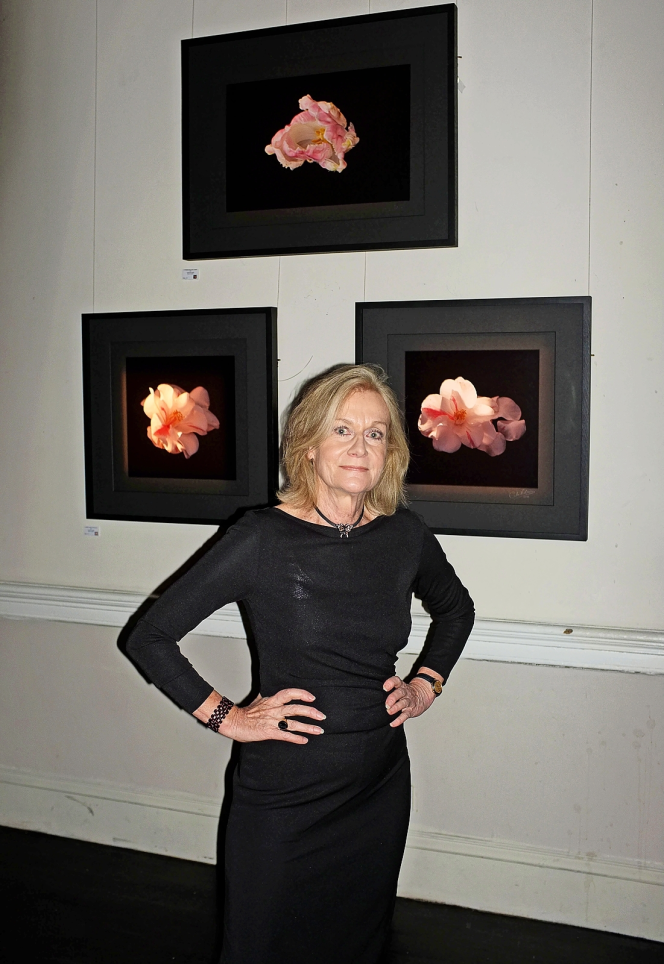 Latimer at her Flowers, Mirroring the Deep exhibition in 2011Richard Young/Shutterstock
“She could read someone’s spirit as soon as they walked in the door,” says her friend the author and actress Elizabeth Sharkey, who met her in 2001 when Latimer took her headshots. “She knew how to bring out what was inside of them.” Latimer worked on sets and in her studio, taking pictures of Barry Manilow in the Seventies, Billy Connolly and Bob Geldof in the Eighties and Rachel Weisz and Kim Cattrall in the Nineties, but her subjects also often invited her into their homes. A passionate gardener, she developed a series on celebrities in their gardens, including John Gielgud and Katharine Hepburn in the late Nineties. “She trod where few people got to tread,” Sharkey adds. She never married or had children. “She had a very courageous life, she lived very intensely … she was very passionate about her work.”
Blanca Schofield
 Rachel WeiszCarole Latimer
John Huston, Vienna, 1968
My first encounter with John Huston was on set for A Walk With Love and Death when he ambled up to me to ask if I had read Ulysses by James Joyce. I replied that I had not. “Call yourself a writer?” he countered. “No,” I retorted, “I call myself a publicist.” He laughed and wandered off. The next day, John came up to me again. “Well, have you read Ulysses?” “Of course,” I joked, my heart thumping and my cheeks burning with shyness. It worked, and from then on there was no more baiting of the new girl. Every night I would sit next to “the King” at dinner, listening to his hair-raising escapades, but he never bored us.
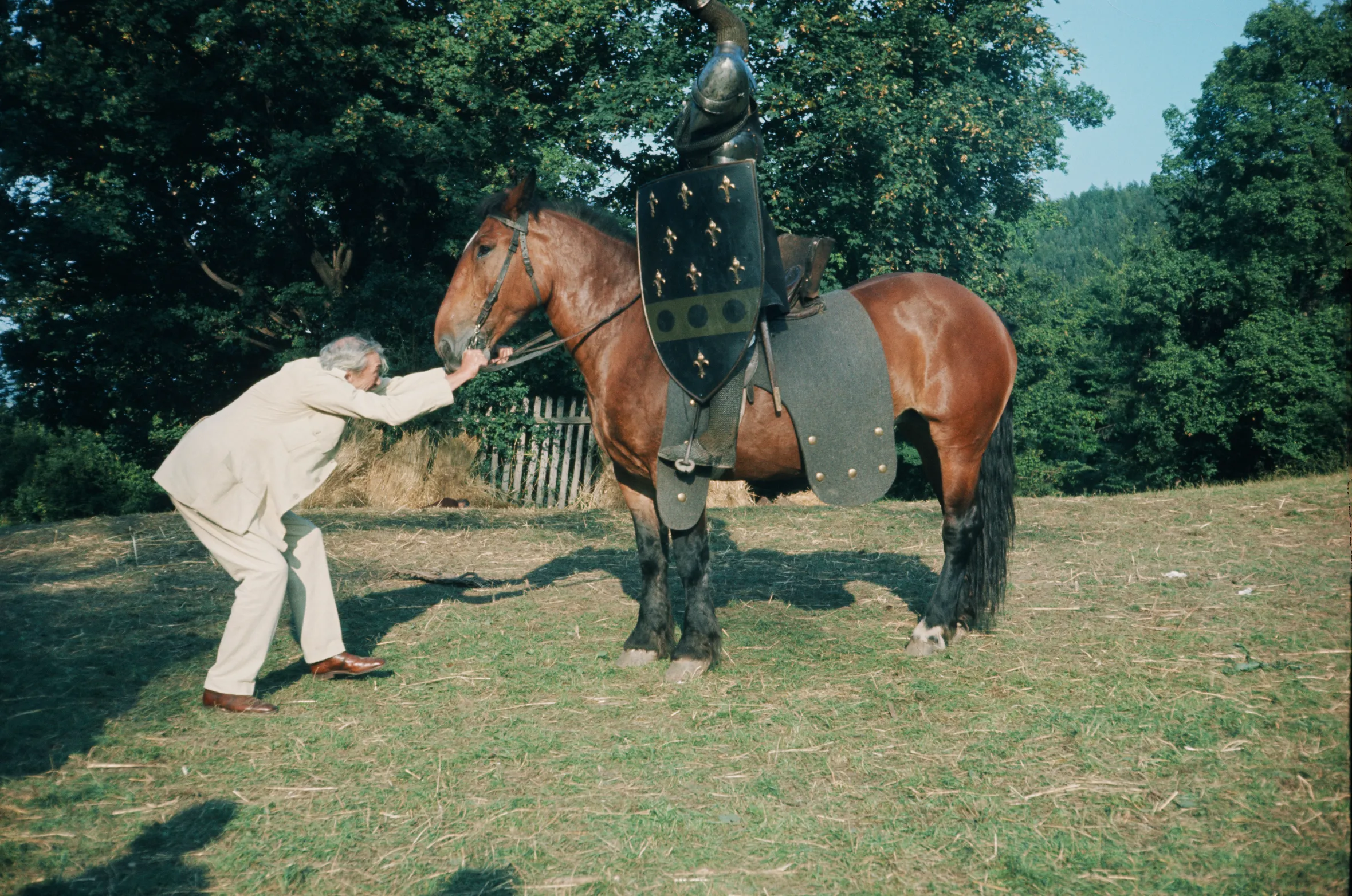 John Huston on the set of A Walk With Love and Death carole latimer
Huston had no scruples about propositioning women and girls: they were all part of the entertainment for him. The day soon came when I became the focus of his attention, followed by an invitation to dine at his hotel, a converted castle called Schloss Laudon. I declined politely, as it went without saying that dinner was not all that was on offer. Huston took my reply in good heart. To him, seduction was a game. The following day he walked over to me on the set, grinning broadly, and said for all to hear, “Man’s got a right to try.” There were other times when the offer was repeated, but I never saw it as sexual harassment. I took it as a compliment.
Katharine Hepburn, New York, 1990s
All my best opportunities have come about by chance. While visiting the director George Schaefer in Los Angeles, I mentioned my garden project and he asked if I would be interested in Katharine Hepburn, knowing she loved her gardens. So I wrote a long letter to Miss Hepburn, explaining my project and mentioning that I had worked with John Huston for four months. The answer came back, polite and not disinterested, but she said that she would be out of town and unavailable.
Two years later I was in New York and decided to drop the shortest line to Miss Hepburn’s East 49th Street address. A few days later I returned to the Fifth Avenue apartment where I was staying when Susan, my elderly, extremely deaf hostess, screamed, “Carole, Miss Hepburn called.” “Did she leave a number?” I shouted. “I don’t have time to take numbers,” she snapped, “I’ve got far too much to do.”
My friend Milton Goldman, one of the best-known theatrical agents in New York, saved the day. “Could I please speak to Miss Hepburn?” I hazarded on the phone. “This is she.” I tried to explain, in brief, my idea of photographing people in their gardens, to show the garden as an extension of their personalities. “I don’t know a great deal about gardening,” came the brisk retort.
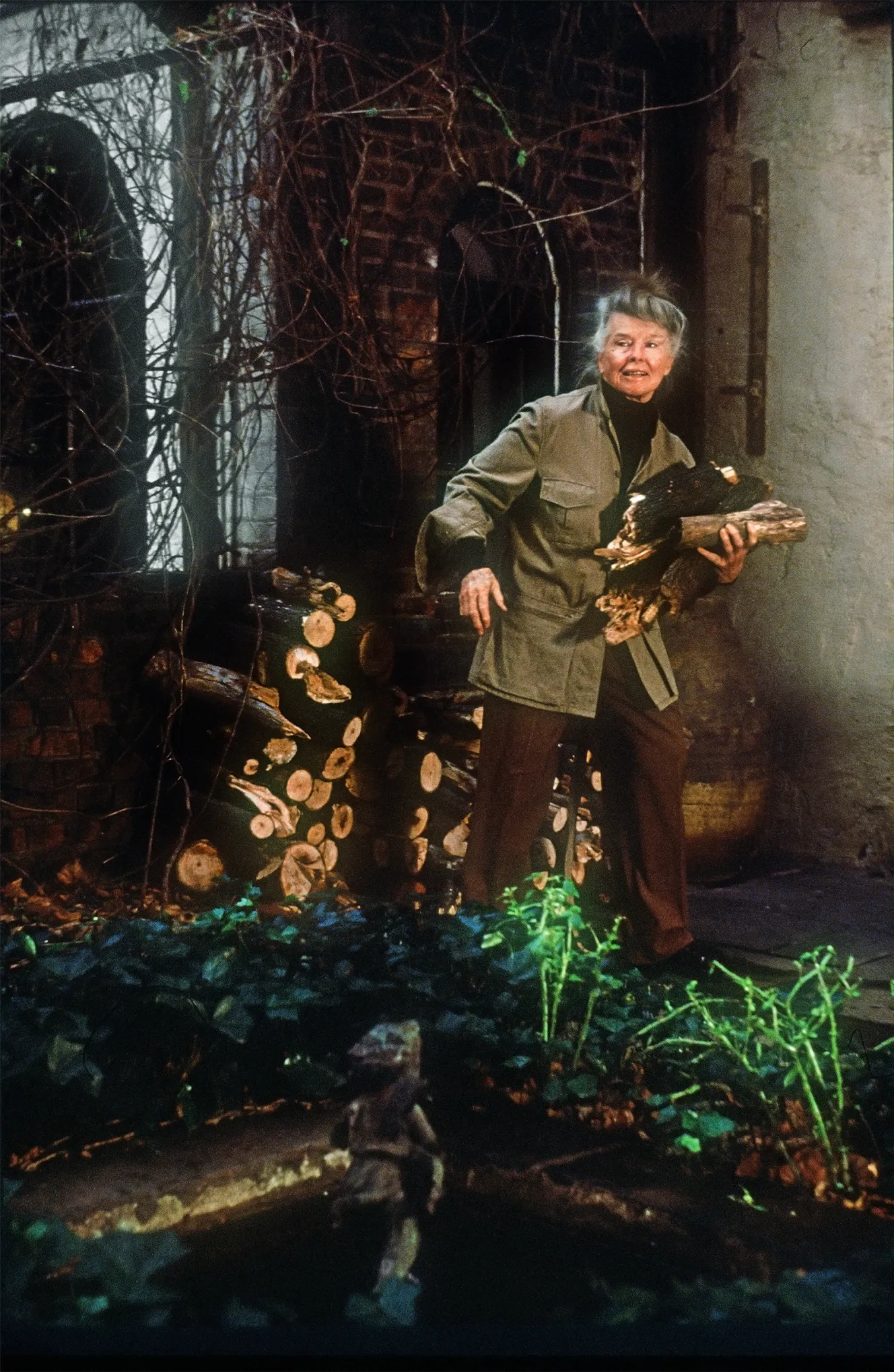 Katharine Hepburn at home in New YorkCarole Latimer
I pointed out that many of the people I had talked to did not know a great deal technically, but that I wanted their feelings and memories of gardens. “What are you trying to do, make jackasses of us all?” came another challenging response. My heart sank. I said that I wanted to know whether greenery was important to her wellbeing. “We’ll all be under it soon enough…” I simply let the pause continue, let her take the lead. And lead on she did. “Call me at nine tomorrow,” and down went the receiver.
As instructed, I phoned Miss Hepburn every morning at nine, and was ready to go: squeaky-clean hair, pristine clothes, cameras packed, lights charged up. Day after day, for three weeks, Miss Hepburn answered the phone on about the third ring and each day she said, “Call me at nine tomorrow,” with no explanation, no “goodbye,” just down went the receiver.
Two days after Thanksgiving, the summons finally came: “I shall be back at three,” and down went the phone.
The day was grey, with that flat, colourless, wintry light which saps the energy. The cab driver was all too aware of who lived in the tall brownstone at 244 East 49th Street. Her chauffeur of many years opened the door. There behind him was a petite figure walking down the narrow hallway, unavoidably recognisable with the familiar twist of hair on the top of her slightly nodding head. The tremor generally thought to be Parkinson’s disease was a rare hereditary condition. The clothes were familiar, a black turtle-neck sweater, khaki jacket and pants, so fashionable only because she had started the trend more than 50 years before. But oh dear, no make-up and the famous redhead’s skin, shiny as a waxed apple with huge red patches caused by sun damage. I would simply have to do a big touch-up job.
We headed straight for the garden, where the light was sinking fast; the surrounding skyscrapers would steal it by four. The outlook, as I had feared, was now bleak; damp brown leaves and unsightly black plastic bags spoke of autumnal work in progress as the plants drooped in harmony with the dreariness of the day. “I hope this won’t take long,” Miss Hepburn muttered ominously. I told her to stay in the warm house while I prepared. “Hurry up!” came the discouraging voice from the French windows as I frantically put up a couple of lights.
Too impatient to wait any longer she now joined me in the chill east wind and off we went, Miss Hepburn rushing around like a meerkat on speed searching the garden for ideas while I dragged my lights around. And then she volunteered, “I can be carrying logs!” As she lifted the logs her head stopped nodding for a split second on the upward movement. Click! I knew I had got the shot and that it had been worth the wait; two years to reach my goal and five minutes to shoot the picture.
I was taken totally by surprise when a choice of tea was offered; Earl Grey was mutually agreed upon and we withdrew to the back living room on the first floor. My first impression was of a real home, a room well lived in.
Miss Hepburn poured the tea and offered me a cookie. I declined. Another scolding for not taking a cookie and a diatribe about the foolishness of young people slimming. I hastily grabbed two cookies. The atmosphere thawed. “I have always had a lifestyle of a great deal of exercise which has always included gardening… I work hard. So that’s why I don’t have to diet. I eat lots of everything, red meat, sugar… I know that eating as much chocolate as I do can’t be good for me; I can eat a pound without noticing. I find people who diet madly exhausting.”
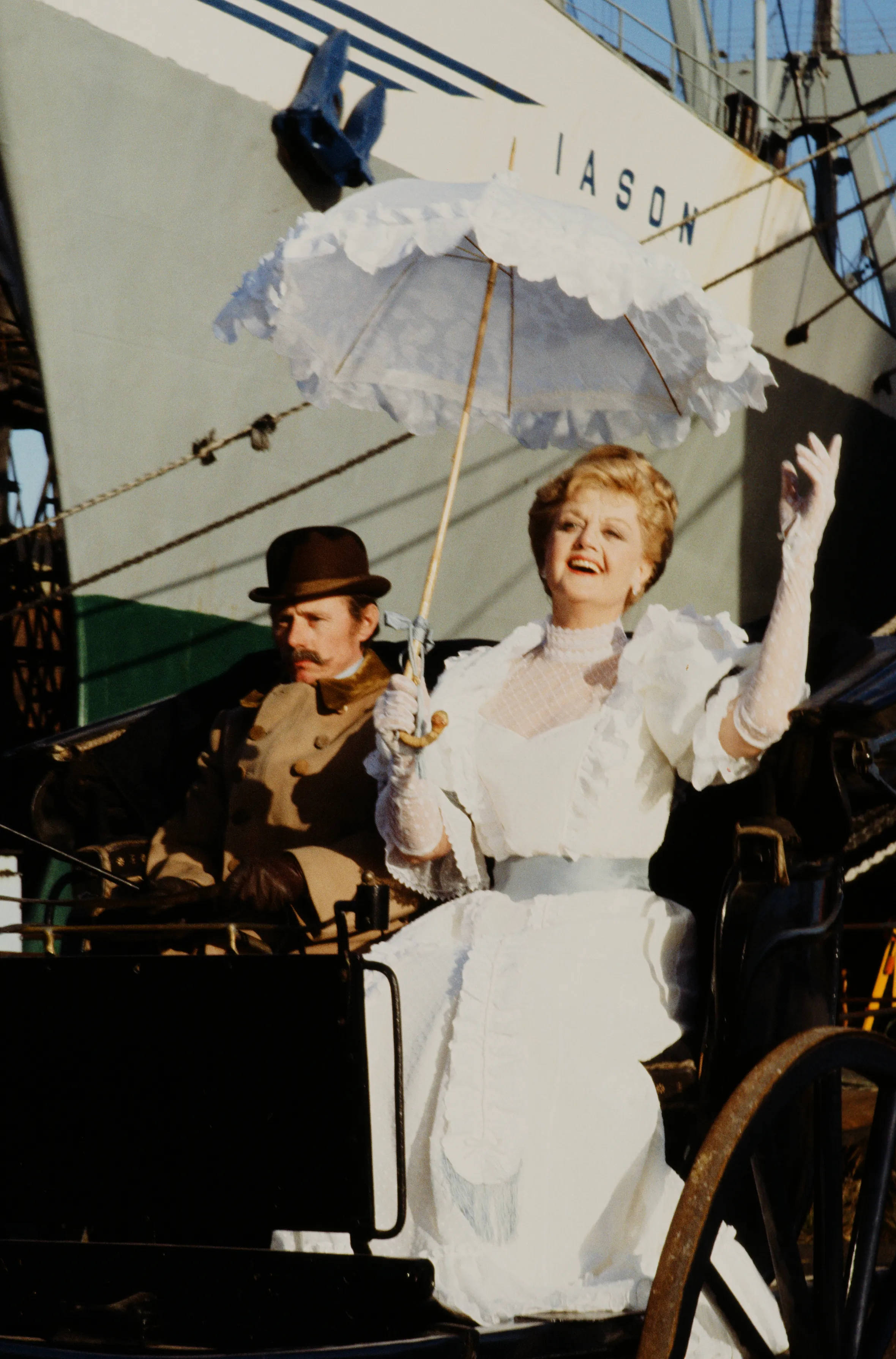 Angela LansburyCarole Latimer
One of six children, she grew up with a father who was mad about gardening. “I plant all the bulbs here and I planted that mountain ash myself, and you can see it is now up to the second storey,” she said, pointing out of the window into the dusk. “I like lilies but not necessarily calla lilies. I like white so much that my entire house is painted white inside. Sadly, I can’t have a favourite perfume as I have lost my sense of smell. I used to dip Q-tips in 4711 [perfume] to refresh my nose when I was working on dusty film sets. It almost totally destroyed my sense of smell and I never noticed at the time.”
Suddenly, Miss Hepburn looked at me intently, as though truly acknowledging my presence for the first time. “You’re wearing exactly the same clothes as I am,” she commented. “Well, isn’t that the funniest thing.” I thanked her for starting the fashion for wearing trousers. “I can’t bear wearing stockings, that’s what started me.” I mentioned that I liked her hairstyle, so timeless and always the same. “My hair is a goof of feathers,” she retorted, and added, “just like yours.”
Quite suddenly, out of the blue, Miss Hepburn asked me if I had slept with John Huston. Taken aback, I said, “No,” and countered by asking her the same question. “No, certainly not, a very dangerous man.” She laughed. Just two women discussing that same old subject.
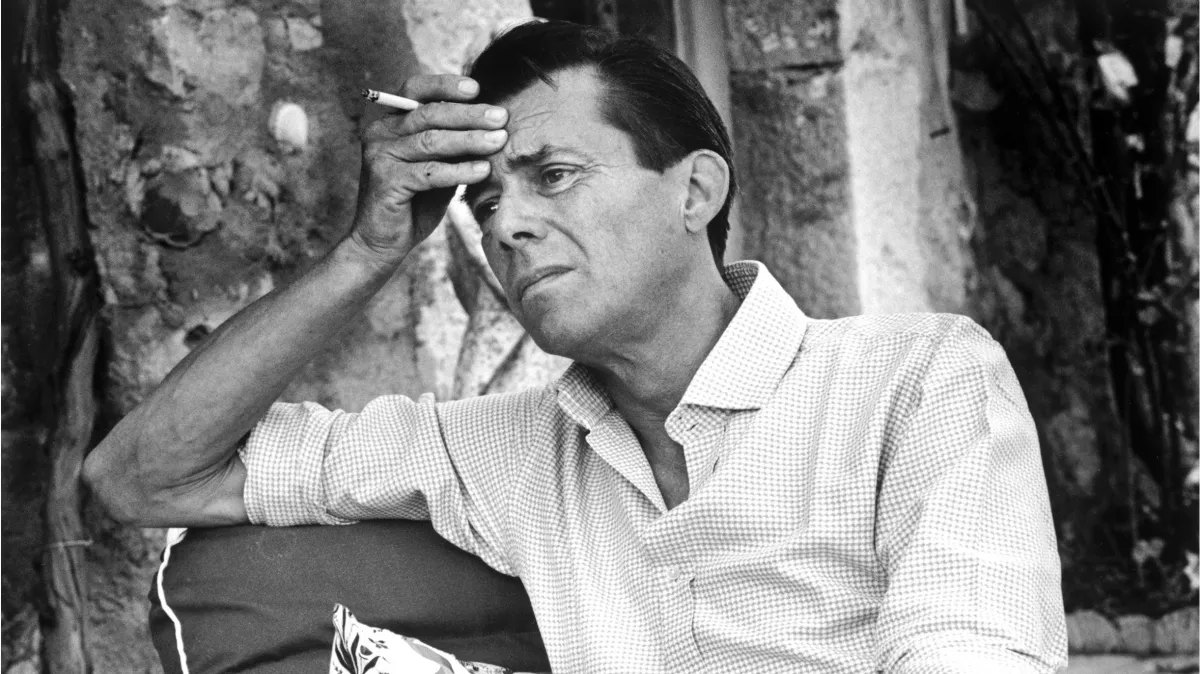
Dirk Bogarde, Grasse, 1980s
One of the most pleasurable and memorable home shoots I have undertaken was an afternoon with Dirk Bogarde in Opio near Grasse in the South of France during the Cannes Film Festival. I had been warned that the drive through pine-covered hills was arduous, along unpaved roads that became no more than confusing tracks leading up to Dirk’s house, Le Pigeonnier.
As we pulled onto the perfectly raked gravel cul-de-sac in front of the house, Dirk appeared, reed slim as ever, and elegant in white slacks, an immaculate blue-checked shirt and flip-flops. He greeted me warmly. “Oh, how tired you look, that wretched festival, so draining. You must have a cup of tea at once.”
At that moment Tony Forwood, Dirk’s dear friend with whom he shared the house, greeted me and disappeared to organise the refreshments. The tea was Earl Grey accompanied by the largest, richest brown sugar lumps I had ever seen. Dirk was keen to tell me they were from Harrods, the only place to get good brown sugar lumps.
He whisked me off on a private tour of his home. At 50, he now had plenty of time to build a wall, do his paintings and sketches, write, and read in the winter by the huge log fire. He had created a fish pond and a vegetable garden in spite of every hiatus known to man, from flooding under his precious olive trees to a leak in the septic tank that created what he thought was a natural spring. In blissful ignorance he had taken a drink before he noticed a piece of lavatory paper floating past him.
Then to my surprise we were heading up to the bedrooms and Dirk revealed that the bedroom with the huge double bed was Tony’s, while his was tiny, with a narrow bed. He explained that he felt desperately insecure in big beds and preferred to be wrapped tightly like a mummy.
Before I realised it I was saying my farewells. “Let me know when you are here again,” wrote Dirk on a postcard. I never returned, as Dirk and Tony had to sell their beloved home soon after my visit and move back to England. Tony fell sick and had several grim years in and out of hospital. It was only when Tony sadly died too young that Dirk had to learn everything to do with running his life, even how to write a cheque.
I later read that in the 1990s, when Dirk lived alone in London, he had written in his flat behind Sloane Square about the loneliness of weekends and how he would go out to buy a newspaper just so he could speak to someone. I wrote to Dirk later when I learnt he had been in hospital, and soon after I received a letter thanking me for my “very sweet and encouraging card … Much love, Dirk.”
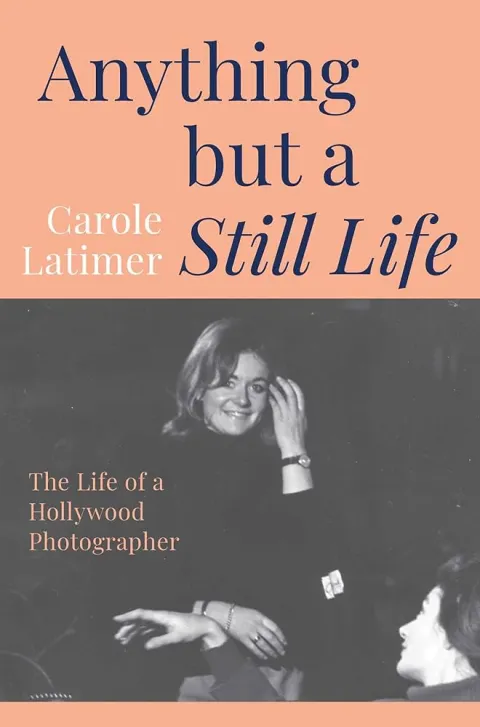
Extracted from Anything But A Still Life by Carole Latimer published on March 19 (Unicorn £30 pp240). To order a copy go to timesbookshop.co.uk. Free UK standard P&P on orders over £25. Special discount available for Times+ members.