
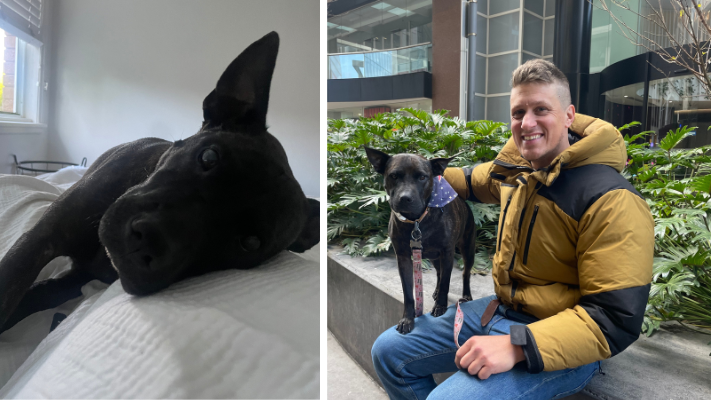
When veterinarians told Sydney tech entrepreneur Paul Conyngham that his rescue dog Rosie had months to live, he didn’t accept the prognosis. Instead, the data scientist and machine learning engineer — with 17 years in the field but no background in biology — turned to ChatGPT and set out to do something no one had done before: build a personalized cancer vaccine for a dog.
Rosie had been diagnosed with advanced mast cell cancer in 2024. Chemotherapy slowed the spread but couldn’t shrink her tumors. So Conyngham spent $3,000 to have Rosie’s healthy DNA and tumor DNA sequenced at the University of New South Wales, then used AI tools — including AlphaFold, a protein-modeling system — to pinpoint the mutations driving her cancer and identify potential drug targets.
“We took her tumor, sequenced the DNA, we converted it from tissue to data, and we used that to find the problem in her DNA and then develop a cure based off that,” Conyngham told Australia’s Today Show (1). “ChatGPT assisted throughout the entire process.”
When a pharmaceutical company refused to supply a promising immunotherapy drug for compassionate use, Conyngham pivoted. He worked with UNSW’s RNA Institute to manufacture a custom mRNA vaccine from his AI-generated formula.
Less than two months after the sequence was finalized, Rosie received her first injection last December — and by mid-March, the tennis ball-sized tumor on her leg had shrunk by roughly 75%, according to Conyngham’s March 15 appearance on Australia’s Today Show.
“At the start of December her mobility was way down, she started to shut down and be a bit sad,” Conyngham told The Australian (2). “And towards the end of January, she was jumping over a fence to chase a rabbit.”
Researchers at UNSW say it’s the first personalized cancer vaccine ever designed for a dog. “It raises the question, if we can do this for a dog, why aren’t we rolling this out to all humans with cancer?” said Martin Smith, director of the UNSW Ramaciotti Centre for Genomics.
Páll Thordarson, director of the UNSW RNA Institute, called the achievement a sign of things to come. “This is the first time a personalized cancer vaccine has been designed for a dog … ultimately, we’re going to use this for helping humans,” he told The Australian, adding that Conyngham’s ability to generate an mRNA recipe with no biology training shows the technology is “democratizing the whole process.”
Rosie’s story is remarkable on its own. But for investors, the real signal is what it validates: the same mRNA platform technology is already being tested in dozens of human clinical trials by some of the biggest names in pharma — and the most advanced programs are nearing potential regulatory approval (3).
Moderna (NASDAQ: MRNA) and Merck (NYSE: MRK) are leading the pack. Their jointly developed personalized melanoma vaccine — now called intismeran autogene — showed a 49% reduction in the risk of cancer recurrence or death over five years of follow-up when combined with Merck’s blockbuster immunotherapy drug Keytruda, according to data Merck released in January 2026 (4). The five-year hazard ratio held steady at 0.51, identical to the three-year mark — suggesting the vaccine trains the immune system to keep surveilling for cancer cells well beyond the treatment window (5).
Phase 3 trials are now underway for melanoma and non-small-cell lung cancer, with interim results from the melanoma trial potentially available later this year. Additional Phase 2 studies are running in kidney cancer and bladder cancer. Jefferies analysts have estimated the vaccine could be priced similarly to Keytruda — around $200,000 per patient — and could achieve multibillion-dollar peak sales in melanoma alone (6).
BioNTech (NASDAQ: BNTX), the German company behind the Pfizer COVID vaccine, is running its own mRNA cancer vaccine program in partnership with Genentech. Their personalized vaccine — autogene cevumeran — showed immune responses persisting for up to nearly four years in a Phase 1 pancreatic cancer trial at Memorial Sloan Kettering, with patients who responded to the vaccine showing delayed tumor recurrence compared to those who didn’t (7, 8).
A larger Phase 2 trial is now enrolling at sites worldwide. BioNTech is also testing mRNA vaccines for colorectal cancer and melanoma, though its oncology timeline trails Moderna’s (9).
All told, more than 400 clinical trials testing cancer vaccines of all types have been initiated globally over the last three years, according to data from the National Library of Medicine — roughly 120 of which are testing mRNA-based approaches specifically (10). The broader mRNA therapeutics market was valued at roughly $7.7 billion in 2025 and is expected to grow significantly as oncology programs advance, according to BCC Research (11).
Read More: 8 essential money moves to make once you’ve saved $10,000
Read More: You can now invest in this $1B private real estate fund starting at just $10
Moderna and Merck offer the most direct way into this space. Moderna’s entire growth narrative is pivoting from its pandemic-era COVID vaccine business toward oncology — its personalized cancer vaccine is the company’s flagship pipeline asset. Merck brings Keytruda, already one of the best-selling drugs in the world, as the combination partner.
But the investment case comes with real risk. Moderna reported full-year 2025 revenue of $1.9 billion, a 40% decline from $3.2 billion the prior year, driven by falling COVID vaccine demand (12).
The company continues to operate at a loss — its full-year net loss narrowed to $2.8 billion from $3.6 billion in 2024, but it’s still burning through cash as it funds a sprawling pipeline. Moderna ended 2025 with $8.1 billion in cash and investments, and management is targeting breakeven by 2028 (12, 13).
Adding to the uncertainty: the FDA initially issued a Refusal-to-File for Moderna’s U.S. flu vaccine submission in February 2026 — a decision STAT News reported was made by FDA CBER head Vinay Prasad over the objections of career staff — though the agency subsequently reversed course and accepted an amended application later that month, with a decision expected by August (14).
Federal health officials have also scaled back hundreds of millions in mRNA research grants under the Trump administration, including the termination of roughly $500 million in mRNA vaccine contracts through the Biomedical Advanced Research and Development Authority (BARDA).
BioNTech is another name to watch, though its oncology programs are at an earlier stage, with its lead cancer vaccine candidates still in Phase 1 and 2 trials.
The approach itself also has real practical hurdles that go beyond any single company. Each vaccine must be custom-manufactured for an individual patient based on their tumor’s unique mutations — a process that currently takes roughly 30 days to produce, according to Moderna CEO Stéphane Bancel, and costs upward of $100,000 per patient by industry estimates (15, 16). Scaling that across millions of cancer patients is a manufacturing and logistics problem no one has cracked yet.
“Cancer is heterogeneous, meaning patients with the same type of breast cancer might have tumors with different molecular signatures,” Mansoor Amiji, a pharmaceutical sciences professor at Northeastern University whose team recently published a review of the field, told Northeastern Global News. “We need to almost go towards a personalized therapy model, but personalized therapy is hard to do.”
What a tech entrepreneur with a sick dog and a ChatGPT subscription demonstrated in a matter of months — going from tumor biopsy to custom mRNA treatment using AI — is the same process that Moderna, Merck and BioNTech are spending billions to industrialize for human patients.
It’s not a cure. Conyngham is the first to say so: one of Rosie’s tumors didn’t respond, and the team is already sequencing it to design a second vaccine. But AI-driven drug design, falling sequencing costs and proven mRNA delivery platforms are pushing personalized cancer vaccines out of the lab and into late-stage trials with real data behind them.
For investors, the question isn’t whether this technology works. The five-year melanoma data suggests it does. The question is which companies can manufacture it at scale, get it through a shifting regulatory environment and turn a one-patient-at-a-time treatment into a commercially viable product. That race is well underway.
And for Rosie? She’s still here — jumping fences, chasing rabbits and living proof that a guy with a laptop, a sick dog and a stubborn refusal to accept the odds can push science forward in ways nobody saw coming.
Join 250,000+ readers and get Moneywise’s best stories and exclusive interviews first — clear insights curated and delivered weekly. Subscribe now.
—
We rely only on vetted sources and credible third-party reporting. For details, see our editorial ethics and guidelines.
Today Show Australia (1); The Australian (2); Scientific American (3); Merck (4); Fierce Biotech (5); Reuters via AIM at Melanoma (6); BioNTech (7); Nature (8); Oncology Pipeline (9); Northeastern University (10); BCC Research (11); Moderna via ACCESS Newswire (12); Motley Fool (13); STAT News (14); Fox Business (15); Industry estimates (16)
This article provides information only and should not be construed as advice. It is provided without warranty of any kind.