
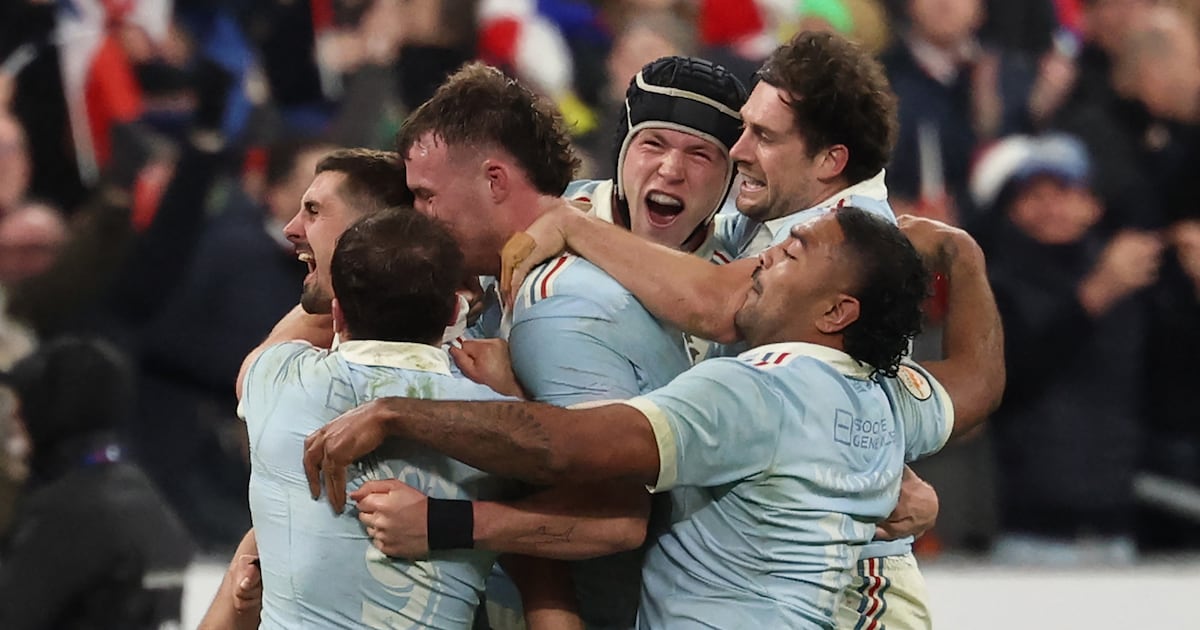
Well then, what the heck to make of that? We seem to live in a very black-or-white era, with less grey area or middle ground. Almost everything has to be “the best” or “the worst”, be it coaches, players, teams or tournaments. But truly, that was the best Championship ever, wasn’t it?
If only Fin Smith had kicked his goals on the last night in Paris, or Henry Pollock not opted to pass in the game’s final play, or Trevor Davison not high-tackled Josh Brennan, England would have won and Ireland would now be the 2026 Six Nations champions. Then there’d be little debate, in Ireland anyway.
It all had uncanny echoes of Super Saturday in 2015. Same set of fixtures, different home venues. Wales set the target with a 61-20 win over Italy in Rome, before Ireland became clubhouse leaders by beating Scotland 40-10 in Murrayfield and England came up just short when winning a madcap game against France in Twickenham by 53-35. Cue an Irish trophy presentation in Murrayfield.
Once again three teams were in the last-day title hunt, but this year’s denouement was more thrilling and memorable, and also in keeping with the whole wild and wacky six-week ride. Not so in 2015.
The main reason Super Saturday lived up to its billing then was because Ireland’s Grand Slam dreams were dashed by a 23-16 defeat in Cardiff the week before. That set up a three-way fight and the shackles came off.
The recalled Luke Fitzgerald received more passes in the first quarter than Simon Zebo had done in the previous four games. Ireland had scored just four tries (conceding a miserly two) before doubling their tally in Murrayfield. Last Saturday, the tries rained even more freely, with 29 as against 27, but that topped off an altogether more entertaining Championship.
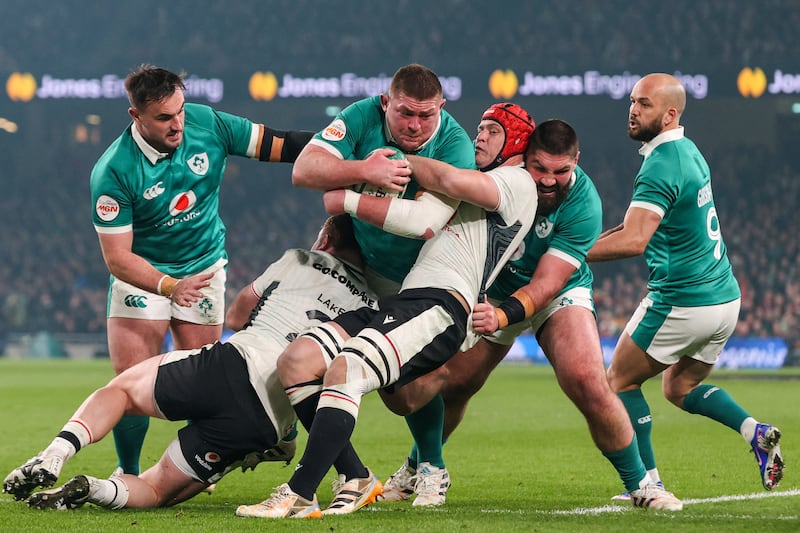 Ireland’s Tadhg Furlong is tackled during the Six Nations match between Ireland and Wales at the Aviva Stadium in Dublin, on March 6th. Photograph: Paul Faith/AFP via Getty Images
All told, there have been a Championship record 111 tries, 50 more than in the largely forgettable 2015. The compressed six-week format must have contributed. More rotation, more punishing schedules, no let-up. Referees and TMOs let the game flow.
If the ball was at the back of a collapsed scrum, teams were told to play it, and referees found more of a balance between the attacking and defending teams at the breakdown, making it harder to keep teams out in the red zone, although not impossible.
So much for the prophets of doom and gloom about the game.
Having beaten Ireland 36-14 and scored the most tries (30), France deserved to be champions, although they were lucky against England. It helped that Louis Bielle-Biarrey made any kick-chase an unfair race. His nine tries were another Championship record.
Fabien Galthié allowed his team to play with freedom, apparently at the players’ behest, which makes sense when you have Antoine Dupont and Matthieu Jalibert, although they leaked 14 tries in the last two games. Their rugby was exhilarating and their 77 offloads were 32 more than the next best, namely Ireland.
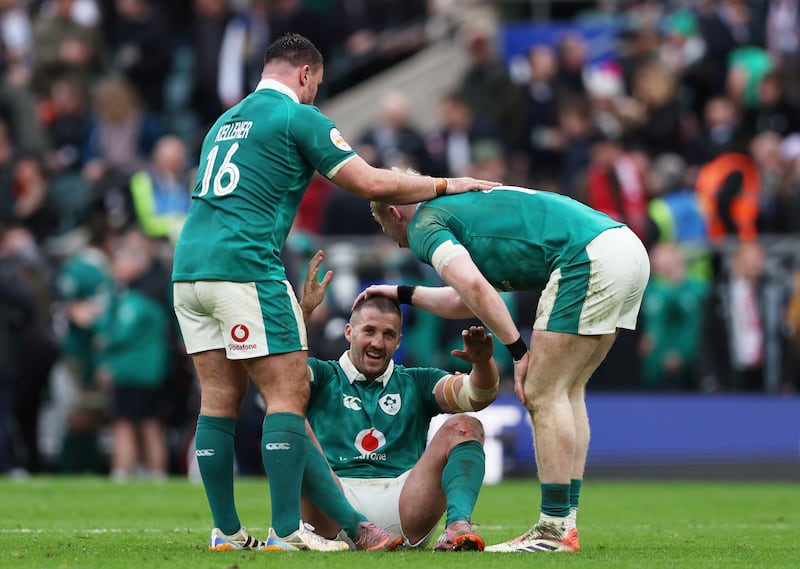 Ireland’s Stuart McCloskey celebrates victory with teammates Rónán Kelleher and Jamie Osborne at Twickenham on February 21st. Photograph: Steve Bardens/RFU Collection via Getty Images
This reflected Stuart McCloskey’s transformative effect, along with the injection of pace provided by Robert Baloucoune and Tommy O’Brien. Ireland’s outside backs scored 11 of their 20 tries. At 28 and 27, Baloucoune and O’Brien have both been “finds” in their debut Championships, as has Tom O’Toole, and there’s been reaffirmation of the world-class quality of Tadhg Beirne, Caelan Doris and Jamison Gibson-Park.
To rebound from the false start in Paris with four wins, including that record-breaking Twickenham victory, and finish at full throttle against Scotland to earn a fourth Triple Crown in five years is not to be sniffed at.
Gregor Townsend took some solace in his team playing their best rugby yet under his watch and they threw plenty at Ireland, whose 232 tackles on Saturday was their highest total in 15 years. Also, it’s worth noting that the ball-in-play time for that game was 42.9 minutes, compared to 34.9 in Cardiff and 35.6 in Paris.
Ultimately there was something in it for everyone. Italy had a first-ever win over England and a fourth-place finish. Wales made huge strides from their dismal opener to eventually end a 15-match Six Nations losing run.
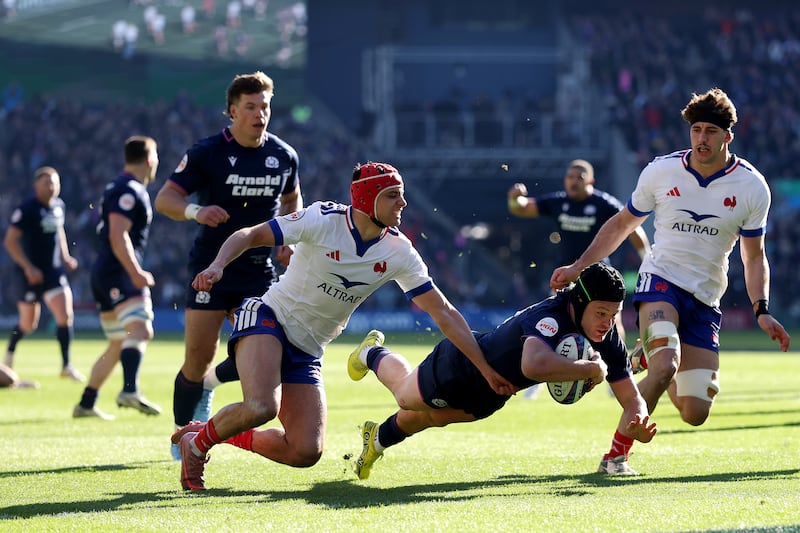 Darcy Graham of Scotland scores his team’s first try during the Six Nations match between Scotland and France at Murrayfield on March 7th. Photograph: Stu Forster/Getty Images
That Twickenham opener also misled England, before they were jolted by Scotland and derailed at home by Ireland, but there was an over-reaction to their defeat in Rome when they played well for an hour. They demonstrated in Paris that when they are let loose they are not a bad team at all, even if this was the first Championship for 50 years in which they lost four games.
But even if there is often one team seemingly consigned to the wooden spoon from the outset, a good side has to finish fifth. That’s the Six Nations. And it was that kind of tournament – seemingly setting a record for broken records.
There’s still plenty of road to be travelled between now and the World Cup. Next up the inaugural Nations Championship in July and November, before next year’s edition of the oldest and best annual competition in world rugby.
Oh, and, same as France this year, Ireland bookend the 2027 Six Nations with Friday night and Saturday night games at home to France and England. That will be interesting, albeit this one will take some beating.