
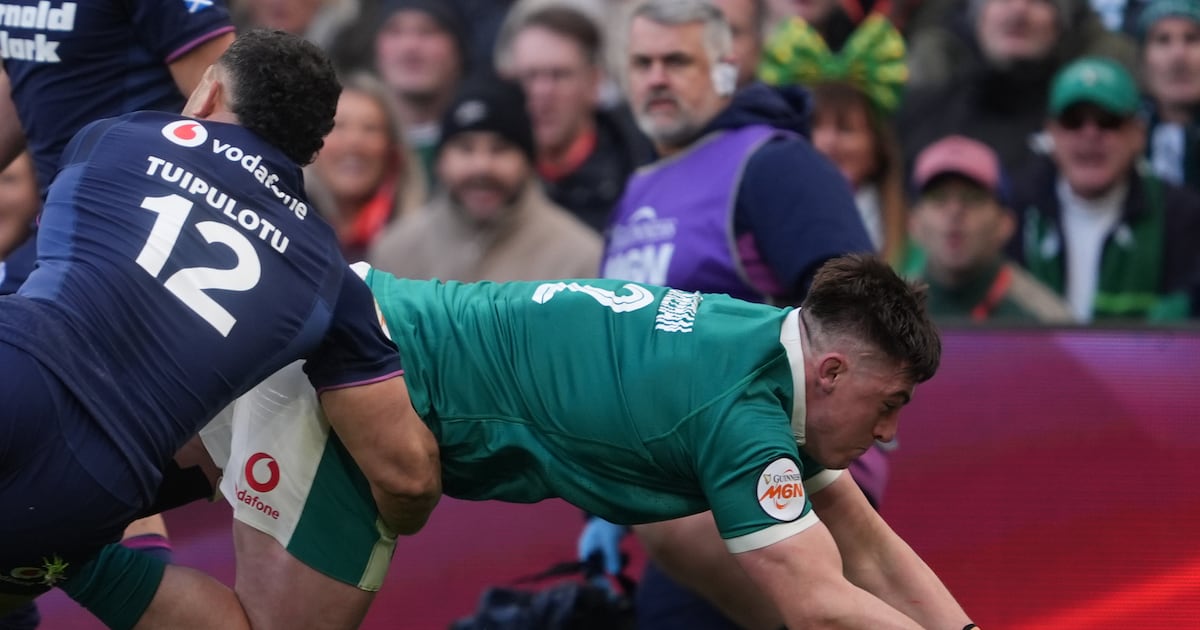
At the start of this Six Nations campaign, we highlighted one stat to watch with Ireland: rucks per try. Every attack coach’s dream is to score without the ball hitting the floor, a zero-ruck try. Don’t offer chances for defences to disrupt the ball.
Ireland showed signs of progression on this front in Twickenham. Tries came within a phase or two of securing possession. The satisfaction of the zero-ruck try – other than Jamison Gibson-Park’s clever quick-tap – did not materialise. Until Saturday.
By and large, the focus of this analysis was on counter-attack. France are masters of the zero-ruck score with their ability to strike off loose ball. Just give it to Louis Bielle-Biarrey.
With Ireland, we forgot about the other critical source of fast balls, one that has been kind to them through the years: set-piece moves.
Ireland hadn’t scored off an intricate, pre-planned lineout or scrum play all tournament. The last first phase try off set-piece was against Italy last year. That run ended against Scotland, assistant coach Andrew Goodman earning his coin with a playbook that punished Scotland to the tune of three set-piece tries, two of them without a single ruck.
Ireland’s best first phase strike came while attacking Scotland’s tendency for bad defensive decisions from their widest defender. Against Italy, England and France, there were examples of that wide defender – often a wing or fullback – being caught narrow and subsequently picked off.
No surprises that, 19 minutes in, from a scrum close to the touchline just outside the Scottish 22, Ireland went immediately to the opposite flank. See the width of the opening passes. Between Jamison Gibson-Park and Jack Crowley, Ireland use two players to take the ball outside three Scottish defenders – Ben White, Finn Russell and Sione Tuipulotu (circled in red).
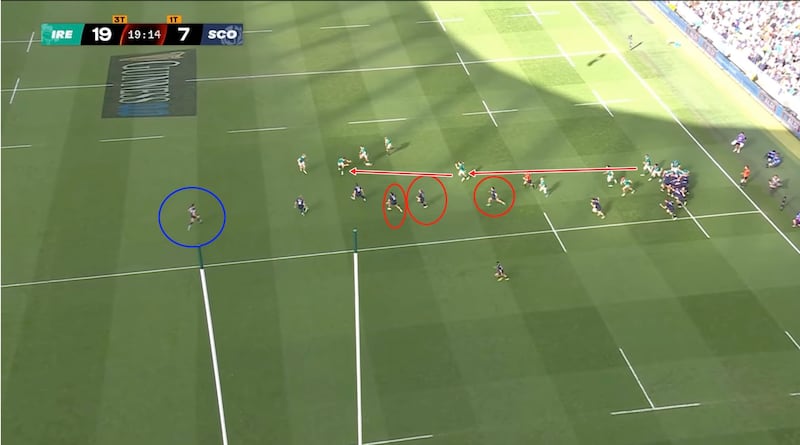 The width of Ireland’s passes from 9 and 10 take multiple defenders out of the game.
By the time Garry Ringrose gets the ball in the middle of the field, Scotland already have a numbers problem. This forces Blair Kinghorn (blue circle above) to bite in. The entire Scottish defence narrows – Kinghorn is their widest man.
Ringrose has one runner short, Jamie Osborne, and one out the back in Stuart McCloskey. Ireland quite often change roles here, with the outhalf running behind the decoy instead of the big centre, but they trust McCloskey as the playmaker. We’re about to see why.
Ringrose hits his midfield partner, but he and Osborne have drawn in Huw Jones and Kyle Steyn while subtly blocking Tuipulotu and Russell (all circled in red) from getting to the wider runners.
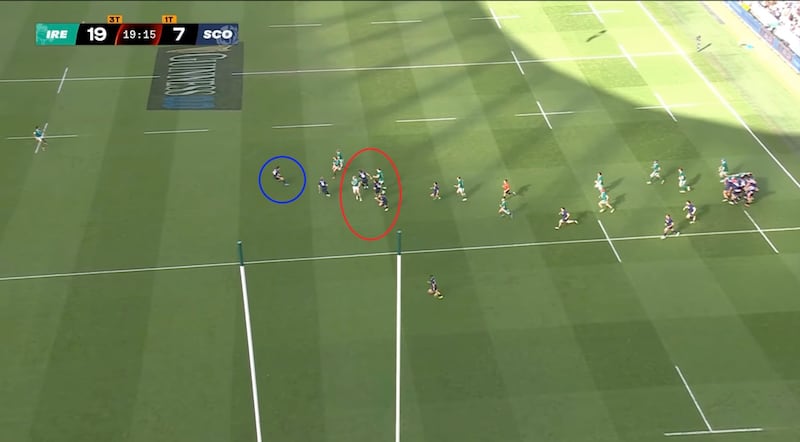 Ireland force Scotland to narrow in midfield and make bad decisions out wide.
Kinghorn (blue circle) is exposed. He’s in a difficult position from the moment Gibson-Park and Crowley have created Ireland’s numerical advantage. Tommy O’Brien’s work off his wing also forces what is known as an overload, sending another runner to mark.
If coming in that narrow, Kinghorn should look to take McCloskey man and ball. It’s a risk to come in tight and not make a tackle. Kyle Steyn, though, is the one marking McCloskey. He also doesn’t make a hit after focusing on Osborne’s short line. That leaves Kinghorn in an impossible position.
He probably thinks he’s coming up to hit O’Brien should he receive a short pass from McCloskey. Steyn’s indecision forces Kinghorn to second guess who he’s tackling – McCloskey or O’Brien. He ends up with neither.
McCloskey spots that Kinghorn, the widest defender, is now in line with the posts and throws a long, looping ball to Robert Baloucoune. The Ulster wing held his width brilliantly, likely an coaching instruction given Scotland’s tendency to condense.
From there, it’s a footrace. Darcy Graham, a speedster himself, is corner-flagging from the opposite wing. Baloucoune, though, just makes him slow up by threatening to cut inside. Watch how he curves his run, ever so subtly feigning to come infield before pushing off his left foot and arcing towards the corner. Then look at Graham’s deceleration (his strides get shorter) and subsequent acceleration as he realises Baloucoune is going on the outside after all.
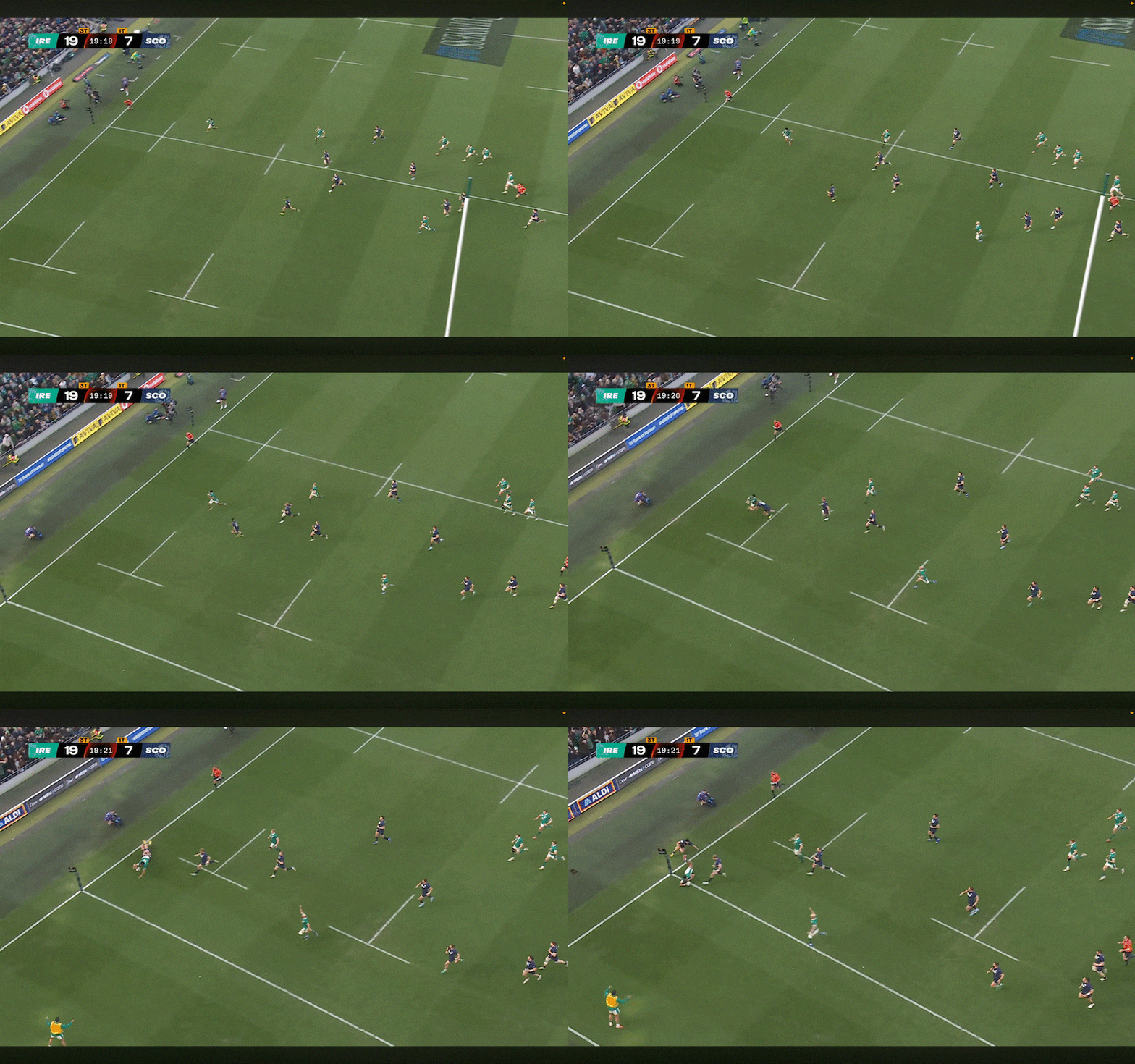 Robert Baloucoune’s footwork allows him to get on the outside of Darcy Graham.
By creating indecision, Baloucoune buys himself enough time to score in the corner. Ireland’s set-piece has exposed Scotland’s wide defence without a single breakdown.
That was, technically, Ireland’s second zero-ruck try of the game. The first was a touch more straightforward but no less welcome.
Ireland’s maul had not previously brought any try-scoring return in this Six Nations. The last time Ireland scored a maul try was against Japan in November.
That Dan Sheehan got on the end of a score on Saturday can largely be put down to another example of average Scottish decision-making under pressure. Contrasted with Ireland’s ability to spot and take advantage of a gap.
 Rory Darge (seven) taps his teammate to tell him to enter the maul, leaving a gap for Sheehan.
This particular maul on 10 minutes wasn’t rumbling over the line. Multiple Scotland players were still spun out on the wrong side, away from the part of the maul which needs manning to repel the drive. This is likely what caused Rory Darge (number seven, above) to tap his team-mate on his right. They both then hit the maul.
By the time the pair did so, the Irish drive was already veering to the left and in the process of collapsing. While Darge did talk to the man on his right, he didn’t make sure the team-mate on his left, Tuipulotu, moved in to occupy the space he was leaving. This created a gap for Dan Sheehan (white circle, below).
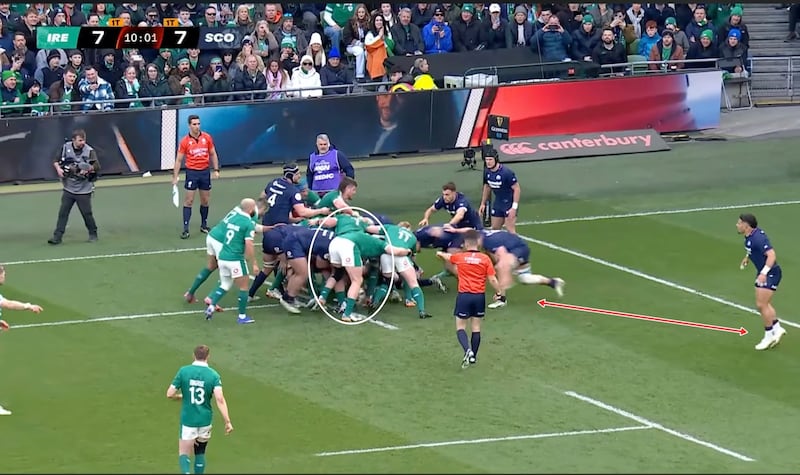 The gap between Rory Darge and Sione Tuipulotu (red arrow) was not filled sufficiently to stop Dan Sheehan from scoring.
From this angle, it looks like Sheehan’s head is too close to O’Brien’s (11) backside to see anything. But it can’t be a coincidence that, as soon as two Scottish defenders dived into an already-collapsing maul, he ran through the space they previously occupied. For any hooker with a functioning pair of eyes, this was a gift.
Where we can credit Ireland’s set-piece once again is their first try of the game. This wasn’t strictly speaking on first phase as there was one Irish ruck.
It starts with a lineout inside the 22, the field position won by Tom O’Toole’s successful scrum penalty. Given the proximity to the try line, Scotland have to be wary of a maul.
They think that Sheehan is throwing to the back of the lineout and put most of their defenders there. Grant Gilchrist (circled in red) gestures in that direction. This is at least in part because of the positioning of Josh van der Flier (red scrum cap), Ireland’s receiver who normally joins mauls to either link with the late-arriving hooker or feed the ball to Gibson-Park and the backline.
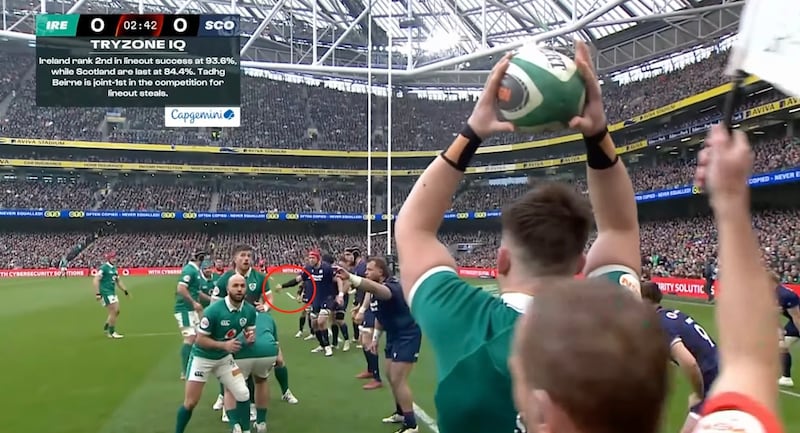 Grant Gilchrist (circled) motions to where he thinks the ball is going.
Instead, Sheehan throws to Joe McCarthy at the front. With most Scottish forwards marking the back, they now scramble towards the touchline to cover the threat of the maul. Ireland have cleverly condensed the lineout with a view to leaving space at the back. A dummy maul, instead feeding Gibson-Park, allows them to attack it.
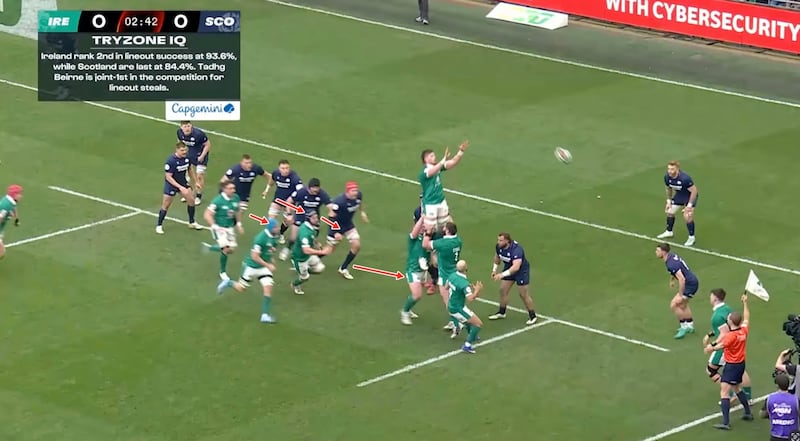 Scotland mark the back and have to react to the ball at the front.
Only the gap materialised elsewhere. It looks like Gibson-Park is targeting the seam, the area between the back of the lineout and the backline. This is always a vulnerability as the backs are deeper than the set-piece, leaving space to build a head of steam. The plan here seems to be to draw the pack towards the dummy maul close to the touchline, leaving two big men in McCloskey and Baloucoune running at a backline shorn of forward help.
But Scotland have actually manned this area pretty well, leaving two heavies at the back of the lineout to mark anyone heading either for the seam or the outhalf. To the point where there is a massive hole in the middle of the lineout, not at the back. Had Gibson-Park seen it, he could have scored himself.
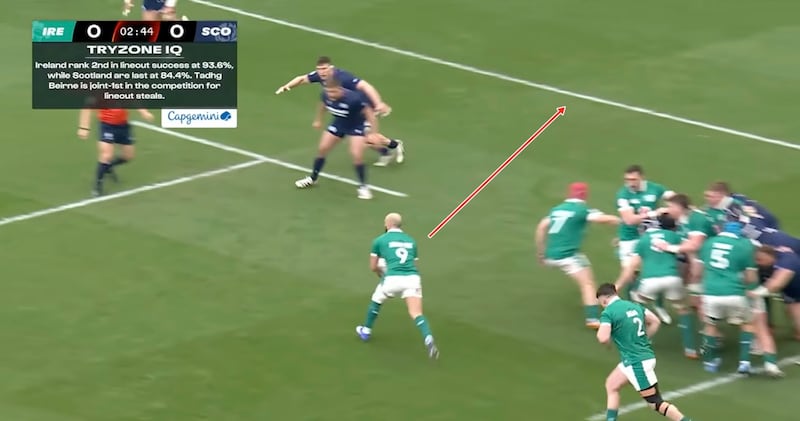 Two Scottish defenders man the seam but leave a gap in the middle of the lineout.
He instead sticks to plan A and hits Baloucoune. It’s not a bad option as play gets to within a metre or two of the line.
 Rob Baloucoune carries off the lineout as Ireland look to attack the seam between the set-piece and the backline.
After the Baloucoune ruck, Gibson-Park flashes a pass across two carry options to Caelan Doris. Again, the width on the pass takes defenders out of the game. The killer from a Scottish perspective, though, is how Doris draws two would-be tacklers to just one man (red circle below). This opens everything up.
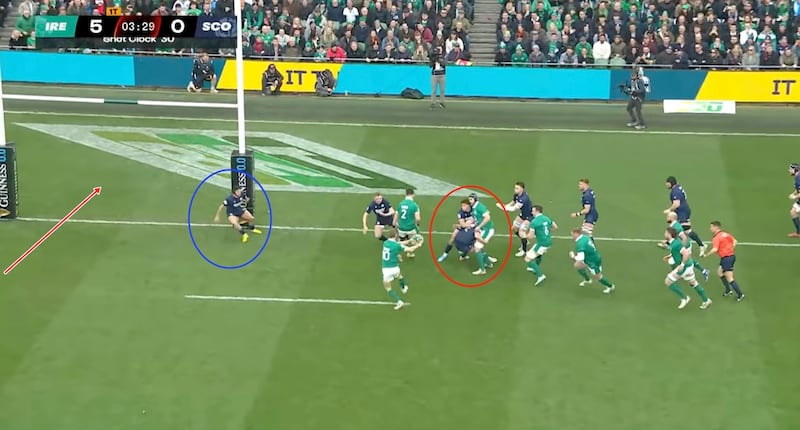 Two defenders draw in to Doris, leaving the outside tacklers in no-man’s land.
With two defenders on Doris, Russell has to bite in on Sheehan (2). Darcy Graham (blue circle) does not have time to adjust having initially held his width. Once again with Scotland, the numbering issue inside forces a wide defender into a difficult position.
Since Russell had to first focus on Sheehan, Graham gets stuck between Crowley (10, above) and Osborne (out of shot). He ends up with neither as the Irish fullback strolls under the posts.
Ireland have historically been a side renowned for their set-piece attacking detail. In this Six Nations, they have started adding a counter-attacking and offloading layer – see O’Brien’s final try courtesy of McCloskey’s basketball pass on turnover ball. That is certainly one way of minimising the number of breakdowns per try, diminishing the opportunity for disruption on the floor. Another is to conjure set-piece strikes that target defensive weaknesses.
Twickenham saw the counter-attack flourish. Saturday brought the set-piece detail. Variety is never a bad thing.