
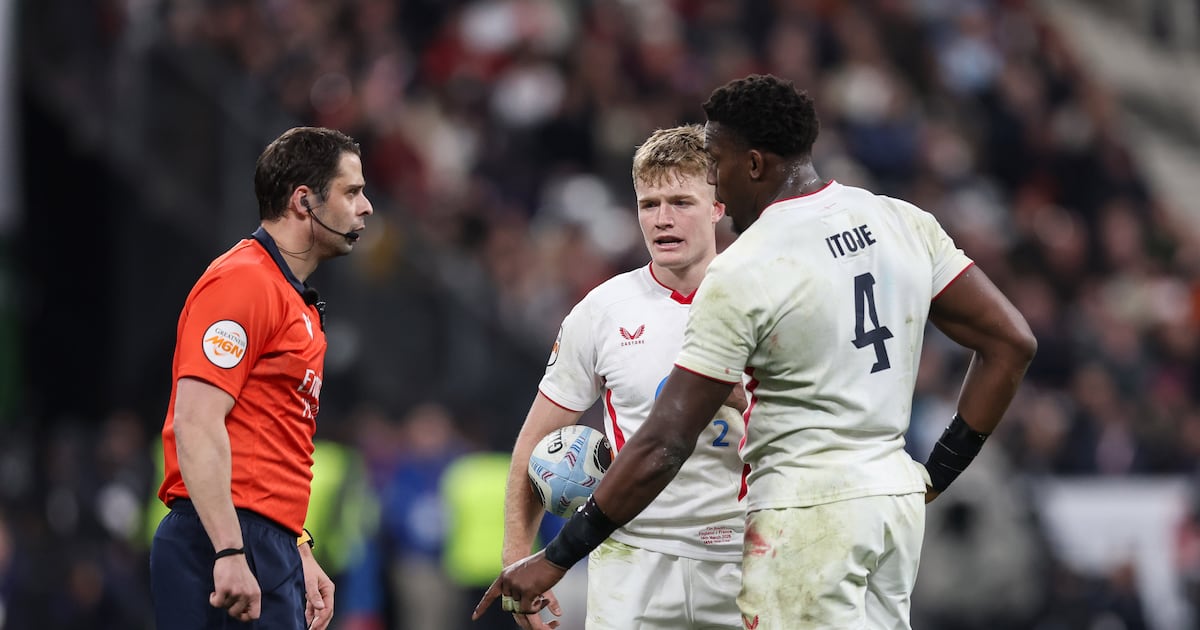
You could not make it up. Just when you think you’ve seen it all, Superlative Saturday came along. As we’d hoped, the weather gods were kind, and the matches delivered rugby which was way beyond our wildest dreams. Above all, there has never been anything like what we saw in Paris, and that includes the colour-clashing French jersey.
The bookies left Cheltenham with a lot of swag in their satchels, and the Six Nations has undoubtedly been very kind to them too. Apart from the favourites winning the last match, the results across the five weekends were unpredictable. Ireland came within a whisker of the championship, which would have been courtesy of the TMO, who called an incorrect forward pass against Italy at the Aviva.
 Ireland denied the title by France’s late act
In Paris, England played off the cuff, hard and fast to great effect. The result hinged on two events. The first one saw the Georgian referee, Nika Amashukeli, award France a penalty try and send Ellis Genge to the sin-bin for collapsing the French attacking maul. In isolation, that was the correct decision.
However, there is a broader picture. It shows the French jumper being shielded by team-mates as he lands and the maul starts to move forward. That, for me, was the first offence — a penalty to England for obstruction was due. It is tricky enough to see at ground level, while the TMO has a bird’s eye view, but, on this occasion, Brett Conran did not seem to offer any concrete advice.
There is a school of thought that a penalty try accompanied by a yellow card is a double whammy, and unnecessarily harsh. But it exists to stop players attempting to get away with an infringement, knowing that the bin awaits if they are caught. Steve Borthwick was distinctly unamused on this one, and he has a point.
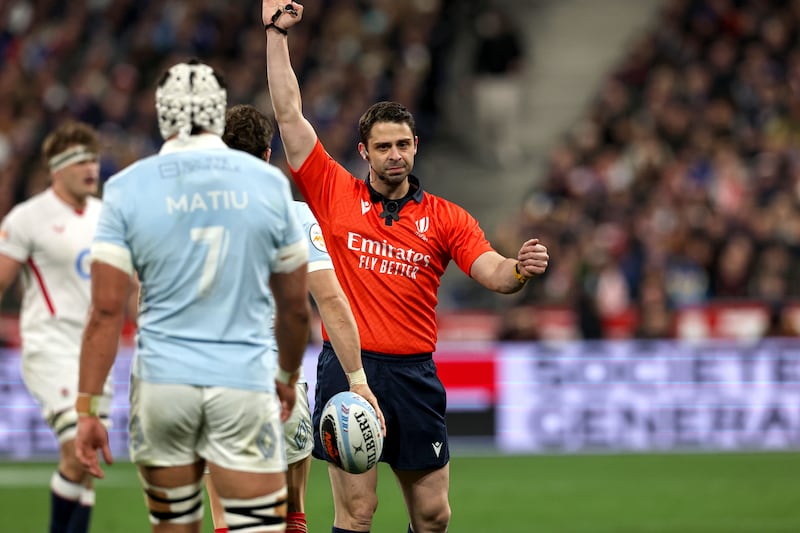 Referee Nika Amashukeli. Photograph: Billy Stickland/Inpho
There was also confusion for England when a penalty advantage was changed to a knock-on advantage (apparently called during the play by the TMO), prior to France breaking out for Louis Bielle-Biarrey’s fourth try. An explanation is needed as to how that fits the TMO protocol. Apart from these two uncharacteristic incidents the referee was good, in a match with the highest degree of difficulty and intensity. Very few officials could have handled matters equally well.
Nonetheless, England looked to have the result in the bag. As the clock ticked into the red, it just had to be Ireland’s championship. But then suddenly, either of two offences gave Thomas Ramos a last-ditch chance to snatch back the title. The first was a high tackle (irrespective of the position of the ball carrier), it appeared to be by replacement Will Stuart. And as advantage was being played, Mario Itoje deliberately knocked-on, the second successive week that the captain has infringed in senseless fashion. The long-range penalty, for France’s ice-veined marksman, was a gimme.
Amashukelli’s reputation, for not entertaining players that want to debate his decisions, stood him in good stead. He was not subjected to constant nagging by players seeking detailed explanations, whereas England had been constantly in the ear of debutant French referee Luc Ramos against Italy. The players know it, so they don’t bother the Georgian. More referees should follow his example, and his non-use of first names is very much more appropriate than the “chummy” prattle we hear too often. Hopeful future elite referees, please take note.
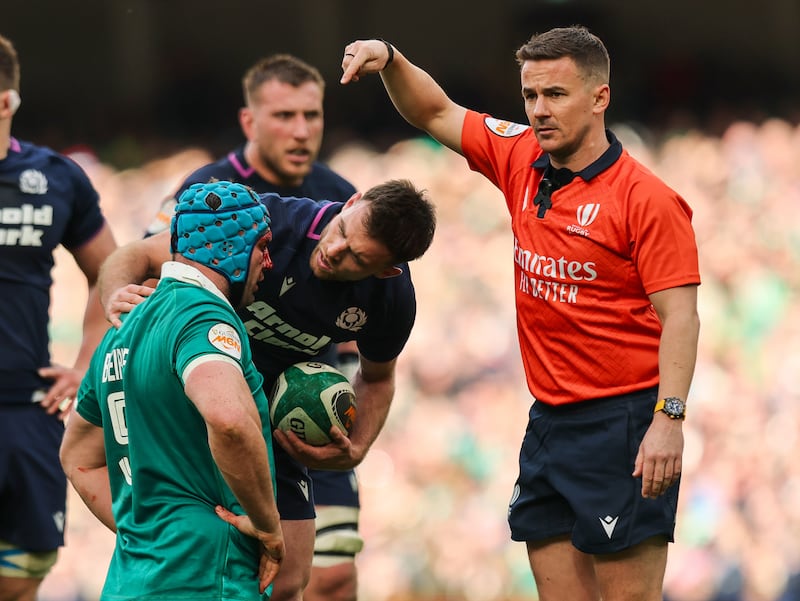 Assistant referee Luke Pearce signals to the sideline for Ireland’s Tadhg Beirne to receive medical treatment. Photograph: Ryan Byrne/Inpho
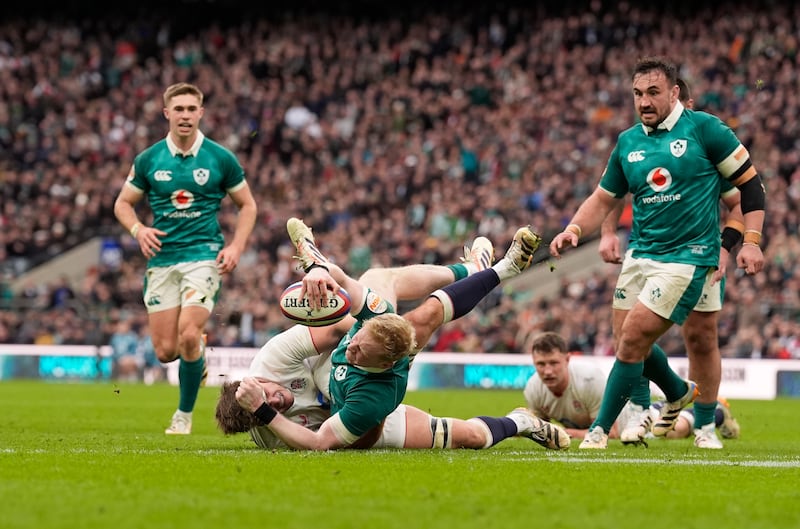
The day had started off at the Aviva, with a marvellous display by Ireland. Coming second, and winning the Triple Crown, are of very high merit. Referee Luke Pearce was somewhat quieter than usual and, given the margin of victory, he had no bearing on the outcome. But I would question Dan Sheehan’s try. Tommy O’Brien had latched onto the maul in front of Sheehan, shielding him, before the hooker broke away, and went over unopposed.
Robert Baloucoune’s try was probably the moment of the match – Ireland used the scrum for the great attacking platform that it is. Nine of the Scottish team were involved in it, leaving just six defenders. Fast ball out, then a tremendous pass and finish, were the ingredients for a wondrous score.
The Six Nations is all the poorer when Wales are not playing well, failing to be competitive. So, the majority of rugby followers will have been pleased to see them put in a storming performance against Italy, harvesting a richly deserved victory. Englishman Christophe Ridley was in charge, and he did well. He might consider, though, reducing his repeated explanatory signalling, it can come across as justifying decisions.
Everybody should be grateful that the recent World Rugby shape of the game conference, chaired by Australian Brett Robinson, fortuitously and surprisingly concluded that no law changes were necessary, and that the contest for possession is integral to the game. We have watched persistent proof of it throughout the Six Nations. The shape of the game is just fine.
Follow our rugby WhatsApp channel
If you want the latest rugby news, analysis and opinion then you should follow our dedicated WhatsApp channel. From Gerry Thornley to Owen Doyle and Gordon D’Arcy, we have every angle covered.
Find the channel here.