
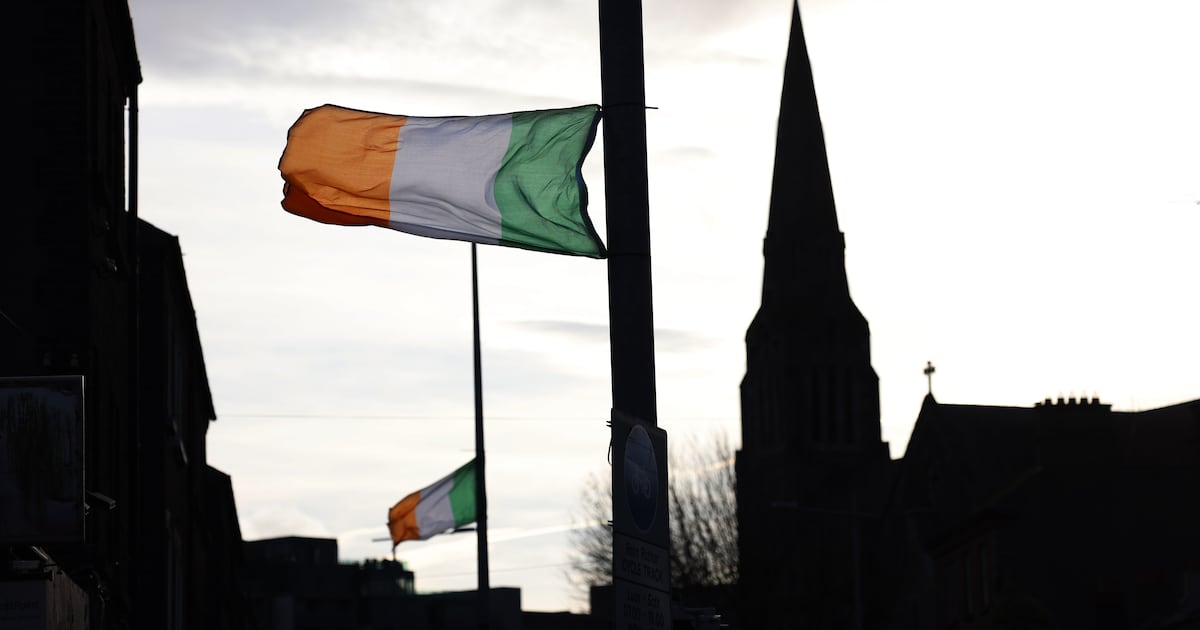
Trevor White: Yes. Our flag was supposed to unite us – but that’s not how it has gone
St Patrick’s Day is an excuse for a bit of navel-gazing that must be the envy of the world. Every year we toast the plucky resilience of the Irish, the day off work and the craic that flows long after closing time. Such festivities play well with Irish-Americans, who underwrite many expressions of what it means to be Irish. From Temple Bar to the Paddy’s Day parade – invented in America – our nation is feted through the eyes of people who left here long ago. (Their devotion is marked by dyeing things green.) Yet we struggle to accommodate the views of people whose families have been here for more than 300 years.
Take the flag. Honestly, take it. It is a contentious part of our history. Get another one – quickly, before our friends in the North take the hump. Yes, they are bound to object, not because unionists are truculent, but because the flag has come to represent a strand of nationalism that is toxic and racist. It has no place in a united Ireland.
The flag and us: it was not supposed to end like this. The Tricolour was designed in a spirit of reconciliation. Unlike our national anthem, with its shameless glorification of violence, the flag was supposed to unite rival notions of what it means to share this island. That was before the Tricolour became synonymous with the provisional IRA and republicanism in the North. In the South, it has recently become such a potent symbol of xenophobia that immigrants know to fear its presence on a lamp-post.
It must go.
Anyone who wants a united Ireland is well advised to hasten slowly. Yet the country is full of two-pint republicans who rarely stop waffling for long enough to consider the implications of their demand for a 32-county state in jig-time. Sure, why would we bother changing the flag when the land will be ours alone? A more pertinent question is how we might unite the people of this island without any part of the island descending once again into violence.
Any sensible answer involves change and compromise, a willingness to experiment with new ways of seeing the world. Redesigning our flag would demonstrate that we can consider a fresh start. Refusing to do so would give unionists good cause for concern.
States often adopt new emblems. Think of post-apartheid South Africa, which marked the transition to a “rainbow nation” with a new flag. Or Canada, which replaced colonial symbols with a maple-leaf flag. Such decisions speak to noble instincts and mature deliberation. If we get it right, Irish unity could some day be an equally positive moment in our history. A new flag would signal the creation of a new political settlement.
What, then, should the flag look like? That decision must not be left to politicians and barroom bores. It is far too important. Indeed, reimagining emblems of the state should be the work of artists, who have the imaginative capacity to look beyond shibboleths and worn-out pieties.
A new flag has the potential to unite people of all faiths and none. But getting there is bound to prove contentious. If the flag is to do the important work of pointing to a shared future, it cannot allude to one tradition over another. In other words, it must disappoint hardliners on both sides. So our new flag should prove controversial, just as Ireland’s Call was widely mocked when it was introduced in 1995.
The implications of that knowledge are quite radical. There is, for example, a credible argument that our flag should not be green. If you object to that idea, ask yourself what it means to be Irish today, and what it might mean if we have the wisdom to become a nation once again. What are you prepared to give up in order to realise your dreams?
Trevor White is a writer and founder of the Little Museum of Dublin.
Conor McGuinness: No. We should work towards a country where the Tricolour means what its creators intended
The idea that a united Ireland might need a new flag is occasionally raised in wider conversations about constitutional change on this island. Debate is healthy. But when it comes to the Irish Tricolour, my own view is clear – the flag of a united Ireland should remain the Tricolour.
The green, white and orange flag was not created as the emblem of one tradition over another. Quite the opposite. Our national flag was first flown by Thomas Francis Meagher in Waterford in 1848. From its earliest use, the Tricolour was explicitly intended as a symbol of reconciliation between the two main political traditions on this island.
The symbolism is straightforward but profound: the flag was designed to symbolise the inclusion of the Protestant and Orange tradition in a new, independent Ireland, which was represented by the traditional green. The design was directly inspired by the French flag, symbolising revolutionary republican ideals. That is why white lies between the orange and green – the aspiration to peace and friendship between the two.
This idea remains as relevant today as when it was first articulated during the revolutionary ferment of the 19th century. And in the context of building a new Ireland based on equality, respect and reconciliation.
Too often the Tricolour is misunderstood. Some see it only as a nationalist emblem, or associate it narrowly with the southern state. But the truth is that the flag was conceived as a promise that the Irish nation would be broad enough to include all of its people. In that sense, the Tricolour is not a barrier but an invitation to reconciliation.
If Ireland is to be united, it will be through a process that respects identity, acknowledges difference and creates space for every tradition on this island. The Tricolour already expresses that ambition in visual form. Few national flags anywhere in the world carry such an explicit message of coexistence.
Nor should we underestimate how widely recognised and respected the Tricolour already is internationally. It flies above embassies, appears on global sporting fields, and is instantly associated across the world with Ireland and the Irish people.
Changing it would mean discarding a flag that has accompanied generations of Irish people – at moments of struggle, achievement, celebration and grief.
Yes, the Tricolour is sometimes misused or appropriated by those who stand in direct opposition to the values it represents. Elements of the far right occasionally wrap themselves in our national flag while promoting division, intolerance or xenophobia. But their misuse of our flag is not a reason to abandon it – it’s all the more reason to reclaim it.
The flag belongs to all of the Irish people, not to any fringe group and not to any narrow ideology. Its true meaning is inclusive, outward looking and rooted in the idea of shared citizenship.
Progressive Ireland should say that clearly and confidently. The Tricolour should be seen not as a relic of the past but as a living symbol of the kind of country we are trying to build – a country that is democratic, pluralist and welcoming.
That includes recognising the importance of the orange tradition on this island. The presence of orange in the Tricolour was never merely decorative. It was deliberate and meaningful. It signalled that the future of Ireland must include those whose heritage is Ulster Protestant. A united Ireland worthy of the name will honour that promise.
If we succeed in building a country where people of every background feel at home – where identity is respected, where citizenship is shared, and where the divisions of the past are overcome – then the Tricolour will finally mean exactly what its creators intended.
The green and the orange, living together in peace, with the white of reconciliation between them. That is not an outdated idea. It is the unfinished work of our generation.
Conor D McGuinness is a Sinn Féin TD for Waterford and party spokesman on rural affairs, community development and an Ghaeltacht.