

Never miss an important update on your stock portfolio and cut through the noise. Over 7 million investors trust Simply Wall St to stay informed where it matters for FREE.
Stryker (NYSE:SYK) was hit by a significant cyberattack linked to an Iran based group, disrupting global operations, manufacturing, and order processing.
The attack led to outages, wiped devices, and forced shutdowns in dozens of countries, raising concerns about supply chain continuity for healthcare providers.
The incident has drawn attention to cyber risks in critical sectors such as medical devices and hospital equipment.
For investors watching Stryker at a share price of $336.77, the cyberattack adds an operational shock on top of recent share price pressure. The stock is showing a 7.6% decline over the past week and a 7.4% decline over the past month, with a 1 year return of an 8% decline. Over a 5 year period, the return of 54.2% indicates that many holders may still be sitting on sizeable gains even after the recent weakness.
The key questions from here are how quickly Stryker can restore normal operations and what the incident means for future cybersecurity spending and margins. Investors may also focus on how healthcare customers respond, whether order timing shifts, and how regulators and hospitals raise expectations for cyber resilience across the sector.
Stay updated on the most important news stories for Stryker by adding it to your watchlist or portfolio. Alternatively, explore our Community to discover new perspectives on Stryker.
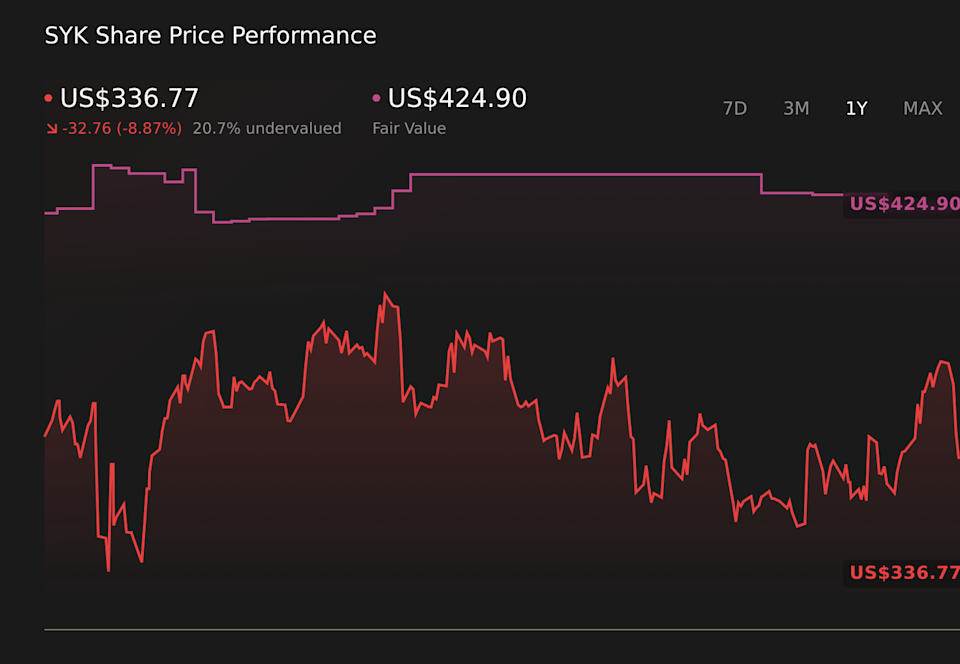 NYSE:SYK 1-Year Stock Price Chart
The Stryker cyberattack falls squarely into regulatory and legal territory because it cuts across data security, critical infrastructure and healthcare continuity. For a company that has just pushed deeper into connected care through its SmartHospital Platform, any sign of weakness in cybersecurity is likely to draw attention from regulators and hospital procurement teams. Authorities in the US and Europe have been increasingly vocal about cyber risk in medical devices and hospital systems, so investors should factor in the possibility of tighter reporting requirements, mandated security upgrades and higher ongoing compliance costs. The incident could also influence how hospitals assess vendors like Stryker, Medtronic and Johnson & Johnson when they award multi year contracts, with cybersecurity provisions becoming a bigger part of tenders and audits.
The attack highlights the importance of Stryker’s push into digital health, including SmartHospital and robotics. Hospitals may value vendors that can clearly show how they secure interconnected systems.
It challenges the narrative that acquisitions and digital expansion simply scale growth, because cyber incidents can introduce extra costs, potential contract clauses, and added scrutiny from regulators and hospital IT teams.
The risk of geopolitically motivated cyberattacks on medical suppliers is not explicitly captured in the existing growth story and may change how investors think about operational resilience alongside product demand.
Story Continues
Knowing what a company is worth starts with understanding its story. Check out one of the top narratives in the Simply Wall St Community for Stryker to help decide what it’s worth to you.
⚠️ Cybersecurity and operational risk, as shown by the large scale outage and wiped devices, could mean higher future costs and a closer eye from regulators and hospital customers.
⚠️ Supply chain and delivery risk, with disruption to manufacturing, shipping and order processing, may affect how hospitals assess Stryker’s reliability compared with peers like Zimmer Biomet or Boston Scientific.
🎁 The company has been growing earnings and analysts expect further earnings growth, which may support its ability to absorb higher cybersecurity and compliance spending.
🎁 Shares are trading below analyst price targets and below one fair value estimate, which some investors may see as compensating to a degree for the additional risks highlighted by the attack.
From here, focus on three things. First, any formal disclosures from Stryker on the financial impact of the cyberattack, including write offs, remediation costs or changes to 2026 guidance. Second, whether US or international regulators introduce new cybersecurity expectations for medical device and hospital equipment suppliers, and how quickly Stryker responds. Third, customer behaviour, including comments from hospitals that rely on Stryker systems and whether contract terms or order patterns change compared with rivals. Together, these signals will help you judge if this event remains a contained operational setback or turns into a longer running regulatory and reputational issue.
To ensure you’re always in the loop on how the latest news impacts the investment narrative for Stryker, head to the community page for Stryker to never miss an update on the top community narratives.
This article by Simply Wall St is general in nature. We provide commentary based on historical data and analyst forecasts only using an unbiased methodology and our articles are not intended to be financial advice. It does not constitute a recommendation to buy or sell any stock, and does not take account of your objectives, or your financial situation. We aim to bring you long-term focused analysis driven by fundamental data. Note that our analysis may not factor in the latest price-sensitive company announcements or qualitative material. Simply Wall St has no position in any stocks mentioned.
Companies discussed in this article include SYK.
Have feedback on this article? Concerned about the content? Get in touch with us directly. Alternatively, email editorial-team@simplywallst.com