
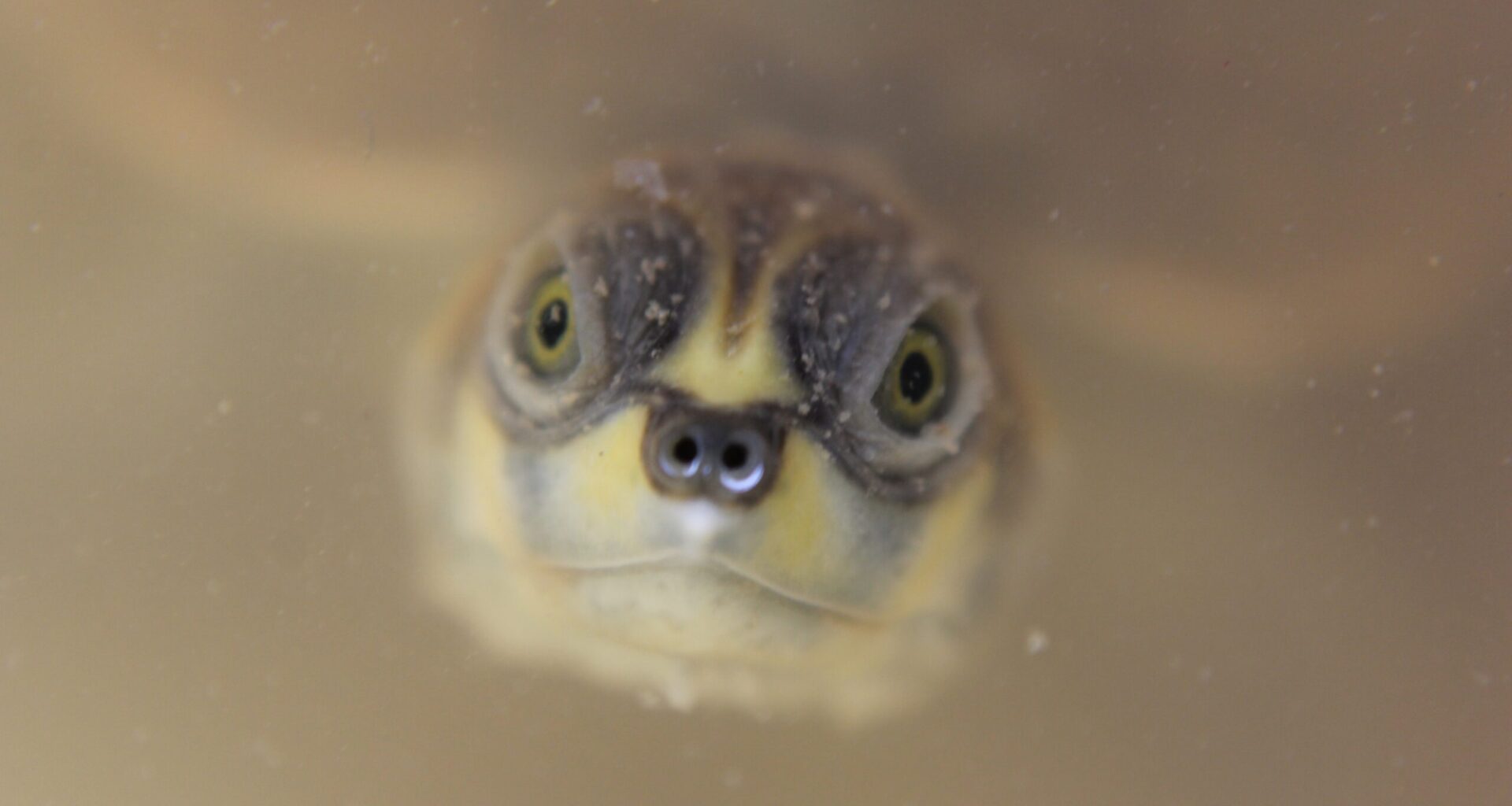
A planned shipping waterway on the Tapajós River, a major tributary of the Amazon, may disrupt the sophisticated social communication systems used by the Amazon river turtle (Podocnemis expansa), a species likely to be endangered.Underwater noise from barges risks drowning out the vocalizations used by adult females to guide their young during collective migration in the species’ second-most important nesting area, scientists say.The waterway is a central piece of Brazil’s new push to ease the transport of soybean and corn for export.
See All Key Ideas
It’s just a sweet, squeaky sound, like that of a rubber duck. For scientists, however, it could have various meanings, ranging from “Time to spawn!” to “Come on, little ones!” to “Time to migrate!” Researchers studying the Amazon river turtle (Podocnemis expansa), South America’s largest turtle, found that hatchlings begin communicating even before birth, probably to agree on the best time to break out of the eggs and burrow up from the sand to the beach.
“The Amazon turtle is one of the most social species of turtles in the world,” Camila Rudge Ferrara, the researcher who first proved the turtle’s communication skills, told Mongabay. “They migrate in groups, lay eggs in groups, and hatch in groups,” added the coordinator of the Chelonian Conservation Program in the nonprofit Wildlife Conservation Society in Brazil (WCS Brasil).
Soon, however, the chatter of Amazon river turtles in the Tapajós River, a major tributary of the Amazon, may be disrupted by the noise of dredgers, ferries and boats circulating in the river: An ambitious waterway is being planned to ship minerals and grains to the port in the city of Santarém, in Brazil’s Pará state.
“The frequency of the sound, dredging and boats may interfere with the turtles’ communication,” Ferrara told Mongabay, but noted that scientists haven’t yet been able to establish this as fact. “The high-frequency underwater noise will disrupt the migration of these animals.”
The latest conservation assessment for the species is expected to declare it endangered on the IUCN Red List, pending a review.
Sound produced only by baby turtles:
Sound produced by both baby and adult turtles:
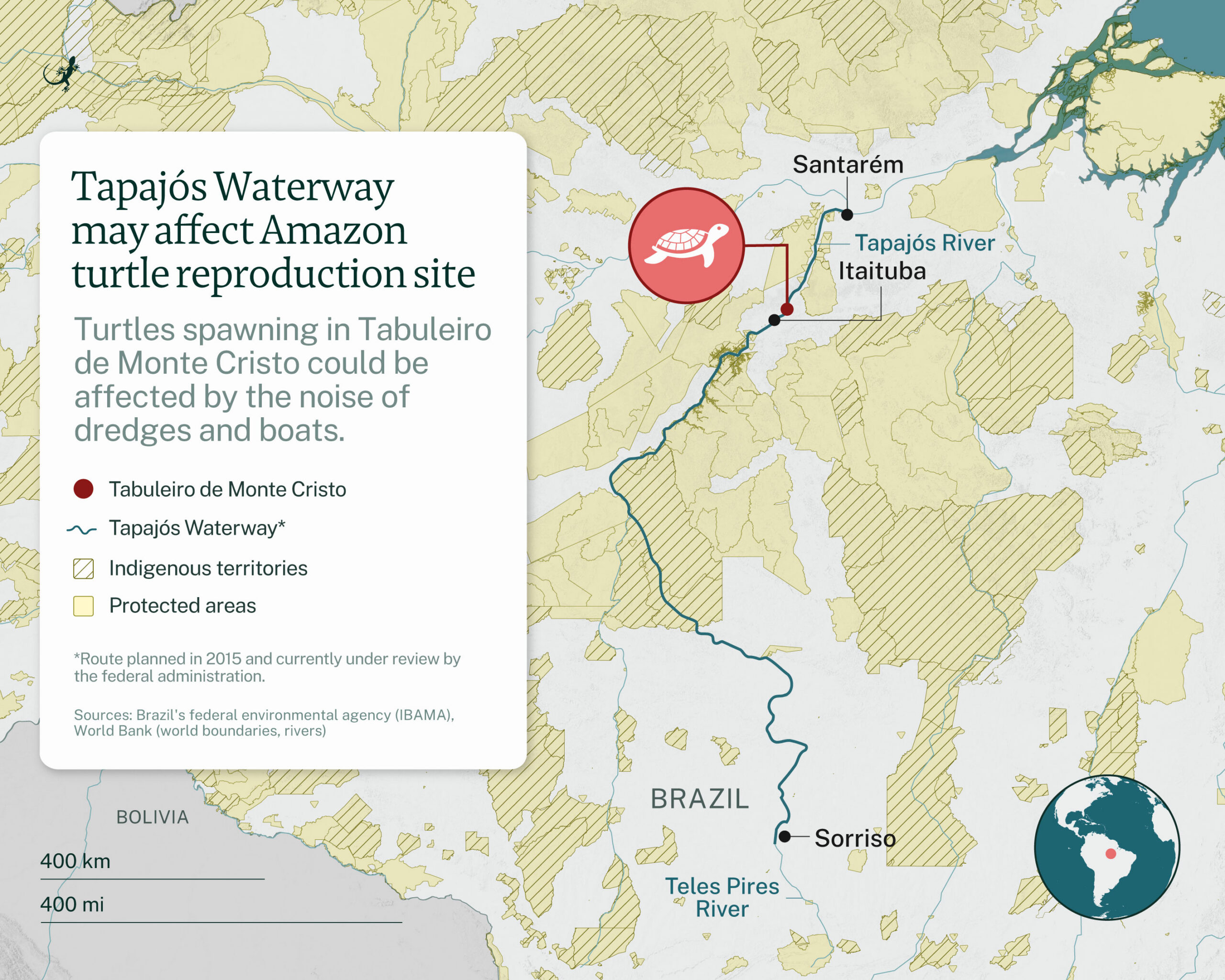
The Tapajós River is home to the species’s second-most important reproduction area, a sandy island called Tabuleiro do Monte Cristo, located 43 kilometers (27 miles) from the municipality of Itaituba. Every year, around August, thousands of Amazon river turtles migrate from different parts of the Tapajós and gather in front of the Tabuleiro.
They spend around a month preparing to lay their eggs by regularly exposing their massive bodies, measuring about 90 centimeters (35 inches) and weighing 65 kilograms (143 pounds), to the sun’s heat. Then at night, groups of up to 1,000 females start leaving the water to lay their eggs in large holes in the Tabuleiro’s sands.
“The Amazonian turtle is very selective when choosing where to build its nest,” Roberto Lacava, an environmental analyst with IBAMA, Brazil’s federal environmental agency, told Mongabay.
In Tabuleiro do Monte Cristo, the species finds its favorite kind of sand. The elevated terrain also minimizes the risk of nests flooding due to sudden rises in river levels.
“The turtle shows loyalty to the Tabuleiro,” said Lacava, who coordinates IBAMA’s Amazonian Chelonians Program in Pará state. “The individual that spawns on Monte Cristo returns there to spawn the following year.”
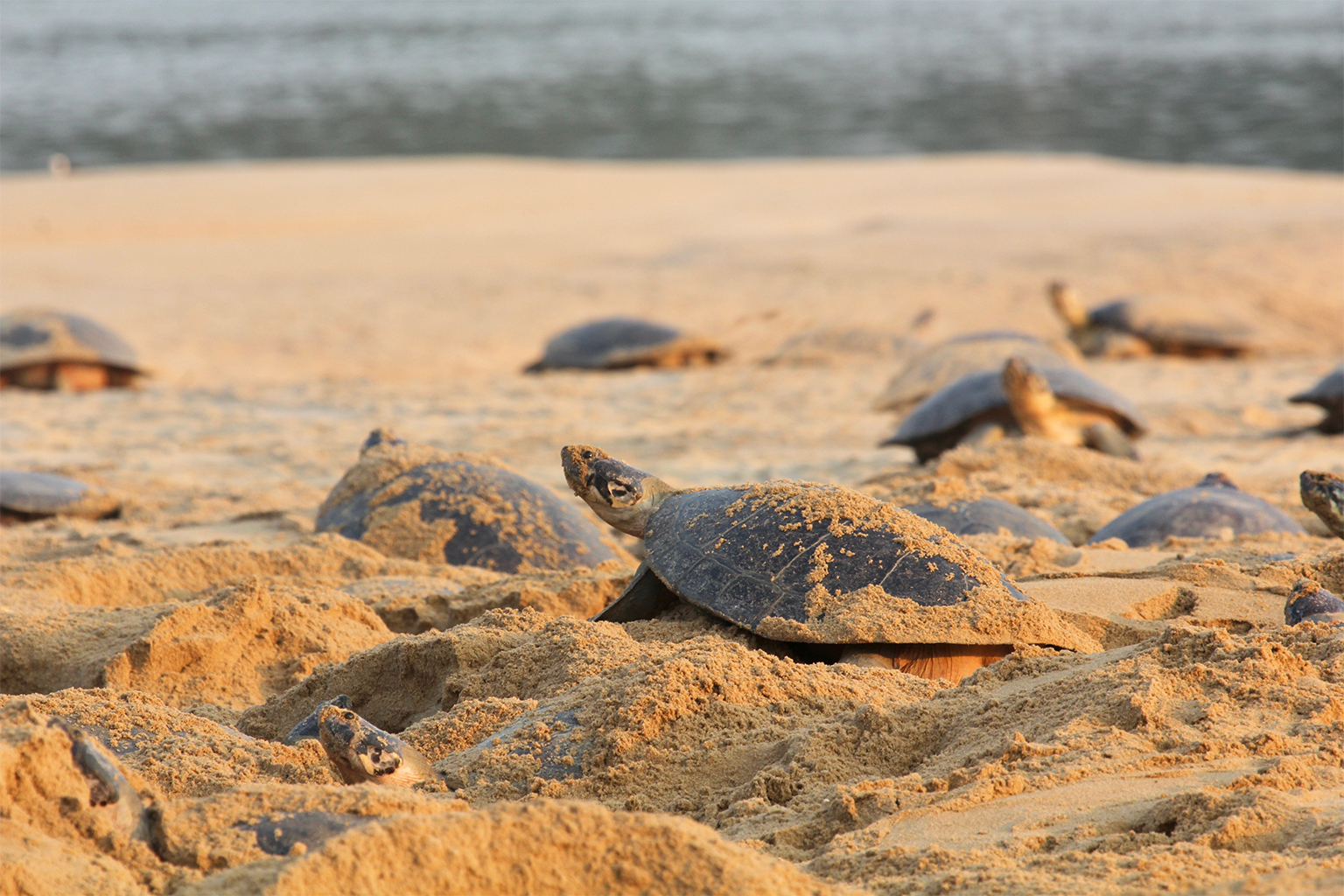 The Amazon river turtle is the largest freshwater turtle in South America, weighing around 65 kg. Image courtesy of Camila Ferrara/WCS Brasil.
In 2025, IBAMA estimated that 19,447 females nested in the area, each laying 100 to 150 eggs. The impressive figures result from a five-decade effort. In 1979, when IBAMA began working in the Tabuleiro area, only 327 females came to the nesting beach.
Despite its constant presence in the Tapajós River, IBAMA’s team was surprised to find dredges churning up the riverbed near the Tabuleiro area in March 2025, under the orders of the National Department of Transportation Infrastructure (DNIT). “If a project of this magnitude is going to be carried out in the region, we need to be notified,” Lacava said. “We need to be able to give our opinion on the best time to carry out these interventions on the river so that they do not disturb the turtles.”
The Pará state environmental secretary, who authorized the dredging, argued it was an emergency operation to assure the river’s navigability through “a critical drought situation.”
Key shipping route
It’s no secret, however, that the federal government has bigger plans for the Tapajós River.
Brazil wants to turn the Tapajós into a central “hub” within the Arco Norte project, a series of infrastructure initiatives aimed at improving logistical efficiency for export commodities like soybeans and corn. The hub would integrate the BR-163 highway with the river’s waterways and the proposed Ferrogrão railway, a controversial project to connect the grain-producing state of Mato Grosso to the port of Miritituba on the Tapajós, potentially reducing transportation costs by 30%.
This infrastructure network is considered key for Brazil’s exports and China’s dreams to link commodity production areas and the newly inaugurated Chancay Port in Peru. Brazil lies on the Atlantic edge of South America, so the link to Chancay on the Pacific would facilitate greater trade with Asian markets by cutting through the Amazon — including a 3,000-kilometer (1,900-mile) railway crossing the rainforest. The project also includes a waterway along the Araguaia and Tocantins rivers, where a singular rock formation would be blasted to create space for barges.
In 2015, a study commissioned by DNIT envisioned expanding the navigable stretch from the current 345 to 1,789 km (214 to 1,112 mi) through interventions such as dredging sediment from riverbeds and blasting rocks. As a result, around 30 million metric tons of cargo, mostly soybeans and corn, would circulate in the waterway per year in barge convoys the length of a 70-story skyscraper laid on the river. The project also includes the construction of six river terminals and the expansion of a transshipment port in Itaituba.
In an email to Mongabay, the Ministry of Ports and Airports stated the route proposed in 2015 is under review: “The ongoing assessments consider a different section of the waterway, which is still under technical definition.” (Read the full response here.) DNIT, which responds to annual routine dredging, told Mongabay that there are no scheduled maintenance service works on the Tapajós River at the moment. (Read the full response here.)
“If these large, transoceanic ships pass through there, we don’t know what impact that will have on the turtles,” Lacava said. “It could be that something similar to what happened on the Trombetas River,” he added, referring to another important Amazon river turtle spawning site in northern Pará.
In the early 1980s, a port began operating in Trombetas to transport the bauxite mined by Mineração Rio do Norte, prompting intense vessel traffic. According to Lacava, over the following years, the number of female turtles nesting in the area dropped from 7,000 to fewer than 700.
“Although the actual reason for the decline has not been confirmed, there is a strong possibility that large vessel traffic is related,” Lacava wrote in a technical note sent to the Pará federal prosecutor’s office (MPF-PA).
Despite its economic promise, the development of the Tapajós waterway and its associated infrastructure faces significant environmental and social controversy. The basin is already a known hotspot for deforestation, land grabbing and illegal mining, while also suffering from mercury contamination. Projects like the Ferrogrão railway have met intense opposition from Indigenous groups, such as the Kayapó and Munduruku, because the planned route cuts through forest reserves and traditional territories. Critics argue that these new routes mirror development strategies from Brazil’s military dictatorship era, prioritizing agribusiness expansion at the risk of imploding the Amazon and escalating human rights violations.
In 2025, the federal government issued a call for tenders to hire a company to carry out annual dredging along the stretch of the Tapajós River between Santarém and Itaituba for the next three years. It also included this waterway in the National Privatization Program. By February 2026, President Luiz Inácio Lula da Silva backtracked on both measures after Indigenous people from more than 20 ethnicities occupied the Santarém grain terminal of commodity trader Cargill in protest at the plans. The government promised to halt the waterway plans until all affected communities have been consulted.
According to the Ministry of Ports and Airports, “studies related to the development of the waterway are undergoing technical and environmental assessment” and will be submitted for public consultation when completed.
Baby talk
Found throughout the Amazon Basin, the Amazon river turtle can live for more than 40 years; some individuals make it to more than 100, according to Lacava.
In Brazil, which accounts for 60% of the P. expansa population, the species experienced a sharp decline in the 1800s. Turtle oil, used to illuminate Amazonian cities like Manaus and Belém, made the turtles a precious target for hunters.
The turtle’s flesh is also an important component of the diet of people throughout the Amazon, including Indigenous communities. However, it is the massive consumption in large city centers, fueled by wildlife trafficking, that poses the real threat to the species.
“The problem is these wildlife traffickers who supply the cities,” said WCS’s Ferrara. “These large turtle catches are the ones wiping out the turtle population.”
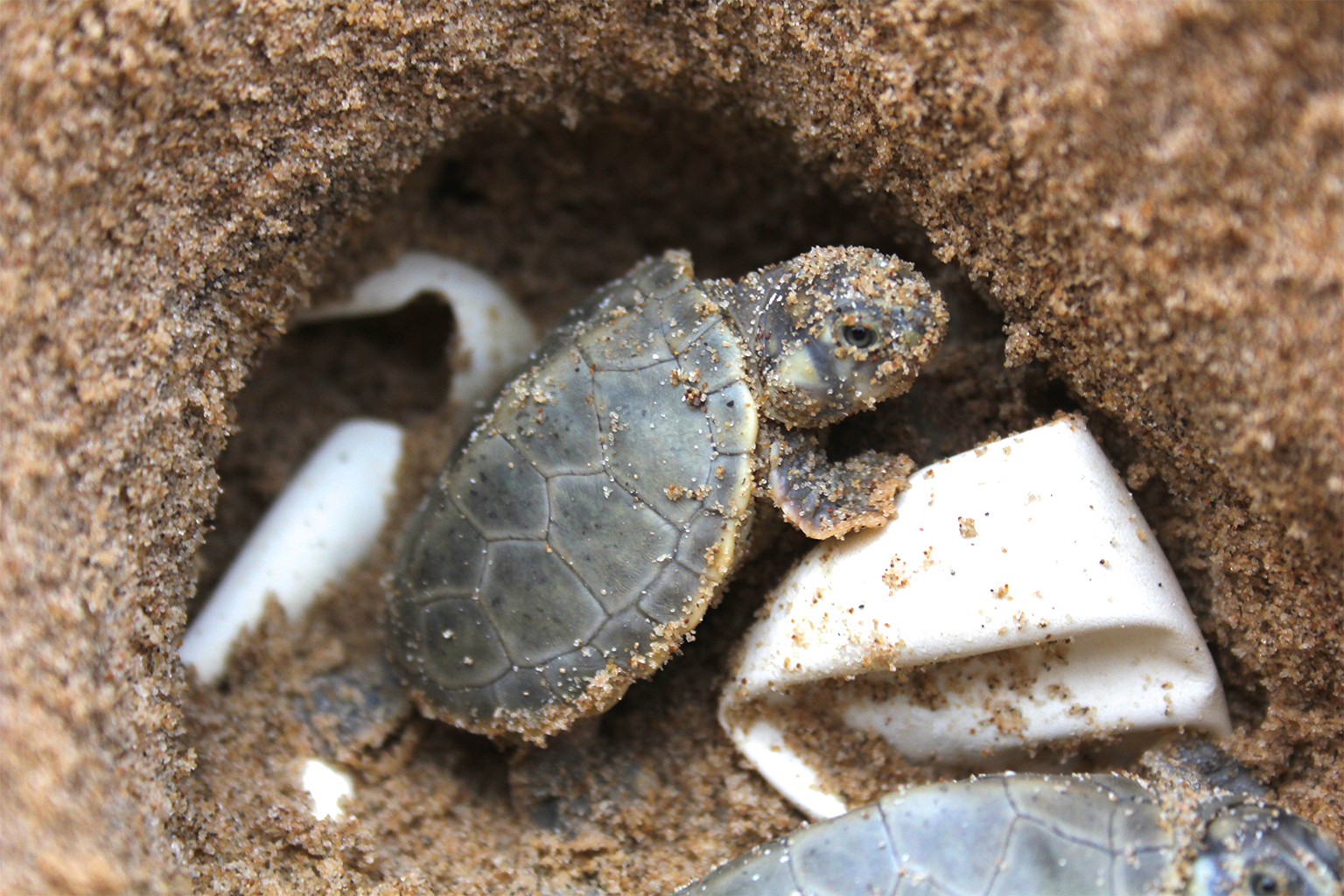 Baby turtles begin communicating with each other while still inside the eggs. Image courtesy of Camila Ferrara/WCS Brasil.
One of the goals of IBAMA’s Amazonian Chelonians Program is to combat wildlife trafficking by continuously monitoring reproduction sites. From 1979 to 2022, the total number of Amazon river turtles that hatched at 11 major nesting areas covered by the program increased by 95%, a study by Lacava showed.
In Tabuleiro do Monte Cristo, more than a million baby turtles hatched in 2025. The days of egg hatching are eagerly awaited by children and adults from nearby river communities, who go to the beach to watch the tiny turtles emerging from the sand.
“That’s so beautiful,” said Francisco de Sousa, who lives in the Monte Cristo community, right in front of the Tabuleiro. For five years, he’s been working with IBAMA to monitor the site, in addition to piloting speedboats and taking care of the IBAMA base in the Tabuleiro. “It’s very satisfying because we work all year long, and when the end of the year comes, which is the harvest, we feel blessed by that harvest. Because it’s a harvest of what we planted.” During the hatching season, he goes to the Tabuleiro early every morning to count and then release the baby turtles into the river.
According to Ferrara, hatchlings start communicating with each other around 36 hours before cracking their eggs. “They do this to synchronize the birth,” she said. For her research, she used microphones to record the turtles’ vocalizations underwater and inside the nests in the Trombetas River. “This will make digging easier, because the Amazon turtle nest is almost a meter deep; it is a very deep nest.”
In the Trombetas River, Ferrara observed that many adult females wait for their babies in front of the beach so they can migrate together to feeding areas. She recorded distinct vocalizations when the mothers and babies met.
Besides interfering with this communication, dredging threatens to change the height of the beaches and the kind of sand in the river, Ferrara said. “Larger grains allow for greater temperature and heat exchange than beaches with smaller, more compacted grains, and all of this hinders the egg incubation process,” she said.
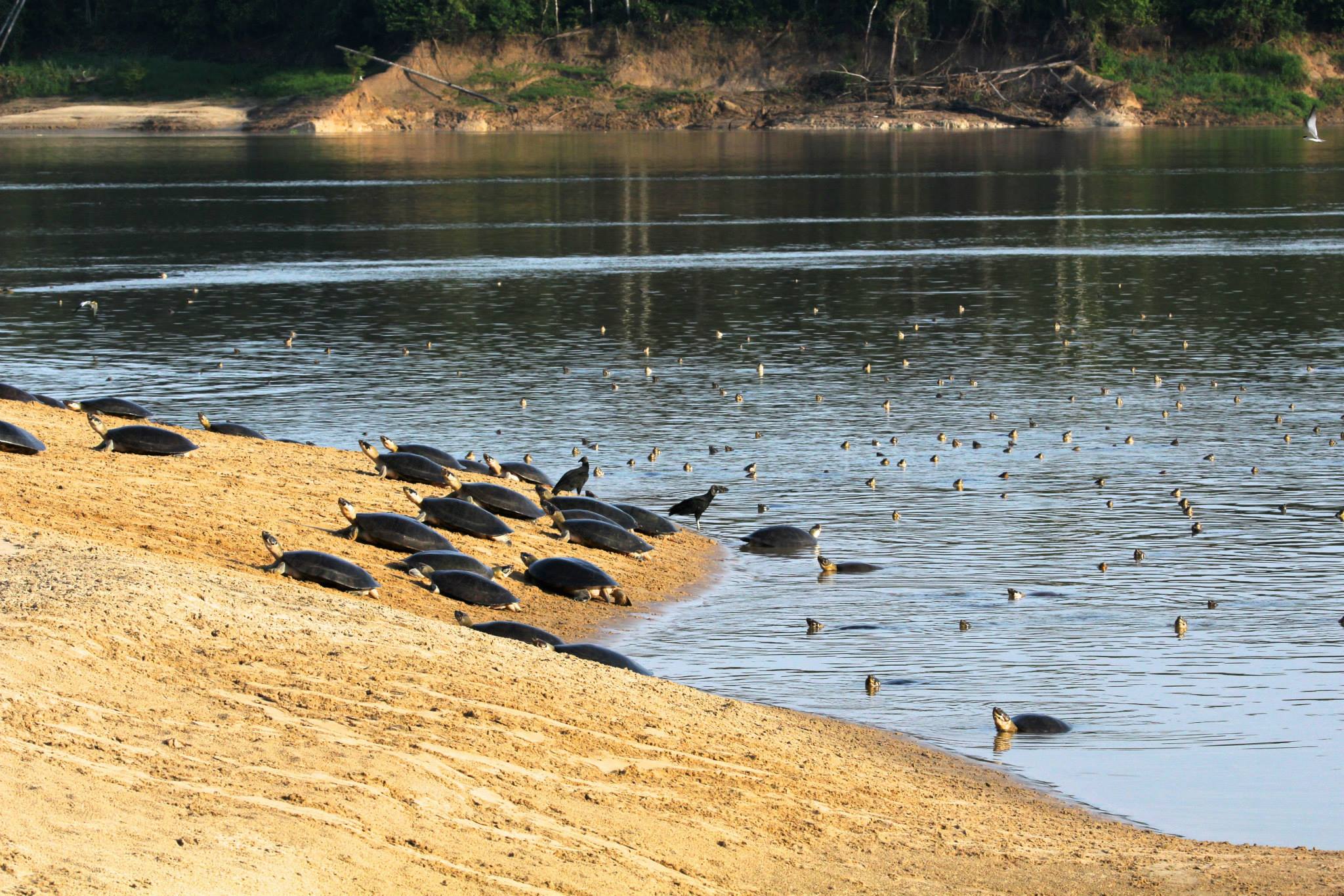 Female Amazon river turtles communicate with each other to find the best time to lay their eggs. Image courtesy of Camila Ferrara/WCS Brasil.
The presence of large boats could also scare turtles away, Lacava added: “They are very sensitive to human presence.”
Two other closely related species also lay their eggs in Tabuleiro do Monte Cristo: the tracajá, or yellow-spotted river turtle (Podocnemis unifilis) and the pitiú or iaçá, the six-tubercled Amazon river turtle (Podocnemis sextuberculata), the Amazon’s most threatened turtle. According to ICMBio, the government agency that manages Brazil’s federal protected areas, many other species would also be affected by the waterway, especially in the area around the two islands of Ilha do Meio and Ilha Grande.
These are breeding sites for two river dolphin species: the tucuxi (Sotalia fluviatilis) and boto rosa (Inia geoffrensis), or Amazon river dolphin. Experts say dredging and shipping activity head could cause the dolphins to suffer “hearing injury, acoustic masking, behavioral change, stress induction, reduced foraging efficiency, and increased susceptibility to disease.” The area is also of “vital importance” for the Amazon manatee (Trichechus inunguis), which uses these islands and their channels for feeding and protection.
DNIT’s studies show that seven protected areas and three Indigenous territories (Kayabi, Munduruku and Sai-Cinza) would also be affected by the waterway. According to MPF-PA, which filed a lawsuit demanding consultation of affected communities, another 50 villages in Tapajós National Forest and the Tapajós-Arapiuns Extractive Reserve would also be impacted.
Banner image: The noise from dredges and large vessels may interfere with the Amazon river turtle’s communication. Image courtesy of Camila Ferrara/WCS Brasil.
Amazon Indigenous groups fight soy waterway as Brazil fast-tracks dredging
FEEDBACK: Use this form to send a message to the author of this post. If you want to post a public comment, you can do that at the bottom of the page.
