
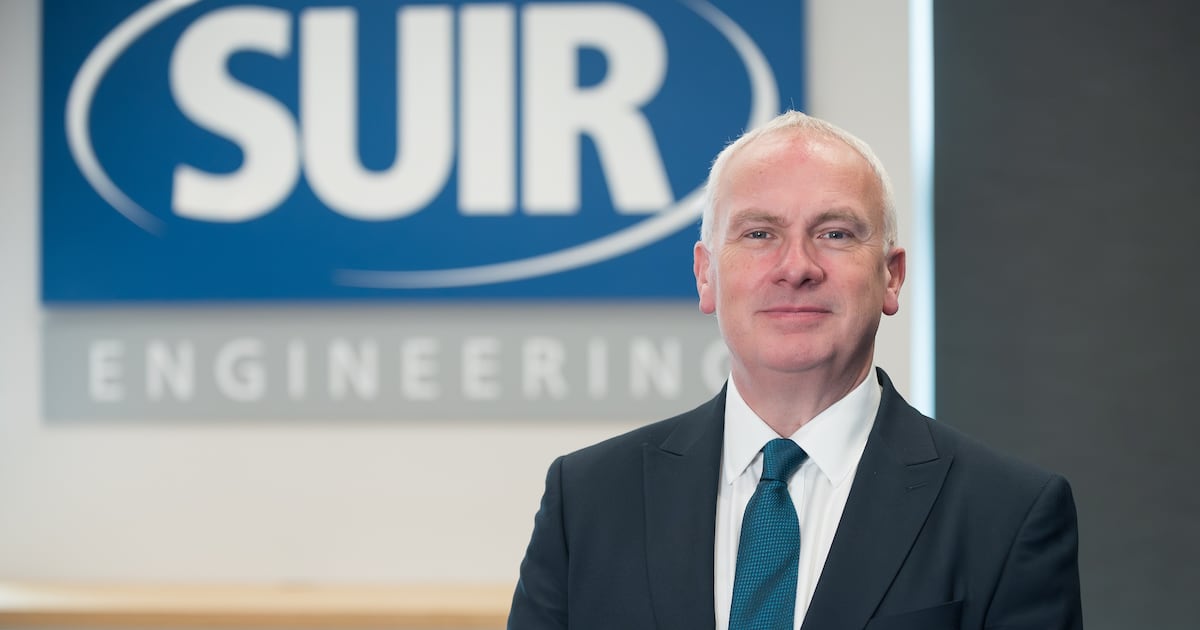
John Kelly’s grandfather was a cooper in the Guinness brewery before leaving for Liverpool in the early 1930s “when the work got tight”, though his great-grandfather never grew to accept that a new generation of Kellys would grow up “overseas”.
Once there, Kelly’s grandfather began working in Cains Brewery on the Docks Road in Liverpool. His first child, also called John, born in 1931, started primary school in Sylvester Street in Everton.
“My great-grandfather kept coming over and taking my father back to Ireland to work on the farm in Skerries, because he didn’t want, as he put it, the eldest Kelly boy growing up overseas,” says John Kelly, now the chief executive of Suir Engineering.
“He’d collect my father from school and take him a few hundred yards to the terminal and straight on to the ferry and over to Ireland before my grandfather even knew anything about it,” Kelly tells The Irish Times.
In the beginning, the Liverpool Kellys lived in Norris Green in the east of Liverpool, “a real hard-working, working-class area in Liverpool, a very Catholic working-class area”, he tells The Irish Times.
His father became the first in the family to own their own home when he moved out to Maghull, “from where on a clear day, we could see Aintree Racecourse if we stood on the hill”.
Back then, Maghull was an emerging “new town”, where the Catholics went to the Maricourt convent and school and nearly everyone else went to the Church of England school “that backed on to our house”.
Throughout, the Liverpool Kellys returned to Ireland, “home”, in the words always of his father, who later served in the British Army, though his mother’s Irish connections were a further generation back.
The blood links with Ireland have helped Kelly during a career that brought him to the Dublin-based Mercury Engineering in the early 2010s: “Being from Liverpool, I probably wasn’t quite viewed the same as I would be if I was coming from elsewhere.”
The view the Irish take of the British, he has found, depends on “how far north they’re from, and whether they’re from an Irish stronghold such as Liverpool or Manchester, or somewhere with an affinity with Ireland”.
Today, Kelly leads Suir Engineering, with 1,600 employees, which offers mechanical, electrical, instrumentation and high-voltage engineering services to companies not just in Ireland, but the United Kingdom, Scandinavia, Finland and Germany, too.
Sometimes. he’d recruit hurlers and train them to be electricians because they were good hurlers.
Headquartered in Waterford, Suir began life in Mooncoin, Co Kilkenny under its now deceased founder, Noel Doyle, who mixed a passion for business with an even-stronger passion for hurling.
“Sometimes. he’d recruit hurlers and train them to be electricians because they were good hurlers,” says Kelly, with a smile. “He even had the canteen roaring away in the afternoon so they could go straight to training from work.”
Today, Suir Engineering is owned by private equity group, Duke Street, which bought it from EDF Energy in 2023 – following a tumultuous decade when Suir – though profitable – had to be extracted from the collapse of its then owner, Royal Imtech.
Usually, Duke Street keeps companies for three to five years before selling them, but “they do have businesses within the portfolio that they’ve held for 10, 11, 12 years and they do like the business.
“I really like working with private equity, because as long as you do what you say you’re going to do, you’re fine. It’s all about performance. If you’re performing then, you’ve no problems at all with them,” Kelly tells The Irish Times.
Today, Suir has a few key pillars to its business, he says – data centres, energy, including electricity grids and renewable, life sciences and pharmaceuticals, and food and beverage manufacturing.
“We’ve stopped trying to chase everything and focus on what we are best at doing,” he goes, adding that Suir has worked with every one of the 10 biggest pharmaceutical firms based in Ireland.
 ‘Over a billion eyeballs will be on the parade’: St Patrick’s festival CEO Richard Tierney
“We do upgrades works to grids. We build big substations. We connect to the grids for large users such as data centres and pharmaceutical plants. We connect developers to the grid to build power stations and solar farms and wind farms.
“That gives the opportunity to work overseas with them because they like to work with people who they know and trust to deliver, especially when they’re going into new territory, as well,” he said.
Three years ago when Kelly took over from Michael Kennedy as chief executive, 70 per cent of Suir’s work was in Ireland, mostly for a Grade A list of multinationals and major Irish-owned firms.
Today, the split is 50/50, with growth coming in the United Kingdom, Germany, Denmark, Sweden: “Now, we’re also in Austria as well and we’re likely to work in Finland,” he says.
The shift from 70/30 to 50/50 figures holds lessons. Major pharmaceutical investments in Ireland are not currently happening, and unlikely to do so for the next few years, partly because of the presence of Donald Trump in the White House.
“They don’t want to be seen to be putting two billion into Ireland to build a new plant in Grange Castle, or wherever, they don’t want to be invested in large capital projects with such a political backdrop.
“So, the investment is smaller scale – to refurbish plants and to eke out the life of the plant and to get more out of it. They’re sweating assets at the moment, rather than big capex investments,” he goes on.
Consequently, Suir has now moved some of its highly-skilled life sciences people abroad for the first time: “We’re working in Germany with one of our customers that we would normally work with back here, but not on a major scale.”
However, there are others who would be willing to spend in Ireland, such as data centres and renewable developers, but are not because of electricity grid shortages – ones that are being worked on, but which will take up to five years to solve.
But there’s no avoiding that the next three years are going to be fairly barren for data centres in Ireland. There’ll be a few built, but that’s it.
“For the next three years to five years, at least three years, there’s definitely more investment overseas than in Ireland because of the restrictions with power,” Kelly declares.
Recent changes should spur some construction of data centres with energy located on site, but “the grid upgrade works has got to move an awful long way, I think, before we’ll see large-scale development again like we’ve seen elsewhere”.
Everything about data centres spurs claim and counterclaim, especially numbers that show that a quarter of the current electricity supply is consumed by the ones already in existence, and that the figure will go up to 30 per cent.
For Kelly, such numbers illustrate past failures and past successes. Firstly, Ireland was at the forefront of a technological wave that came into the country. Secondly, the gird never grew in size as it should have done.
“It’s a worry, but I’m hopeful that that can be corrected eventually. But there’s no avoiding that the next three years are going to be fairly barren for data centres in Ireland. There’ll be a few built, but that’s it,” he said.
The ESB is “doing a fantastic job this year”, he says, with significant advances being made because of “the large transmission lines, big substations, big reinforcement and stabilisation of the grid works” under way.
Such words are not empty rhetoric, said the Suir Engineering chief executive: “It’s the case. That’s all in procurement that we’re actually tendering for right now,” he tells The Irish Times.
For now, however, the Irish companies that built data centres in Ireland in years past are in demand elsewhere: “They really are the envy of Europe. Developers love to have the big Irish engineering businesses work for them.
“They’ve got a proven track record. They were building them in Ireland and building so many of them long before the rest of Europe woke up to the demand, or created the space for them,” he goes on.
Given his role, Kelly must think about the company’s fortunes a decade from now, not just tomorrow, and he acknowledges fully that the climate challenge will impact on every element of Suir’s business.
Much has been done, he argues, to make business more energy-efficient, but root-and-branch reforms will be required in years ahead: “You’ve got to actually show what more you can do.”
 circa 1930: Scene of the dockside in Liverpool with vessels alongside. (Photo by Hulton Archive/Getty Images)
“Instead of trying to transport hundreds of people to places miles away to carry out work, how many hours can be done in a factory closer to home in a more productive, efficient, clean manner and then ship a product.
“Can the site be turned into an assembly site rather than a construction site? We want to do a thing called stick building, with modules and products that bolt together. Just assemble and commission. Then it’s up and running.
“If you don’t need to have 4,000 men working on the site and you can get by with 500 men because it’s an assembly site, then that’s got to be better for the local area that you land in,” he continues.
Each of the pillars to Suir’s business – energy, pharma, data and food and beverage production – will be core to its future: “Each of them are resilient. I think they’ll all survive going forward for different reasons.”
Data centres are disliked by many, but they are central to the AI revolution, but to remote working, too: “If you want all the efficiencies that come from the next industrial revolution that is AI, then you need data centres.
“Energy, especially renewables, are central, too. Life sciences? We’re all living longer. We all have and will have more conditions that need treatment. That’s why we chose them. Not just because we are good at them, but each have a long-term future.”
Turning to the workers of the future, Kelly prefers the glass half-full, rather than half-empty analogy about those who are taking up, and will take up apprenticeships and college degrees.
Currently, Suir has 350 apprentices on its books: “They’re more aware of choices than people at my age were back in the 80s and 90s. They’ve made a conscious choice to be with you. But they want to be with businesses that are successful.
“One that are trying to shape the future, that have a plan, that want to invest in modern technology. They don’t want to be in an archaic, old, dying industry like an old dinosaur,” he goes on.
Kelly speaks with personal interest, since his youngest daughter is an apprentice electrician with Suir. Like any father, the issue of whether a job has a future for his children figures highly.
“I still can’t see AI coming along and pulling cables and fitting conduits in people’s factories and in data centres just yet,” says Kelly, who became an apprentice after leaving school with GCSEs, before later earning a quantity surveying degree.
The company has invested heavily in an apprentice training centre in Citywest in Dublin, and plans a second one, but that was done to deal with problems it encountered dealing with apprentices.
I wouldn’t say it’s a slower way of life here, but people are more thoughtful, it’s more about people here. People will tell you their story in a pub. That wouldn’t happen in Britain.
Following an examination, Suir found that it lost 30 per cent of all of the apprentices it took in – and the vast majority of those were falling away in the first year: “So they needed more support.”
Equally, it found that 60 per cent of the hand injuries were being suffered by apprentices, mostly first-year ones, even though they make less than a third of the workforce.
He does not accept that pay rates are keeping people away from apprenticeships: “They’re getting 50 per cent in the first year, I think it is, and then 66 per cent and then 75 per cent and then 100 per cent.”
Looking back to Liverpool, he says college graduates are leaving laden with debt, while apprentices would have “money in the bank, a car, a few nice holidays, all their studies paid for”, and a career for the years ahead.
Now three years living in Dublin, Kelly, though he has maintained a home in the UK, is in Ireland for the long term: “I’m not here just for the job, I always felt like I wanted to come back after having three years with Mercury.
“That was a great time. Fabulous business, great people in it. Really enjoyed the environment, a good family-friendly environment as well. A real good atmosphere. I like team sports as well, and everyone here is involved to some degree, or other.
“People actually talk to each other, which I like. It easy to live in a detached way in the UK. It’s easy to be detached from your community, from the people around you, even just the general conversation and chit-chat around you.
“People there are so busy. I wouldn’t say it’s a slower way of life here, but people are more thoughtful, it’s more about people here. People will tell you their story in a pub. That wouldn’t happen in Britain.”