
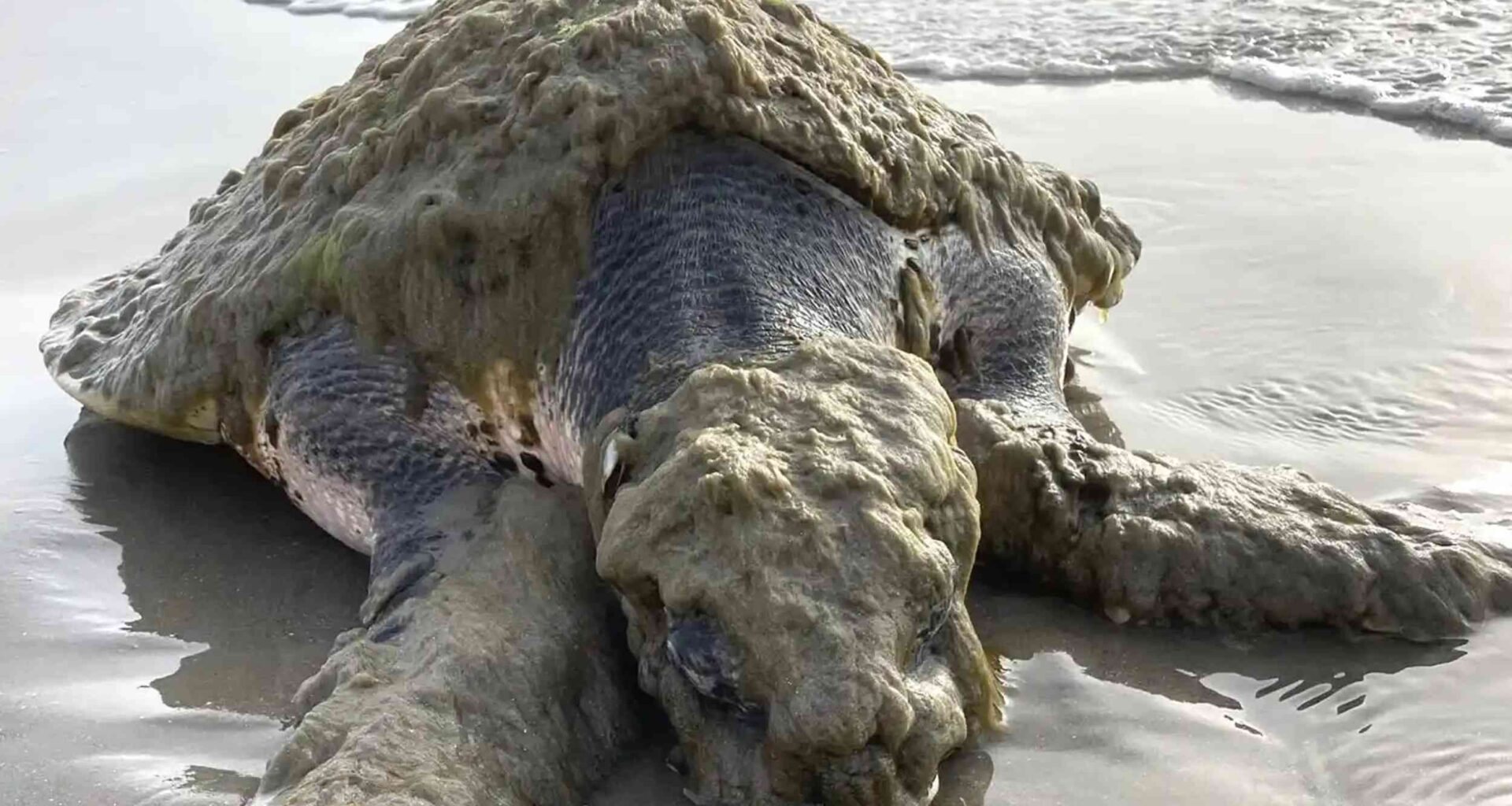
Researchers have documented a critically endangered Kemp’s ridley sea turtle washed ashore in Texas heavily overgrown with marine organisms, revealing a severe breakdown in its ability to swim and maintain normal health.
That condition exposes how quickly physical decline can compound in this species, turning reduced movement into a life-threatening cascade.
What rescuers saw

On a beach near Galveston, the turtle’s shell and body were densely coated with algae, barnacles, and sediment that signaled prolonged debilitation.
Interpreting those signs, Christopher Marshall at the Gulf Center for Sea Turtle Research (GCSTR) documented that such heavy colonization reflects a loss of normal swimming capacity.
As the buildup increases drag and weight, the turtle slows further, allowing more organisms to attach and deepen the same decline.
That reinforcing cycle defines a narrow window for intervention before the condition advances beyond recovery.
Importance of the shell
When a sea turtle loses speed, epibionts – organisms that settle on living animals – can build up faster than the turtle can shed them.
“Healthy sea turtles are swimming sea turtles,” Marshall said, reducing the problem to a simple rule about movement and health.
Extra drag then forces a weakened turtle to burn more energy, which leaves even less strength for normal swimming.
That vicious cycle helps explain why a turtle can look unusual onshore while the deeper emergency remains out of view.
Rescue for the turtle
After the rescue, care moved into the Houston Zoo and Texas A&M partnership, which treats more than 100 sea turtles each year.
For this turtle, that system meant an emergency veterinary visit before transfer to the rehabilitation hospital.
“This turtle is in critical condition,” Marshall said, making clear that the danger reached far beyond the crust on her shell.
Even experienced GCSTR teams face uncertainty here, because recovery depends on whether the body can reverse a cascade already underway.
Kemp’s ridley turtles
Known to biologists as Lepidochelys kempii, Kemp’s ridleys are the smallest sea turtles, reaching about 2 feet (0.6 meters) and 70 to 100 pounds (32 to 45 kilograms).
Adults live mostly in shallow Gulf waters, where crabs dominate the diet and nearshore habitats shape daily movement.
Unlike most sea turtles, females nest during the day, mature at about 13 years, and can live at least 30 years.
Those slow life rhythms raise the stakes for every adult female, because replacing one breeder can take more than a decade.
A species at risk
Numbers once reached the tens of thousands, then crashed so hard that 1985 brought only 702 nests and fewer than 250 females.
Protection later helped the species rebound, with nest counts climbing about 15 percent each year through 2009.
Recent assessments still place Kemp’s ridleys among the most endangered sea turtles, with about 22,300 mature adults worldwide.
That history turns one rescue into more than local news, because the species has little room for repeated losses.
Where turtles still nest
Most Kemp’s ridley nesting happens on Mexico’s Gulf coast, and about 95% occurs in the state of Tamaulipas.
Texas still plays a key role because Padre Island National Seashore on the south Texas coast holds more Kemp’s ridley nests than any other U.S. location.
Such a narrow range leaves the species exposed when storms, coastal development, fishing pressure, or pollution hit the same shores.
A turtle found near Galveston therefore carried the weight of a population tied to a remarkably small stretch of coast.
Threats across lifespan
Fishing gear remains the biggest threat, because bycatch, the accidental capture of animals in gear, can drown turtles or cripple survivors.
Boat strikes, plastic waste, habitat loss, and changing ocean conditions add pressure at every life stage, from egg to breeding adult.
Warmer sand can also skew hatchling sex ratios, because temperature helps determine whether developing turtles become male or female.
Those stacked pressures help explain why a sick turtle on one Texas beach can reflect trouble far beyond that shoreline.
Guidance for beachgoers
Beachgoers did the right thing by calling trained responders instead of trying to push the turtle back into the water.
Stranded sea turtles are federally protected, and untrained handling can worsen injuries, hide symptoms, or disrupt the medical picture.
Across Texas, the sea turtle network directs people to the hotline for injured or nesting turtles: 1-866-TURTLE-5.
Fast reporting works because it shortens the gap between discovery and treatment, which can decide whether a debilitated turtle survives.
One rescue, bigger story
What washed ashore looked unreal, yet the heavy coating told a story of exhaustion, drag, and lost strength.
Public rescues also serve science because each turtle can reveal disease, injury patterns, and hazards waiting offshore.
Since 2019, GCSTR has responded to more than 500 turtles and treated nearly 300 at its rehabilitation hospital.
Those numbers suggest this female was not an oddity, but one visible case in a demanding coastal workload.
Next steps for survival
Her fate now rests on whether rest, veterinary care, and time can reverse the collapse that began when she stopped swimming well.
Even a successful release would leave limits, because scientists still know less than they would like about long-term survival after rehabilitation.
—–
Like what you read? Subscribe to our newsletter for engaging articles, exclusive content, and the latest updates.
Check us out on EarthSnap, a free app brought to you by Eric Ralls and Earth.com.
—–