
Main Points
Iran has halted gas supplies to Iraq and threatened to attack oil facilities in Saudi Arabia, the United Arab Emirates (UAE) and QatarIt comes after attacks on the huge Iranian South Pars gasfield, which according to Israeli media reports, were carried out by Israel in co-ordination with WashingtonDonald Trump has threatened to “massively blow up” the entire South Pars gasfield if Iran carries out any more retaliatory attacks on Qatar’s LNG gas facilitiesMore than 3,000 people have been killed in Iran since the US-Israeli attacks began, the human rights group Hrana estimatesEU leaders will meet today to seek ways to curb the jump in energy prices triggered by the Iran warIn response to rising fuel and oil costs, the Irish Government will consider cutting excise duties, said Minister for Justice Jim O’Callaghan
Key Reads
Jade Wilson – 15 minutes ago
Cabinet expected to approve bundle of supports next week to soften the impact of steep energy costs
Taoiseach Micheál Martin has said a coming package of Government support to soften the impact of steep energy costs will be designed to avoid inadvertently hurting the wider economy by pushing up inflation, Jack Power reporters from Brussels.
Cabinet is expected to approve a targeted bundle of State supports next week, to respond to the surge in the price of oil and gas caused by the US and Israel’s war in Iran.
Martin said there were social protection “instruments” that would enable help to be directed towards more vulnerable households. “Obviously we will look at the full gamut of areas where we can give some support to people,” he said.
“Our immediate priority is to try and alleviate pressures on people, on families in particular, and then to make sure that we can do it in a way that doesn’t do any damage to the economy or doesn’t create any secondary effects in terms of inflation,” he said.
Martin was speaking in Brussels on his way into a summit of EU leaders that will be dominated by the continuing fallout of the Iran war. Tehran’s decision to effectively close off the Strait of Hormuz, a key shipping route in the Gulf that a fifth of the world’s oil and gas passes through, has seen global energy prices shoot up.
European gas prices jump 35 per cent with attacks on energy infrastructure in the Gulf
European natural gas prices rose as much as 35 per cent today after attacks to energy infrastructure in the Gulf intensified overnight.
European gas prices have increased by more than 60 per cent since the US-Israeli war on Iran began on February 28th, Reuters news agency reported.
The price of Brent crude – the global benchmark – also increased to $112 a barrel today. It settled yesterday at $107.38 a barrel, according to reports, bringing the cost of crude oil up more than 48 per cent since the war began. It has not dropped below the $100 threshold since March 13th.
Jade Wilson – 3 hours ago
What can EU leaders do about rising energy prices?
In a letter to leaders, European Commission president Ursula von der Leyen said the “seismic” shock of the war was already having “profound” knock-on effects in Europe. Everyone is hoping the surge in the price of oil and gas is short-term.
“We have been here before, whether with Ukraine, the pandemic or the energy crises,” von der Leyen, the head of the EU’s executive arm, wrote in the March 16th letter.
So what’s the plan? Irish Times Europe Correspondent Jack Power examines the issue in this piece.
Jade Wilson – 3 hours ago
Oil refinery targeted in Kuwait
An oil refinery in Kuwait was targeted in a drone strike this morning, sparking a “limited” fire , according to state media.
The fire at the Mina Al-Ahmadi refinery was contained and there were no reports of injuries, the Kuwait News Agency reported, citing the Kuwait Petroleum Corporation.
It is one of the largest oil refineries in the Middle East, with a petroleum production capacity of 730,000 barrels per day.
Jade Wilson – 3 hours ago
More than 3,000 killed in Iran and 900 killed in Lebanon
More than 3,000 people have been killed in Iran since the US-Israeli attacks began, the US-based Iran human rights group HRANA estimates.
Authorities in Lebanon say 900 have been killed there and 800,000 forced to flee their homes. Iranian attacks have killed people in Iraq and across the Gulf states, and at least 13 US military service members have been killed in the war.
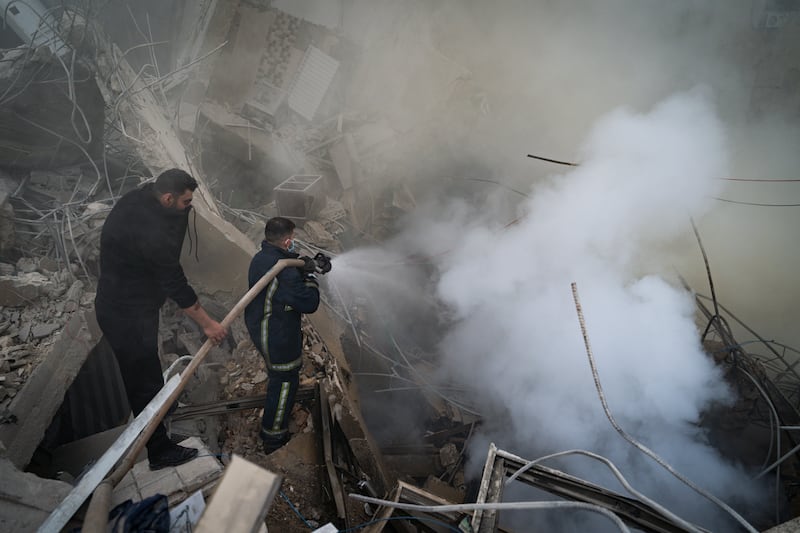 Firefighters work to extinguish a fire on a building that has collapsed after an IDF air strike in Beirut, Lebanon. Photograph: Adri Salido/Getty Images
 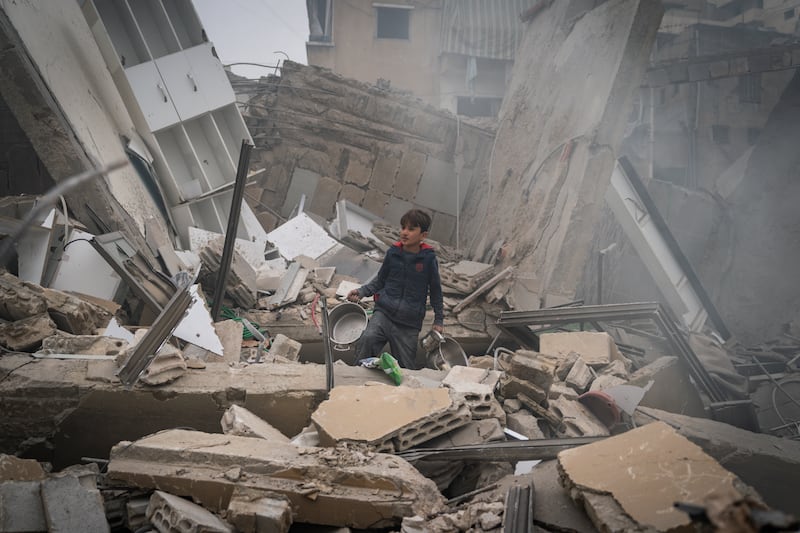 A child searches for kitchen tools among the debris of a building that has collapsed after an IDF air strike in Beirut, Lebanon. Photograph: Adri Salido/Getty Images
Jade Wilson – 3 hours ago
EU leaders seek to curb energy prices as gas prices increase by more than 60 per cent
European Union leaders will seek ways to curb the jump in energy prices triggered by the Iran war when they meet on Thursday but they have few easy options.
European gas prices have increased by more than 60 per cent since the war on Iran began on February 28th.
Jade Wilson – 3 hours ago
Foreign ministers of 12 Muslim-majority countries call for immediate halt to Iran’s strikes
The foreign ministers of 12 Muslim-majority countries meeting in Riyadh denounced Iran’s strikes on Gulf neighbours, calling for an immediate halt.
Iran’s targeting of residential areas and civilian infrastructure, such as oil facilities, airports and desalination plants, could not be justified under any circumstances, the ministers said in a statement.
“This pressure from Iran will backfire politically and morally and certainly we reserve the right to take military actions, if deemed necessary,” Saudi foreign minister Prince Faisal bin Farhan told a press conference after the diplomats met.
Interceptors were seen fired from near the Riyadh hotel where the conference was held around the time the ministers gathered for the consultative meeting on the Iran war.
Jade Wilson – 3 hours ago
Trump considers sending more troops to the Middle East
With no sign of de-escalation, Trump is considering sending thousands more US troops to the Middle East, a US official and three other people familiar with the planning told Reuters.
Those troops could be used to restore the safe passage of oil tankers through the narrow Strait of Hormuz, a chokepoint for a fifth of the world’s oil trade.
Trump this week asked US allies to help reopen the strait, but his request has so far been rebuffed. Iran’s closure of the strait has spiked energy prices and fuelled fears of a rise in inflation globally.
Jade Wilson – 3 hours ago
Trump threaten to ‘blow up’ South Pars gas field if Iran retaliates
Donald Trump has threatened to “massively blow up” the entire South Pars gas field if Iran carries out any more retaliatory attacks on Qatar’s LNG gas facilities.
The US president also said in a post on his Truth Social platform that the US “knew nothing” about Israel’s Wednesday attack at the South Pars field, which Iran shares with Qatar, and neither did Doha. Trump said “no more attacks will be made by Israel” on the field – unless Iran “decides to attack a very innocent, in this case, Qatar”.
Trump added: “In which instance the United States of America, with or without the help or consent of Israel, will massively blow up the entirety of the South Pars Gas Field at an amount of strength and power that Iran has never seen or witnessed before.”
Israel reportedly struck the giant South Pars gasfield on Wednesday, marking a major escalation of the war, hours after Israeli forces killed the regime’s intelligence minister and launched some of the most intense airstrikes in Beirut for decades.
The UAE government has described Iran’s retaliatory strikes a “dangerous escalation” in the war. – Guardian