

Anyone who’s been a parent in the last decade will be familiar with their Gen Z, and now Gen A children going through various stages and cycles of anxiety. There’s the looks anxiety – why don’t I look like/have a body like my favourite influencer or celebrity? There’s the lifestyle or status anxiety – why isn’t my lifestyle as exciting and flashy as everyone on Instagram or TikTok?
There’s exam anxiety, where students aren’t just comparing themselves to their classmates like the old days, but absolutely everyone on social media, particularly those who got 10 grade 9s or four A*s “without even revising” (yeah, right).
And while parents and carers will be experienced – and no doubt weary – with the conversation about how nothing in real life is as it is on social media, it often does little to comfort your inconsolable teen. Now, thanks to the children of celebrities (often referred to somewhat pejoratively as “nepo babies”) and the way they are marketed across media, there is now “success anxiety” for the parents of Gen Z and Gen A to contend with.
In the last few weeks, the latest member of the Beckham clan to emerge as an “entrepreneur” is their youngest daughter, 14-year old Harper Beckham. There was global, breathless coverage about her imminent skincare line, which will be aimed squarely at tween and teenage girls.
The ensuing publicity made much of the fact “this was all Harper’s idea” and how “she’d always wanted to start her own business” and that she was a real challenger to Kylie Jenner’s makeup empire – now valued in the billions. This excited coverage filtered through to the target audience – the teens and tweens – on platforms like Snapchat, TikTok and Insta, and much of the reaction was – sad and a bit dispirited, actually.
The Gen A girls I spoke to were moderately(ish) excited about Harper’s products – though in the current saturated tween and teen beauty market, they will have to be something quite special to compete with their beauty favourites. But there was something about it that made them feel sad, too. There was a sense of why, at the same age as Harper, they too weren’t starting businesses with billion-pound potential? Ayla, 14, told me: “I’m the same age as Harper and I work so hard at school; my parents work hard to give me opportunities, and I’m just worried I’ll never be as successful as she is. I wish I could find a way to start my own business too and be successful like her.”
The despondency was depressing to witness. Our young people need to know Harper Beckham didn’t “start her own business” either. The enormous social media following she has was probably activated before she was born by her ambitious parents and strategists who have been trademarking names and leveraging her parents’ selling power to flog beauty products to the next generation. Harper is quite literally the poster child for a lifestyle fantasy, selling it to impressionable teens and tweens.
It might be true the “idea was all Harper’s” – though what a coincidence considering her mother’s connections – but the notion she’s become some plucky entrepreneur, handily when she comes of “social media age”, and all it needs is a big idea and a head full of dreams, is patent nonsense.
Harper Beckham, like her brothers and various other nepo babies, was born into vast wealth and fame, so let’s stop spoon-feeding “normal” kids anything to do with entrepreneurial brilliance. The same is true for Kylie Jenner, Jamie Laing, Hailey Bieber, all the Trumps, Lily-Rose Depp, and all the other offspring of celebrities who would rather we all forget their names, but instead bask in their talent and genius.
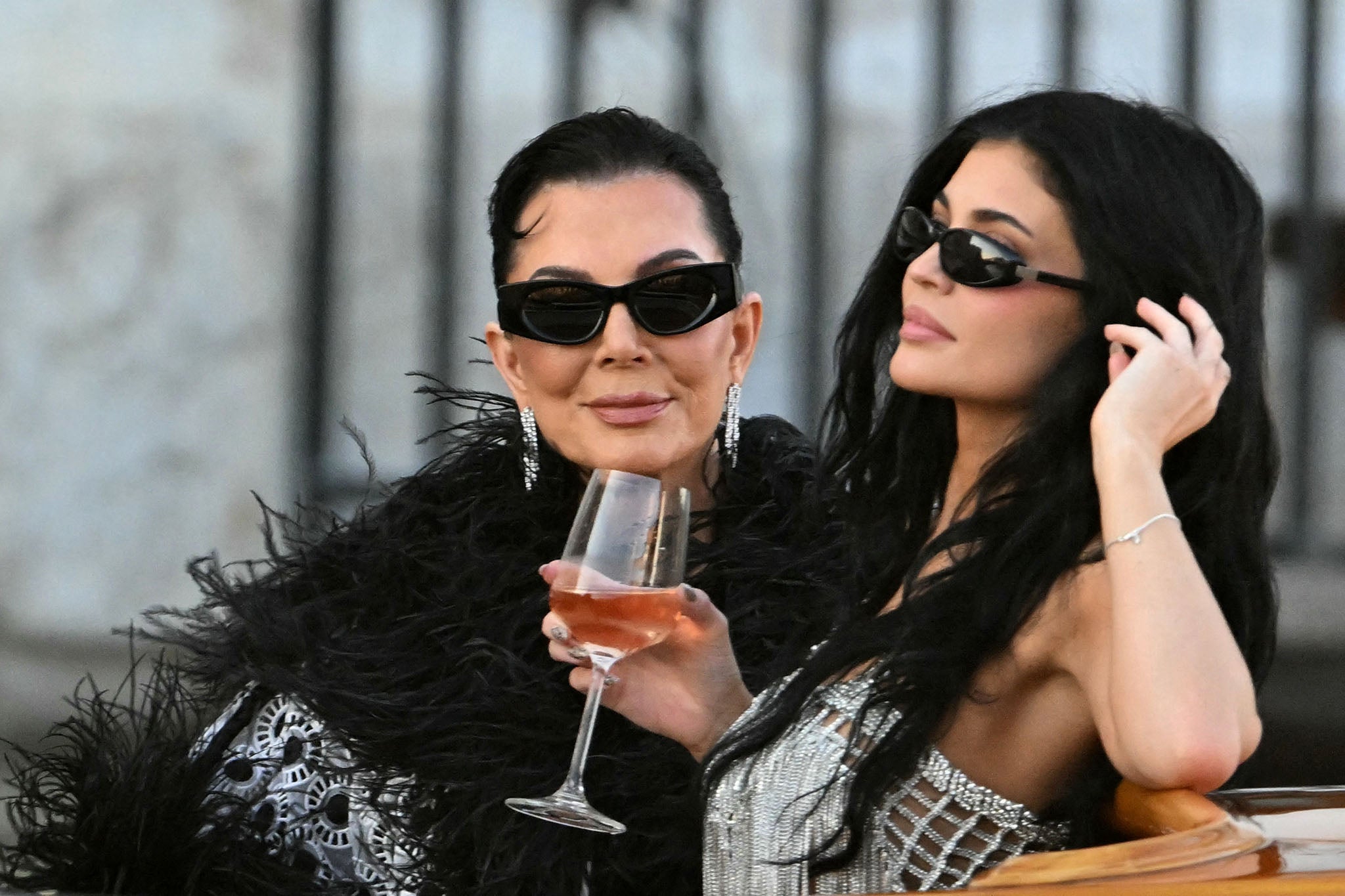 Kylie Jenner (right) has used the profile of her famous family to launch a hugely successful makeup brand (AFP/Getty)
In the current Darwinistic culture where competition over everything is more ferocious than ever, it’s not unreasonable for famous, wealthy and connected people to give their children a boost in their chosen fields. If we’re being honest, most of us would do anything to help our children thrive and be successful.
But what we can and should all push back on is when this is dishonestly presented to the world as miraculous success on a level playing field we all share and compete on. Because we don’t. Celebrity kids were born on fourth base, so when they score a home run, good for them – but let’s not pretend it’s the same as the young person who won the game starting from first base, with no fancy kit and no cheering squad.
When you go into schools, universities and spaces where young people are, like I do, you clock “success anxiety” everywhere and it’s causing real psychological damage. As is the entrepreneurial mindset, which is the product not just of nepo baby culture, but also influencer culture, the crypto craze and online entrepreneurs who will crow about overnight success and nine-figure seed funding on platforms like LinkedIn, Telegram and TikTok.
How authentic any of these overnight success stories and young millionaires are, is open for debate, but it doesn’t change the fact that a whole generation of young people are being fed the lie that overnight success is theirs for the taking. We can see this in full sight on Louis Theroux’s manosphere documentary, when toxic influencers actively peddle the myth that hard work and more traditional routes to success like school, university and professional qualifications are for “losers”, “suckers” and “betas”.
The notion that life’s winners are the ones who eschewed the system and took huge gambles on an idea is being pushed by everyone from the current occupant of the White House to celebrity nepo babies who had the fabulous luck of family injections of cash and valuable connections and a huge safety net underneath them should they fail or fall. Our children need to be reminded that it’s very easy to become a millionaire when you’re already a millionaire. And Trump is the biggest example of that.
 Son of a millionaire Donald Trump shows us it’s easy to become rich when you already are from birth (Getty)
Ricardo, 19, tells me: “A young guy who had a lot of business success came to our school when I was in Sixth Form and told us basically how he’d made millions from grit and hard work and now had three houses, a model wife and a great life.
“I looked him up afterwards and found out he came from, like, crazy wealth going back centuries, he’d had a huge loan from his dad, and his dad was connected to everyone. I’d be a millionaire too if I had all that behind me and so would anyone with half a brain. It’s OK he’s successful but not telling people how he started out made it feel really dishonest.
Julia, 22, who has been trying to break into theatre since she was a small child, explains: “I don’t knock them for using family connections, I would too if I had any, but them trying to make out like they’re just like the rest of us, or starting where we are, is actually sickening and infuriating.”
In their 2022 New York Times article ‘What is a Nepotism Baby’, authors Anna P Kambhampaty and Danya Issawi describe how the phenomenon gives people a “twinge of betrayal” when they discover someone they love is not the “self-made up and comer” they thought them to be. Talking to young people, this betrayal seems to work on two levels. The first is the recognition of injustice, and I’ve spoken to many 14-year-olds this week who’ve had their first experience of the feeling that Harper Beckham is getting an opportunity none of them will.
The second is that every opportunity taken by a rich, well-connected young person raises the bar a little higher for them and makes their own admission into ruthlessly competitive fields a little bit harder. It’s not just that it’s easier for nepo babies to succeed, it’s that it makes success more out of reach for “normal” young people.
 Hailey Bieber (nee Baldwin) was undoubtedly helped in her pursuit of success by her famous actor father Stephen Baldwin (Getty)
So, how do we support our children through this bout of “success anxiety” that is set to grow in the next few years? Firstly, we need to reset our current view of success and promote the value of hard work and resilience. Currently, 82 per cent of 14- to 15-year-olds in the UK state their most aspirational job was “successful content creator”.
So, let’s indulge that for a second. “Content creator” is a job with a notoriously short shelf life in an extremely fickle, ageist and rapidly changing industry. Just a few years ago, Pewdiepie and Zoella were all the content creation teenage rage; now if you say his name to most Year 9s you get a blank look.
Conversely, if you train to become a plumber, teacher, doctor or join the Navy, those are all professions that can take you to your retirement (AI allowing), opening up all kinds of possibilities from starting your own business and becoming a real CEO to going to the very top and making a real difference in society. These are the ambitions we need to nurture, and ones which champion the Normie Baby, when we ask: what does success look like?