
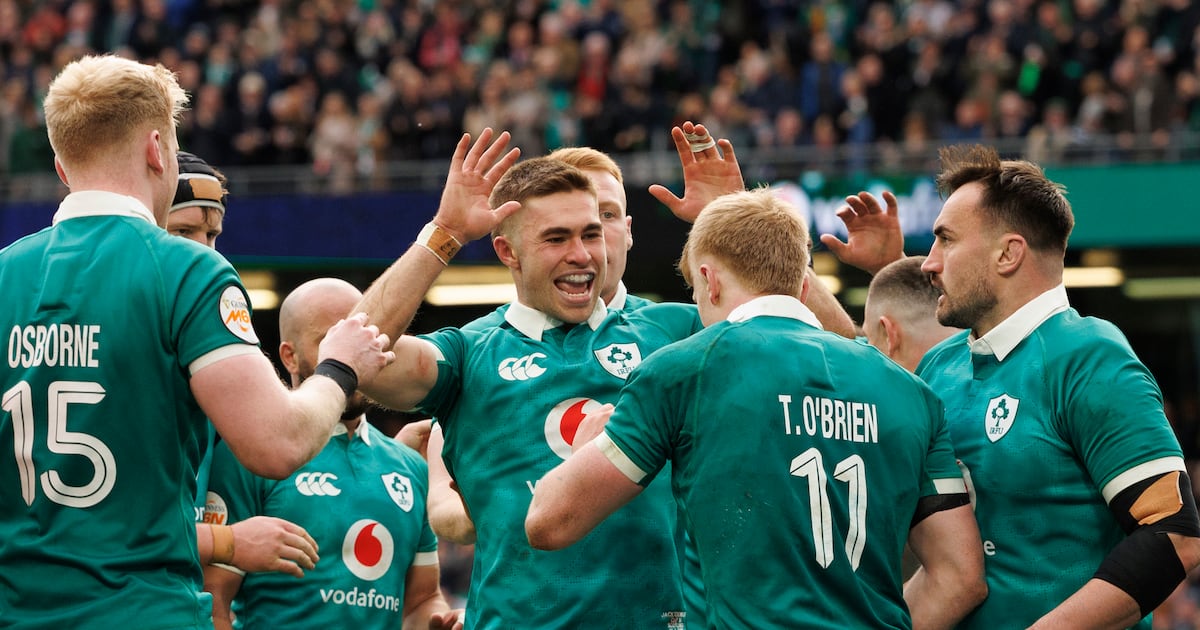
No better time to check the temperature. The state of Irish rugby – and the sport itself – is on an upward curve after an enormously entertaining Six Nations.
Andy Farrell gave a good line last weekend about there being a story in every position. I’d go further and say there are three, even four stories in every position after this campaign.
Ireland fielded 35 players throughout the Championship. That is four bodies above the average of recent seasons, but having seven players make their Six Nations debuts while winning four out of five games is an outstanding return.
Considering the manner of defeat in Paris, a Triple Crown and runners-up in the table is some going in the middle of a World Cup cycle.
The players are not involved in World Cup planning. It is too abstract for an in-tournament camp. But the Irish coaches, clearly, saw a need to deepen their options in every position.
It was a risky move, to use so many untested players, but the pay-off could be seen Down Under in 2027.
Take scrumhalf. The IRFU has wasted no time signing Jamison Gibson-Park to a new two-year contract. Jamo is the form nine in the world. At Twickenham, he was operating on a different level to everyone else. But Craig Casey’s start against Italy and Nathan Doak’s first cap against Wales were not things we usually see.
It’s vital that Ireland do not overly rely on Gibson-Park or Tadhg Furlong at tighthead or any one player in any position. That can only be done by making sure Casey and Doak get sustained minutes in the summer against Australia, New Zealand and Japan.
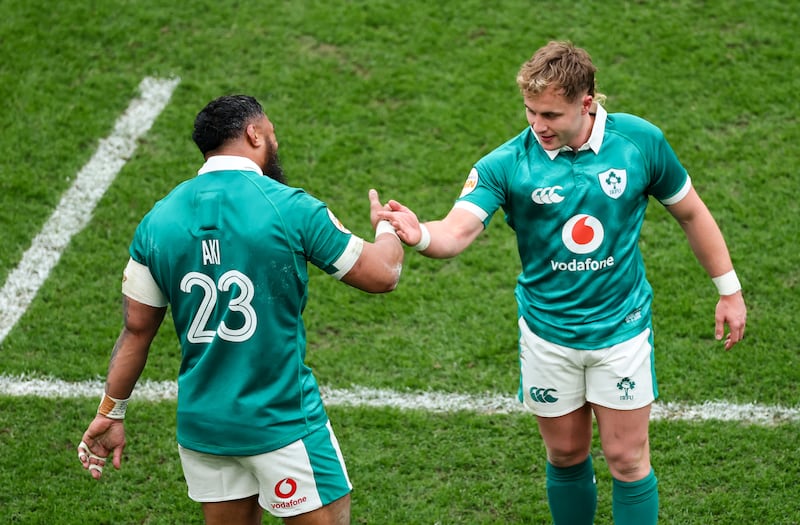 Craig Casey could benefit from more time playing with Ireland. Photograph: Inpho
Perhaps Farrell and the IRFU performance director David Humphreys felt the need to address the fact that Ireland went into the 2023 World Cup with a 38-year-old outhalf in Johnny Sexton while his understudy, Jack Crowley, had not started a Six Nations match.
We were chasing a Grand Slam in 2023. It was the right decision, at the time, but the next man up needs experience. It is easier to do nothing and hope for the solution to magically present itself.
The evolution of a successful sports team has to happen on the run. It can backfire spectacularly if it isn’t done with a delicate hand.
Take secondrow. Arguably Ireland’s strongest area, what with Tadhg Beirne, Joe McCarthy and James Ryan impressing on last summer’s Lions tour of Australia. Tadhg was voted player of the series. He was dynamite at the breakdown throughout the Six Nations and a complete nightmare for the opposition.
McCarthy and Ryan were equally immense. All three remain essential to the cause but Farrell still managed to blood Edwin Edogbo and Darragh Murray.
Edogbo is a powerhouse and Murray looked like a readymade international lock against Scotland. That’s down to the coaches seeing the way he calls the Connacht lineout or his work-rate around the park and then deciding to invest in him over a prolonged period.
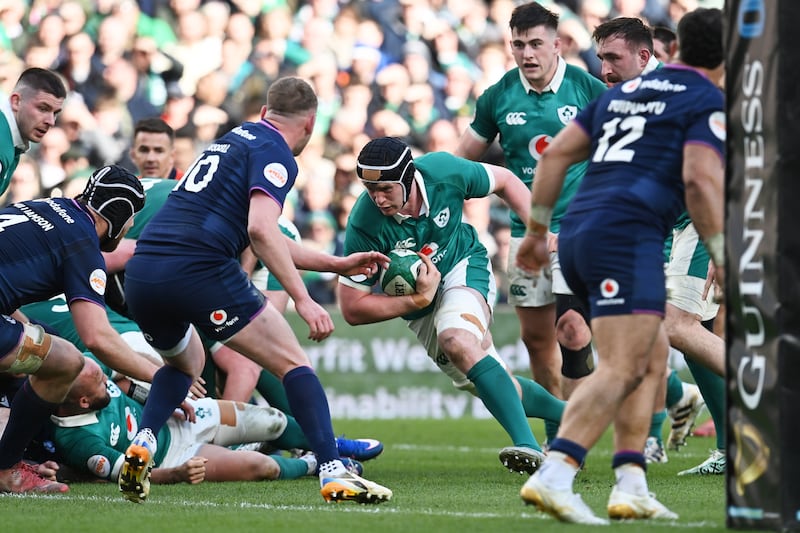 Darragh Murray makes his mark for Ireland by scoring a try against Scotland in the Six Nations. Photograph: Charles McQuillan/Getty Images
Quietly, and without fuss, Paul O’Connell has been working around the clock for more than a year to turn the Irish lineout into a weapon again.
When the backs drill their moves and head for a coffee after training, you can see O’Connell and his lineout operators talking, walking and even lifting their way through lunch. It never stops. They have to learn a different language with tweaks of moves easily filling an NFL playbook.
The backrow has been a fascinating watch. Both Jack Conan and Beirne produced quality performances on the blindside flank yet, somehow, Farrell got a good look at Cian Prendergast from the off in Paris and Cormac Izuchukwu against Italy. And Ryan Baird is to come back.
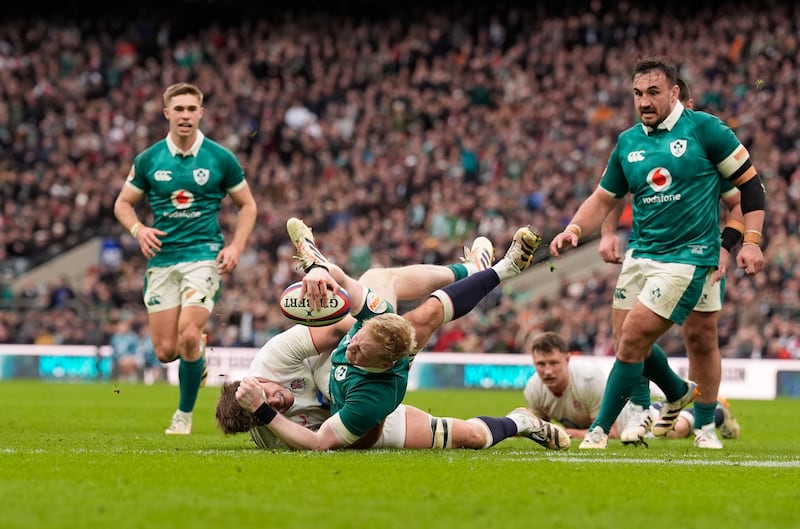
It almost goes without saying by now, but Josh van der Flier is relentless. His reaction to Nick Timoney muscling on to the openside flank was a sight to behold against England, Wales and the Scots.
Josh’s numbers were off the charts: 56 tackles made, zero missed. He rarely gets talked about. But the level he has maintained alongside Beirne, Conan and Caelan Doris is world class.
I’d say the most satisfying return for the coaches is at loosehead prop. With Andrew Porter, Paddy McCarthy and Jack Boyle all injured, we now know everything we need to know about the depth chart. Jeremy Loughman and Michael Milne made an impact while Tom O’Toole shifted from tighthead to claim the jersey.
The back field has been an area of real strength since Hugo Keenan settled into fullback with James Lowe and Mack Hansen either side of him. Lowe won his place back off Jacob Stockdale after Paris and produced some savage moments until he was injured against England, which left a fresh-looking back three of Jamie Osbourne, Tommy O’Brien and Rob Baloucoune.
The new trio finished with 10 tries, spread well between them, bringing sprinter’s pace and levels of competition for places that we’ve never seen before.
The pecking order at outhalf changed during the Six Nations. Pre-competition, Harry Byrne’s form for Leinster got a deserved mention, but Ciarán Frawley finished the tournament as the sort of Swiss army knife off the bench that Connacht and Stuart Lancaster will make full use of next season.
The tournament started with Sam Prendergast as the Ireland 10 and ended with Jack Crowley in the jersey.
That’s a prime example of a competitive squad.
Everyone returns to their provinces where the next player in line will be thinking: “I can break into this group if I perform here.”
That’s a healthy state of play.
Follow our rugby WhatsApp channel
If you want the latest rugby news, analysis and opinion then you should follow our dedicated WhatsApp channel. From Gerry Thornley to Owen Doyle and Gordon D’Arcy, we have every angle covered.
Find the channel here.