
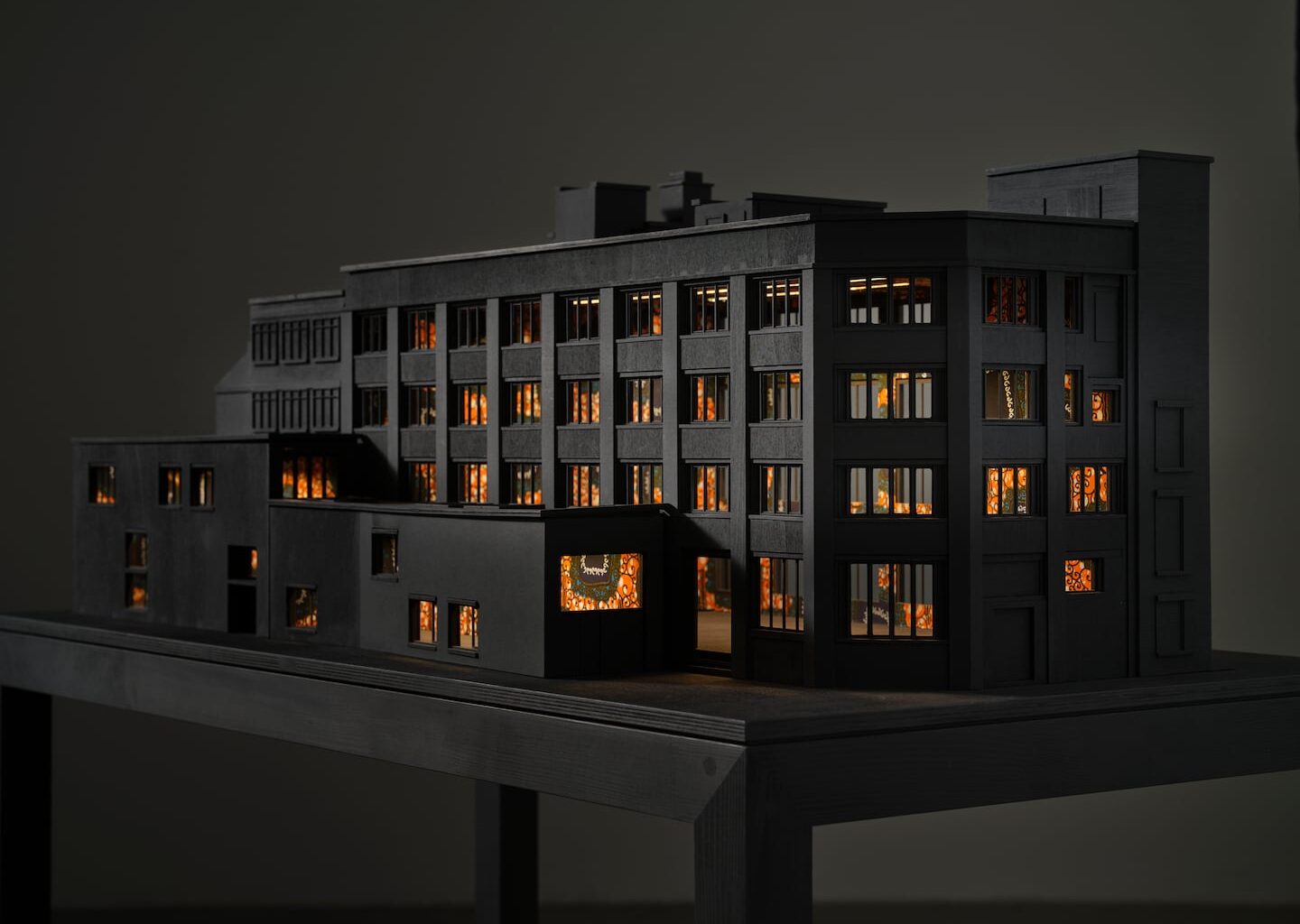
WALTHAM — Sharp black architectural forms carve shadow from scant light in “Sanctuary,” just opened at the Rose Art Museum at Brandeis University. It’s less an exhibition than an experience, with the darkness itself a player in its tabletop drama. The 18 scale models seem adrift in the soft gloom. Walking through feels like a fly-by of a cityscape by moonlight, buildings aglow from within amid the envelope of night. It’s haunting, even chilling. But the light from within each offers the warm solace of hope. It’s a sign of life, and something more.
“Sanctuary” is a recent project of the British-Nigerian artist Yinka Shonibare, whose work has always been fastened to the entanglements of empire and its often-brutal disparities — something he, born in Nigeria at the end of a century of British dominion, knows firsthand. But that concern dissolves here into something broader and more insidious, unbound by national border or era. The buildings are each hand-picked as sites of refuge throughout history, where the persecuted or oppressed found protection. The exhibition is, more simply, about power and powerlessness, and the rare grace of safety in perilous times.
The series was first seen in London in 2024; Shonibare, a famous artist with a global presence — one of his sculptures was on the Rose Kennedy Greenway for years — shows frequently all over the world. This is its North American debut, and its accident of timing is both brilliant and awful. It opened in mid-February, months into a brutal escalation of force in the year-old federal administration’s mass deportation policy. In the month before its debut, ICE agents in Minneapolis had shot and killed Renée Good and, at a deportation protest about two weeks later, Alex Pretti. In the weeks leading up to both incidents, immigration enforcement had grown increasingly aggressive, battering down doors or tearing people from their cars in warrantless arrests on suspicion of being undocumented.
In an eerie reflection of a dangerous time, the exhibition stands sentinel-like in the darkness, connecting this moment in American life to a continuum of fear running through the gamut of history. Each building has its own story to tell: The Temple of Athena, slim and towering with fluted columns, gave refuge to political dissidents in sixth-century Greece; Hotel des Mille Collines, in Kigali, a squat five-story grid of identical units with balconies, was a safe haven for more than 1,200 people in the brutal early days of the Rwandan genocide in 1994. Notre-Dame de Paris, with its stately Gothic spires cast ash-black, glows softly through its grand spiraling rose windows; in the Middle Ages, the cathedral sheltered all manner of refugee and dissident, keeping them safe from persecution within its stone walls.
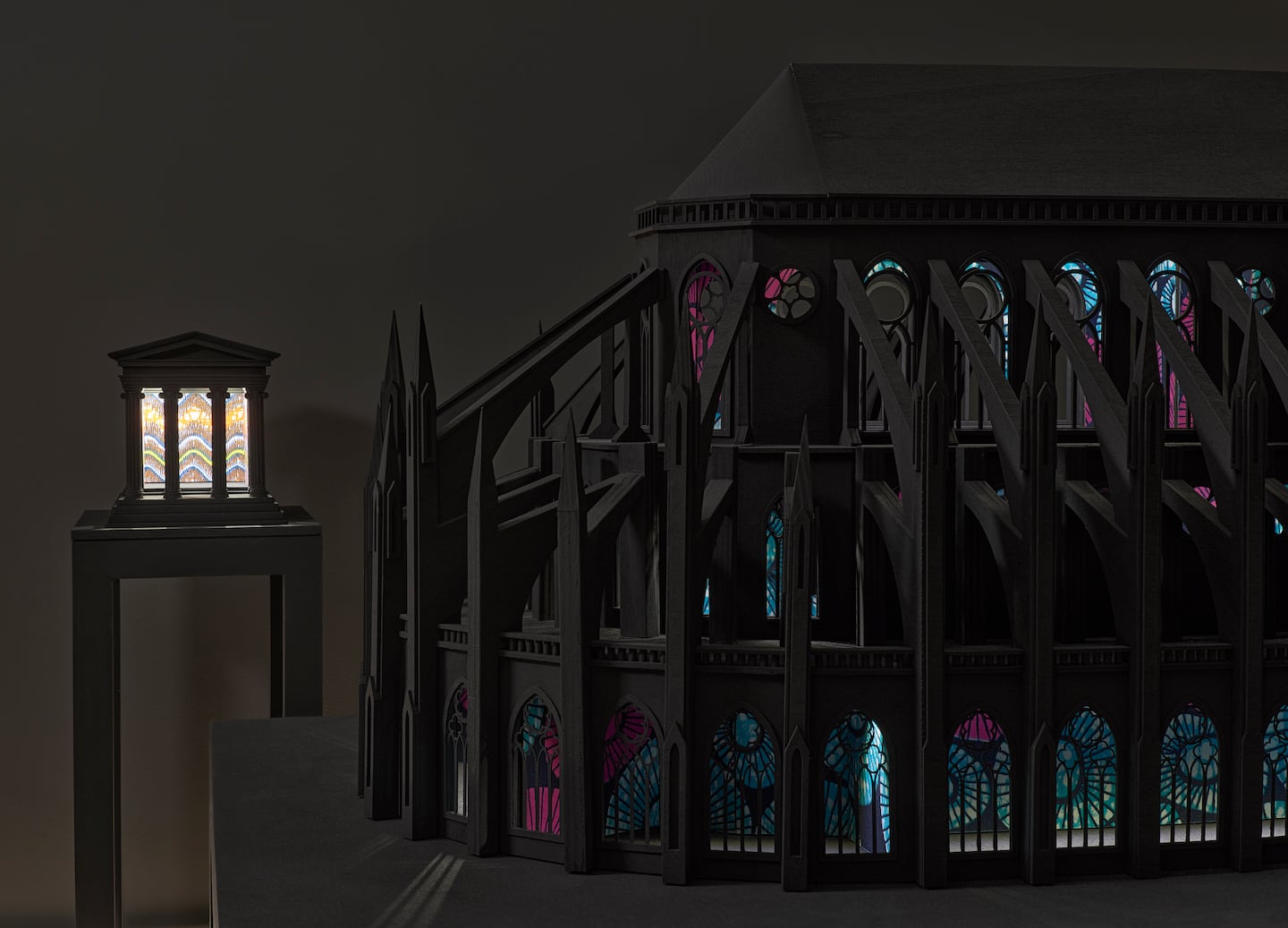 Installation view, “Yinka Shonibare: Sanctuary,” Rose Art Museum. Seen here are scale models of the Temple of Athena in Athens (left) and Notre Dame de Paris (right). Julia Featheringill Photography
The radiance from each of the buildings is colored and enlivened by vibrant print patterns borrowed from traditional West African batik designs. Shonibare has used variations on this visual theme for almost all of his career. For him, they’re like a signature — a complex symbol of appropriation and exploitive exchange between colonial mercantilism and African craft (the patterns were lifted from African makers and mass-produced in Europe, at huge profit, to feed a global craze in the 19th century).
Here, they’re far less pointed, less a symbolic indictment than a sign of life. A spectral version of the United Nations complex in New York — a site conceived as a global nexus of democratic exchange, a sanctuary of ideas about humanity — rises in the shadows, its dusky, streamlined silhouette carved in low light. In its long bands of horizontal windows, the warmth of lively patterns in red and gold radiate.
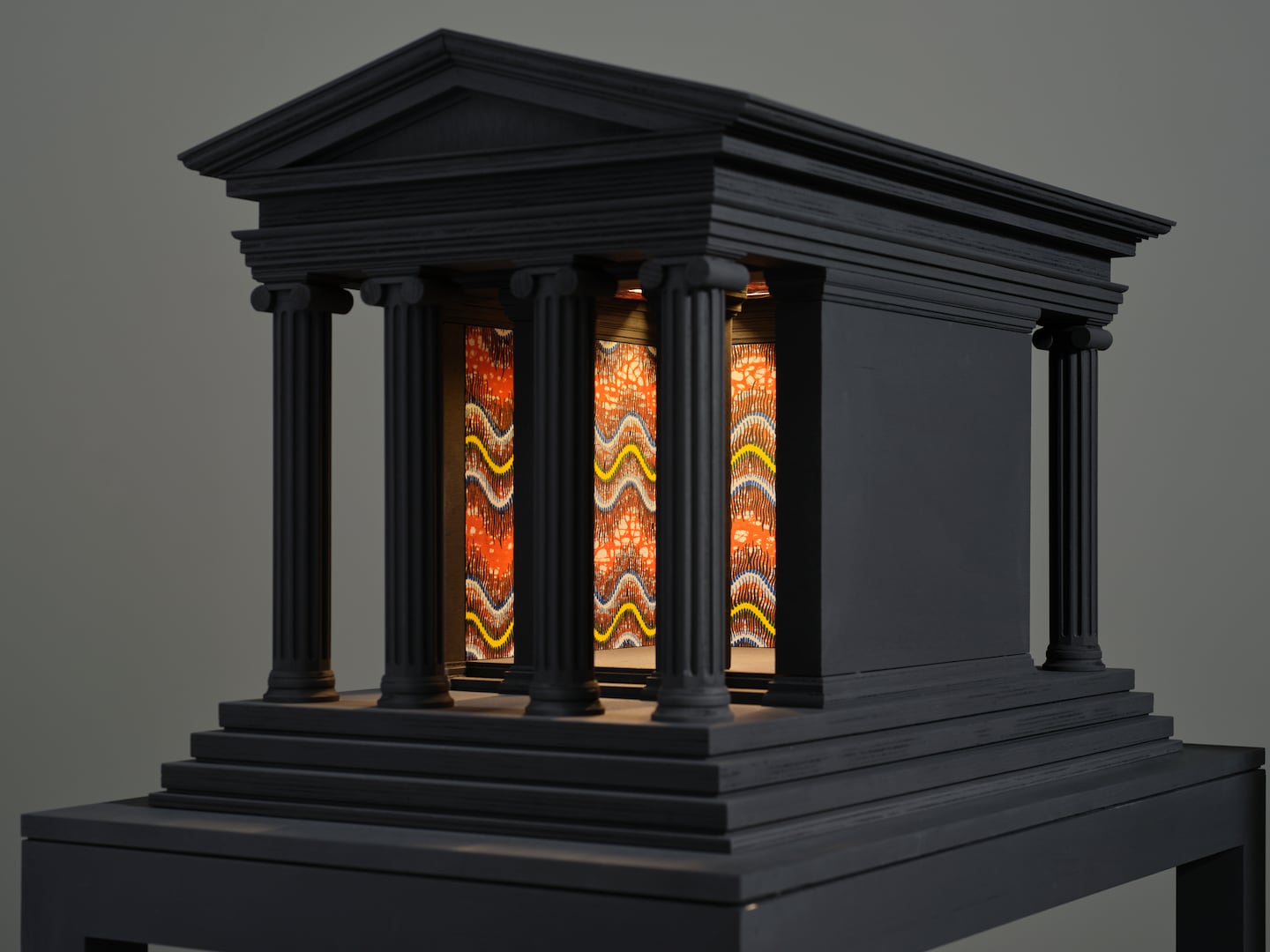 Yinka Shonibare, “Sanctuary City (Temple
of Athena Nike),” 2024. Wood, paint, Dutch wax
printed cotton textile, LED lights. Courtesy of
Tia Collection. Courtesy of the artist and
Goodman Gallery, Cape Town, Johannesburg. ©
Yinka Shonibare CBE. All rights reserved,
DACS 2025.Jo Underhill
Even the architecturally prosaic works here emanate a sense of the uncanny. Peter Mott House, a standard colonial clapboard box, black as pitch, hunkers in the gloom, throwing emerald-tinged light against the shadows from within its modest four walls. The original house, in New Jersey, was a nexus of the Underground Railroad that hid the enslaved from the captors they were fleeing on their way to Canada, and freedom.
With elegant clarity and grace, Shonibare carves a difference between the cold, violent realm of social oppression and the intimate confines of an interior world, where people huddle in the collective warmth of the shared humanity that resists it. Inadvertently, the work also shines a light on an eroding bulwark between public and private, happening right before our eyes. Private interior worlds in this country have been safe spaces, legally-defined sanctuary from unlawful search and seizure. But federal immigration agents, backed by a presidential administration willing to bend the Constitution to its purposes, have recently trampled all over those protections. Doors are now battered down, people regularly seized without judicial warrant. What happens next, when no place is safe? That’s when the darkness swallows the light, and wins.
YINKA SHONIBARE: SANCTUARY
Through Jan. 3, 2027. Rose Art Museum at Brandeis University, 415 South St., Waltham. 781-736-3434, www.brandeis.edu/rose
Murray Whyte can be reached at murray.whyte@globe.com. Follow him @TheMurrayWhyte.