
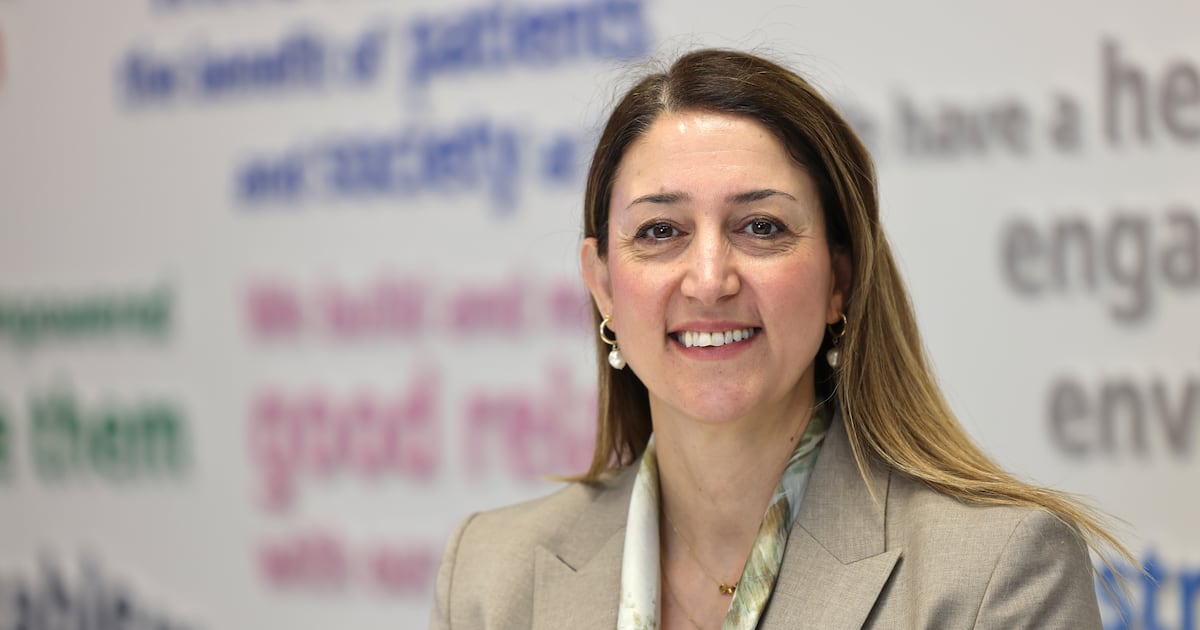
Dilek Dogan Gurluk wants to know what Irish summers are like. The new general manager of Novo Nordisk’s Irish operation arrived here just before Christmas and, like the rest of us, has barely seen the sun since. An unusually bright March morning on Dublin’s St Stephen’s Green has given her some hope.
She is delighted to hear that it doesn’t rain all year round – it can just seem that way.
Working out of their corporate offices in Santry, Dogan Gurluk is responsible for the Danish pharma company’s manufacturing plant in Athlone – where it will produce the new pill version of its blockbuster Wegovy weight management medication which has made Novo Nordisk a household name.
It is in the business of developing and producing what are referred to as GLP-1s – drugs which replicate the hormone that controls blood sugar levels. The effect can be dramatic – bringing both type 2 diabetes and chronic weight problems under control.
The drugs are designed to reduce appetite and slow the digestive process. Their impact has been so significant that food and drink producers around the world are beginning to worry about their sales volumes.
The products have become a constant talking point across society with some high profile promoters – tennis star Serena Williams, talkshow legend Oprah Winfrey and British TV celebrity James Corden have all said they have taken GLP-1s to reduce their weight.
Dogan Gurluk hates the term “fat jabs”.
“There are a lot of opinion pieces in the newspapers. And when I look at some of the headlines, I see a lot of language about ‘fat-jabs’. This is just one example of how the stigma can come into place.”
It is this “stigma” around obesity that prevents patients in many public health systems getting the care that they need, she says. She compares it to the attitude that used to apply to mental health.
“There’s a healthcare professional from Ireland; I was listening to a podcast from him. He mentioned that saying people should ‘eat less, move more’ – it is the equivalent of saying a person in depression should just smile. I agree.”
Motivation
For the 45-year-old, much of the motivation in joining Novo Nordisk lay in seeing the impact diabetes and obesity had on her family in Turkey.
Having spent the majority of her life there, she is of Turkish-Dutch heritage – and moved to Amsterdam just over 10 years ago. English is her third language.
“In Turkey, the prevalence of type 2 diabetes is even higher versus other parts of the world,” she says. “And my family is no exception. So many people in my family, like my father, my uncle, my aunts, my cousins – also my grandmother who raised me when I was a child – had type 2 diabetes. Unfortunately, she didn’t see her 70s. So that’s why I have a personal drive to work in this field.”
When we meet, Dogan Gurluk is still clearly enthused by the previous day’s announcement.
Novo Nordisk is to invest over €400 million in its midlands operation in Athlone – an expansion that will create 600 construction jobs – and should secure the 400 or so positions there for the foreseeable future.
The new oral treatment – which the company says has been taken by more than 500,000 Americans to date – is awaiting authorisation from the European Medicines Agency, the EU regulator. Athlone will produce that and other drugs for markets outside the US.
The investment is obviously welcome in the area.
It follows the disappointment of 2024 when the company decided against expanding its operation at Grange Castle in Clondalkin, Co Dublin. Widely anticipated, the so-called “mega factory” was set to employ 1,100 people and would have likely cost upwards of €1 billion in terms of overall investment.
The deal to purchase the 85-acre site from South Dublin County Council, however, was abandoned and planning permission was withdrawn following an “assessment” by the company.
At the time, it pointed to its recent purchase of the former Elan Drug Technologies site in Athlone from Alkermes as a sign of its overall commitment to operating in Ireland – but the loss of such a project was undoubtedly a big blow.
Dogan Gurluk says Athlone “ticks a lot of boxes” for the company. “If you open the map of Ireland, Athlone sits just in the middle of the country,” she says, noting this makes it a good location for logistics.
“It hosts a technical university, which we are partnering deeply with. So we have access to the highly educated individuals there.”
She is “confident” that the operation will grow over time, adding to the existing employment there. This confidence comes, she says, from the scale of the health problems its drugs are developed to address.
“There are one billion people living with being overweight and obesity in the world now,” she says. “And then if you look at diabetes, there are 800 million people living with diabetes in the world.
“I think the critical part is that 60-70 per cent of the people living with obesity have high blood pressure, they have high cholesterol or they have pain, chronic pain, like knee pain – their sleep is being impacted, their work being impacted, their productivity being impacted. They are having heart attacks or cardiovascular disease over time. So, the impact on public health is huge.”
Despite its innovative work and well-known brand names, tapping the weight gain market will not be all plain-sailing for Novo Nordisk, however. It is locked in fierce competition with another pharma company that also has a sizeable Irish presence – Eli Lilly.
Its Zepbound weight-management drug is widely available and it, too, is readying a new oral treatment. The two companies have been depicted as engaged in a supply-chain war.
The markets are unsure for now whether the Athlone investment will give the Danish company the edge.
Share price
The Novo Nordisk share price fell sharply earlier this year when it said sales and profit growth would decline this year – due to lower prices in the US and a loss of exclusivity for Wegovy and Ozempic – its diabetes version of the same medicine – in China, Brazil and Canada.
The estimate that sales and profits would fall between 5 and 13 per cent was worse than analysts had expected.
When the Athlone news was confirmed, the share price took another smaller dip – with pharma observers suggesting the markets didn’t believe the new investment alone would be enough to meet demand.
“I welcome all the competition here,” says Dogan Gurluk. “We have very strong innovation in our pipeline. It’s not only the oral GLP-1s, but many other assets that we are working on. We are investing in this field more than any other company out there.
“Is this bringing us to the driver’s seat? I think we will look at it. But once again we are a company that is investing for the long term, with our pipeline, with our commitments, like we did for diabetes.”
The cultural impact of Ozempic and Wegovy is already widespread. Along with their competitors, the medicines have become ‘water-cooler’ conversation starters. Their initial success has come with plenty of scrutiny in the media.
For example, an online search for “Ozempic face” produces reams of commentary about the side effects of weight loss medications in general. The term refers to the sometimes gaunt appearance that comes with rapid weight loss.
They have also been the focus of studies looking at “weight regain” that may occur when somebody stops taking the treatment.
A study published in the British Medical Journal earlier this year found that people who stopped taking GLP-1s regained all the weight they had lost within two years. This, the authors concluded, was faster than among people who had undergone traditional, behavioural weight loss regimes.
Dogan Gurluk is very clear that these are medications that people will take for the long haul. She compares them to blood pressure drugs.
She says there needs to be a discussion about how a GLP-1 is a “medicinal product which regulates your hormones”.
“We are not discussing with people that when they stop taking blood pressure drugs, their blood pressure goes (back) to the same levels. We never discuss that when people who are using cholesterol-managing products stop, the cholesterol goes back up. This is biologic.
“Obesity is a disease. It must be treated. That’s why we are also working with governments to provide sustainable access to the people who need it.”
Cost
And then there is the issue of cost. Given that they need to be taken for a sustained period, are they likely to become more affordable?
“We are working on it. We are taking initiatives,” she says. “There are one billion people living with obesity in the world. In Ireland, 60 per cent of the population. We may not expect that the Government can cover such a cost for a long time. We are working with them to improve access. We need to collaborate as individuals together with society as well, because the burden is so big. It will come eventually.”
Dogan Gurluk has been living in Ireland for just over three months, having moved from Amsterdam before Christmas. In addition to adjusting to the shock of the recent bad weather, she has also had time to digest what life is like here for a foreign worker.
For over a decade, multinational companies have raised concerns about the lack of housing and public infrastructure, worries that have been repeated by the inward investment body IDA Ireland. Does she believe Ireland is an expensive place to live and work relative to her previous stints elsewhere?
“I think I’m the wrong person to ask,” she says. “I’m coming from Amsterdam. So when you compare, I believe that Dublin is no different.”
She says the capital has the same housing issues that many other big cities do and has been impacted in similar ways by the inflation that followed the pandemic. “But in many aspects, it’s quite cost effective,” she adds.
“The [cost of living] is high, but I’m not finding it exceptional compared to the other big cities like Amsterdam or Copenhagen or London. Because Dublin, I think, operates at the same level.”
At the same time, she appears to agree with the talking points pushed by the State agencies when it comes to marketing Ireland as an investment location.
“I am positively surprised about many things that I am seeing in Ireland. Maybe I’m in a kind of honeymoon phase. I don’t know. But let’s look at the facts.
“Ireland is the only English-speaking country in the euro zone, right? And it’s a huge, big pharmaceutical hub. And when you look at the workforce, it’s a highly educated, responsible group of individuals working here. So I’m amazed with what I’ve seen so far.”
Dogan Gurluk is speaking before the publication of research in the British Journal of Ophthalmology, showing Wegovy may carry higher risk of sudden sight loss compared to its other GLP-1 products with the same active ingredient.
The study may have implications for dosing and usage levels. In response, the company said that patient safety was its top priority and it took any reports about adverse events “very seriously”.
At the time of writing, Novo Nordisk is still awaiting authorisation for its oral treatment here.
“I’d love to have had it yesterday,” she says.
She notes that the green light was given “quite quickly” in the US but she adds that one unified regulatory body in Europe does “make things easier” in general.
Perhaps understandably, Dogan Gurluk is not keen to get into the details of the approach taken by Donald Trump to the pharma market – or the current geopolitical turmoil. Instead, she says the company will concentrate on what it can do best and how best to serve its customer base.
Having grown up in Turkey, she will be keenly aware of what is happening across the border in Iran, having lived through similar crises there as a child and younger person.
“I’m looking at the recent past. We had corona [Covid], we had many things. It is no different from 20 years ago either. We are focused on improving the things we can control.”
Domestically, she takes great hope from the framework agreement on the supply and pricing of medicines agreed in recent weeks and says it shows a commitment to innovation here. She also sees good things for the company in the EU’s strategy for life sciences.
The Government has been “quite collaborative and open” to date, she says. “There are many things to believe in a bright future as well. I’m sorry to say I’m one of the optimists.”
CV
Name: Dilek Dogan Gurluk.
Age: 45.
Position: General manager, Novo Nordisk Ireland.
Family: Married with a daughter, a cat and a dog.
Something you might expect: As a newcomer, she has been incredibly impressed with the warmth, collaboration and sharp wit of Irish people.
Something that might surprise: How personal this work feels.